What Documents Do I Need for the Digital Nomad Permit?
Navigating the labyrinthine world of Croatian bureaucracy can feel like trying to solve a Rubik's Cube blindfolded, especially when you're dealing with something as crucial as your residence permit. The Croatian Digital Nomad Permit has opened up incredible opportunities, but getting your ducks in a row for the application can be daunting. This comprehensive guide is here to untangle the requirements, detailing precisely what documents you'll need to prepare, saving you time and stress.
The Foundation: Essential Documents for Every Digital Nomad Applicant
When you first embark on the journey to secure your Croatian Digital Nomad Permit, there are several foundational documents that are absolutely non-negotiable. These are the cornerstones of your application, proving who you are, where you come from, and that you meet the basic criteria for this unique residence status. Missing even one of these can send your application into a frustrating holding pattern, so let's get them straight.
Passport and Proof of Nationality
First and foremost, you'll need your trusty passport. This isn't just a travel document; it's your primary proof of identity and nationality. The Croatian authorities are meticulous about this, and for good reason. Your passport must be valid for at least the entire duration of your intended stay in Croatia, plus an additional three months beyond that. So, if you're applying for a 12-month permit, your passport should be valid for at least 15 months from your application date. This might seem like overkill, but it's a standard requirement across many visa and residence permit applications in Europe.
You'll typically need to provide a photocopy of your passport's bio-data page (the one with your photo and personal details), and often copies of any pages with relevant entry/exit stamps or previous visas. The MUP (Ministry of Interior) will, of course, want to see the original during your appointment. If your passport is nearing its expiration, it's always best to renew it before you start the application process. Trust me, trying to renew a passport while simultaneously applying for a residence permit in a foreign country is a special kind of administrative hell you don't want to experience.
Proof of Digital Nomad Status and Remote Work
This is the core of your digital nomad permit application: demonstrating that you are, in fact, a digital nomad. The Croatian law is clear: you must be employed by or performing work for a foreign employer or your own foreign company that is not registered in Croatia. This is absolutely critical. You cannot be working for a Croatian company or clients while on this permit.
So, what kind of documentation satisfies this?
- Employment Contract: If you're a salaried employee, a copy of your current employment contract with your foreign employer will be required. This contract should clearly state your position, the company's location outside Croatia, and ideally, that your work can be performed remotely.
- Client Contracts/Statements: For freelancers or independent contractors, you'll need to provide contracts with your clients, demonstrating ongoing work. A portfolio or a simple website isn't enough; they want to see legally binding agreements that indicate your remote work arrangements.
- Company Registration Documents: If you run your own foreign company, you'll need official proof of your company's registration outside of Croatia, along with documents showing your ownership or position within it. This might include a certificate of incorporation, business license, or articles of association.
- Letters from Employers/Clients: Sometimes, a formal letter from your employer or primary client, confirming your remote work arrangement and that the company is not based in Croatia, can also be beneficial as supporting evidence.
The key is to paint a clear picture that your income and work originate outside Croatia. Any hint of working for a Croatian entity will invalidate your application.
Proof of Funds: Showing You Can Support Yourself
Croatia wants to ensure you won't become a burden on their social system. Therefore, you must demonstrate you have sufficient financial means to support yourself for the entire duration of your stay. The specific amount is tied to Croatia's minimum net salary. As of early 2024, the requirement is to prove funds of at least 2.5 times the minimum net salary for each month of your intended stay. For a single person, with the minimum net salary at approximately €700, this translates to roughly €1,750 per month. If you're applying for a 12-month permit, you'll need to show approximately €21,000 in your bank account or a consistent income stream reflecting this amount.
How do you prove this?
- Bank Statements: Recent bank statements (usually from the last three to six months) from a reputable bank, clearly showing your name, account balance, and consistent income, are the most common form of proof. They want to see that the funds are stable, not just a sudden influx.
- Pay Stubs/Salary Slips: If you're employed, your recent pay stubs can back up the monthly income claim.
- Letter from Your Bank: Some applicants provide a letter from their bank confirming their account balance and good standing. This can be particularly useful if your statements aren't in a readily understandable format.
Remember, this proof needs to be in your name. If you're applying with dependents, the financial requirement increases, usually by an additional 10% of the base amount for each dependent.
Health Insurance Coverage
Health insurance is not just a good idea; it's a mandatory requirement for your digital nomad permit. You absolutely must have valid health insurance that covers you for the entire duration of your stay in Croatia. This isn't just about covering minor sniffles; it needs to be comprehensive enough to handle medical emergencies, hospitalization, and even repatriation in case of a serious incident.
While some expats might eventually consider signing up for the Croatian Health Insurance Fund (HZZO) depending on their status, for the Digital Nomad Permit, it's typically an international private health insurance plan that's required. You'll need to provide proof of this coverage, usually in the form of an insurance policy certificate. This certificate should clearly state:
- Your name
- The period of coverage (matching your intended stay)
- The geographic scope (must include Croatia and ideally the Schengen area)
- The types of coverage (e.g., medical, hospitalization, repatriation)
- The minimum coverage amount (often around €30,000, though this can vary slightly).
Many digital nomads opt for international providers like Cigna Global, which are well-versed in expat needs and can provide policies that meet these specific requirements. Before you commit, make sure to read the fine print and confirm that your chosen policy aligns with Croatian immigration standards. If you're curious about different options, you might want to look into Health Insurance in Croatia: Mandatory, Supplementary and Private Options Explained or Understanding Private Health Insurance Plans in Croatia. Getting this right saves a world of worry later.
Proof of Accommodation and Background Checks
Beyond proving your identity and financial stability, the Croatian authorities will also want to know where you'll be laying your head at night and that you're not bringing any unwanted baggage from your past. These elements ensure your integration into the local community is smooth and secure.
Proof of Accommodation in Croatia
It might seem obvious, but you need to show you have a place to live while you're in Croatia. This isn't just a casual request; it's a legal requirement. The authorities want tangible evidence that you have secured accommodation for at least part of your intended stay, even if it's just for the initial few months.
Acceptable forms of proof typically include:
- Rental Agreement (Ugovor o Najmu Stana): This is the most common and preferred method. You'll need a signed rental agreement for an apartment or house. Ideally, this agreement should be registered with the Tax Administration (Porezna Uprava) by your landlord, although sometimes MUP will accept an unregistered one initially, requesting the registration proof later. The contract should clearly state the address, the rental period, your name as the tenant, and the landlord's details.
- Title Deed (Vlasnički List): If you happen to be one of the fortunate few who own property in Croatia already, a copy of the title deed in your name serves as sufficient proof. This clearly demonstrates your legal right to reside at that address.
- Statement from a Property Owner: In some cases, if you're staying with a friend or family member, they can provide a notarized statement (Izjava o Smještaju) confirming they are hosting you, along with a copy of their own title deed or rental agreement. This option requires the property owner to formally acknowledge your stay.
Always aim for a legitimate, long-term rental agreement. Remember, the MUP needs to see where you'll be based. For more on this, check out Registering Your Residence in Croatia: The Complete MUP Guide. The address on your accommodation document will be the one registered with the police, which is essential for many other administrative tasks you'll face as a new resident, like setting up utilities.
Criminal Background Check
This is a pretty standard requirement for most long-term residence permits globally, and Croatia is no exception. You will need to provide a criminal background check from your country of nationality, or from any country where you have resided for more than six months after turning 18. This document must prove that you have a clean record and have not been convicted of any criminal offenses.
Here's where it gets a little tricky:
- Issuing Authority: The check must be issued by the competent authority in your home country (e.g., FBI in the US, ACRO in the UK, local police department).
- Date of Issue: It usually needs to be recent, typically not older than six months from the date of your application.
- Apostille or Superlegalization: This is often the biggest hurdle. If your country is a signatory to the Hague Apostille Convention, your criminal record check will need an apostille stamp. This is a form of certification that authenticates the origin of the public document. If your country is not part of the Hague Convention, you'll need to go through a lengthier process of superlegalization, which involves multiple levels of certification, usually by your country's foreign affairs ministry and the Croatian embassy/consulate there.
- Certified Translation: Once apostilled/superlegalized, the entire document (including the apostille) must be translated into Croatian by a certified court interpreter in Croatia. You cannot just use any translator; it has to be someone officially recognized by the Croatian judicial system.
Starting this process early is crucial, as obtaining a criminal background check, getting it apostilled, and then translated can take several weeks, if not months, depending on where you're from. It's not something you want to leave until the last minute.
The Bureaucratic Nuances: Forms, Fees, and Translations
Beyond the core documents, there are a few bureaucratic necessities that, while seeming minor, are absolutely critical for a successful application. These are the details that often trip up even the most organized expats.
Application Forms and Biometrics
You can't just walk into the MUP with a stack of documents and expect them to know what you want. You need to formally apply. The primary application form for temporary residence (which the digital nomad permit falls under) is usually called Obrazac 1a. This form is available on the MUP's website or directly at their offices. It's fairly straightforward, asking for your personal details, passport information, and the basis of your application (in this case, "digitalni nomad"). Fill it out clearly, preferably in Croatian if you can manage, or English.
Once your application is submitted and provisionally approved, you'll be called in to provide your biometric data. This typically involves having your fingerprints taken and a digital photo captured for your residence card (boravišna iskaznica). This usually happens at the local MUP office. Don't worry, it's a quick and painless process, much like getting a new passport in your home country. For tips on navigating the MUP, particularly for setting up appointments, you might find How to Book an Appointment at the MUP for Immigration Matters incredibly useful.
Administrative Fees and Stamps (Biljezi)
Yes, unfortunately, bureaucracy comes with a price tag. There are several fees associated with the digital nomad permit application, and they typically need to be paid in Croatian Kuna (HRK) administrative stamps called biljezi or via a bank transfer, though MUP offices increasingly prefer card payments or bank transfers. It's a good idea to always have some biljezi on hand, just in case, as you can buy them at post offices or some newspaper kiosks.
The fees generally include:
- Application Processing Fee: This covers the administrative cost of processing your temporary residence application. It's usually a fixed amount, around €31.80 for the decision.
- Administrative Stamp Fee: A smaller fee for additional administrative costs, typically around €3.30.
- Residence Card Fee: Once your permit is approved, you'll pay a fee for the physical biometric residence card itself, which is usually around €42.40. This card will be your official proof of residence in Croatia.
- Potential Additional Fees: Depending on how you submit your application (e.g., through an embassy/consulate abroad), there might be additional consular fees.
These fees are subject to change, so always check the latest information on the official MUP website or inquire at your local MUP office. It’s always smart to budget a little extra, just in case.
Certified Translations and Apostille/Superlegalization
This is where many applicants find themselves scratching their heads. Croatia, like many countries, requires that any official documents not originally issued in Croatian be translated by a certified court interpreter (sudski tumač). You can't just use Google Translate or ask a Croatian-speaking friend. This interpreter must be officially recognized by the Croatian Ministry of Justice. They will stamp and sign the translation, certifying its accuracy, and attach it to the original document or a certified copy.
As mentioned with the criminal background check, many documents will also require an apostille (for countries signatory to the 1961 Hague Convention) or superlegalization (for non-Hague Convention countries). This is an international certification that makes your document legally recognized in Croatia.
- Apostille: This is a specific stamp or certificate affixed to the document by the designated authority in the country where the document was issued (e.g., Secretary of State's office, Foreign Affairs Ministry). It verifies the authenticity of the signature on the document.
- Superlegalization: For countries that aren't part of the Hague Convention, this is a multi-step process. Your document first needs to be certified by the relevant ministry in your home country, then by the Croatian embassy or consulate in that country.
This process can be time-consuming and costly, so factor it into your timeline and budget. Getting quotes from several certified court interpreters in Croatia is a good idea, as rates can vary. Some reputable moving service providers, like Sirelo, might even have resources or partners who can help navigate these complexities, especially if you're managing this from abroad.
Additional Considerations and Avoiding Common Pitfalls
Even with all your documents in hand, there are still a few more layers to successfully navigating the digital nomad permit application in Croatia. Being aware of these additional considerations can make your experience significantly smoother.
The OIB: Your Croatian Tax Number
While not a document you submit with your initial digital nomad permit application, getting your OIB (Osobni identifikacijski broj) is arguably one of the most crucial steps you'll take as an expat in Croatia. Think of it as your personal identification number, similar to a social security number or tax ID in other countries. You'll need it for practically everything: opening a bank account, setting up utilities, signing contracts, buying property, and yes, it will be linked to your residence permit.
You can often apply for your OIB at the local tax office (Porezna Uprava). The documents usually required are your passport and sometimes proof of the reason for needing an OIB (e.g., your rental agreement). It’s a relatively quick process, and you’ll receive a certificate with your OIB on the spot. While you might manage to submit your residence application without it, you'll certainly be asked for it later, so it’s best to get it sorted as soon as possible after arrival or even before your MUP appointment. For a full rundown, refer to our guide on How to Get Your OIB and Why It Matters for Healthcare Access.
Timing and Submission Logistics
The timing of your application can significantly impact your experience. If you are a non-EU citizen, it is generally recommended to apply for your Digital Nomad Permit from outside Croatia, through a Croatian embassy or consulate in your home country or country of habitual residence. This avoids the risk of overstaying your 90-day tourist visa (Schengen rule) while waiting for processing. If you enter Croatia as a tourist and then apply, you might find yourself in a tricky situation if the processing takes longer than your permitted tourist stay.
If you absolutely must apply from within Croatia (e.g., if you're already here and your tourist visa period allows), you'll need to make an appointment at the local MUP office responsible for foreigners. These appointments can sometimes have long wait times, especially in popular cities like Zagreb or Split. The Croatian government's e-Građani portal is becoming more integrated, and you might find some services or appointment bookings available online, but for complex immigration matters, an in-person visit is usually necessary. Always, and I mean always, ensure you have all your documents, originals, and copies, ready before your appointment. Trying to scramble for a missing paper on the day will only lead to frustration and potentially a rescheduled appointment.
What if Something is Missing?
It’s almost a rite of passage for expats dealing with Croatian bureaucracy: being told you’re missing something. Don’t panic. The MUP staff are generally understanding, especially with foreigners, and they will typically provide you with a list of any additional documents needed and a deadline to submit them. This is usually called a "dopuna" (supplement).
My advice? Take a deep breath, get a clear understanding of what’s required, and prioritize getting it. Keep copies of everything you submit, and if possible, ask for a written confirmation or stamp that they received your supplementary documents. Proactive communication can also help; if you know you'll be slightly delayed in getting a document, inform the MUP office in advance. Remember, patience is your greatest virtue when dealing with administrative processes here.
Summary of Key Digital Nomad Permit Documents
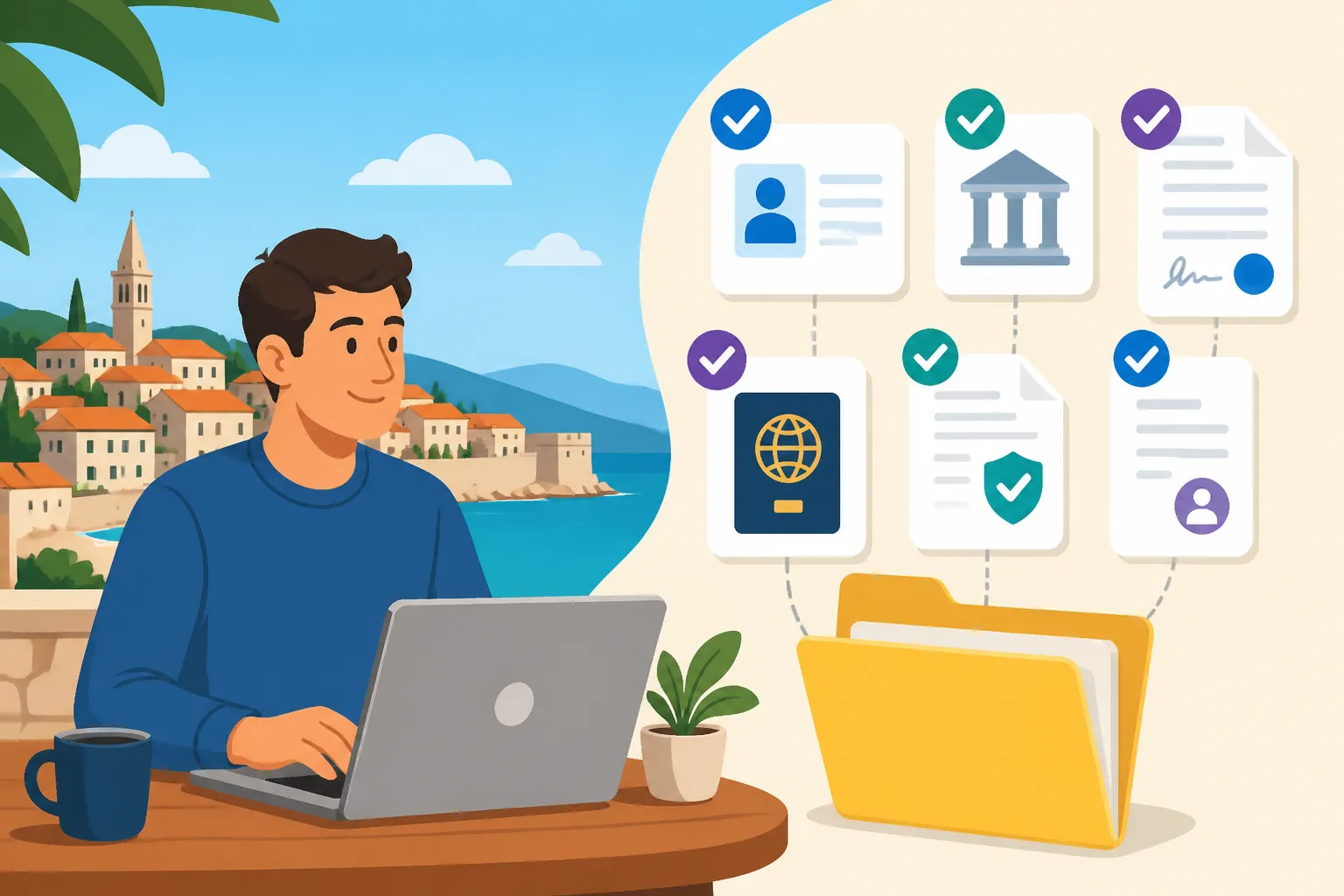
To help you keep track, here's a quick overview of the essential documents for your Croatian Digital Nomad Permit application:
| Document Type | Purpose | Key Requirements |
|---|---|---|
| Passport | Identity & Nationality | Valid for intended stay + 3 months; copies of bio-data and relevant stamp pages. |
| Proof of Digital Nomad Status | Confirms remote work for foreign entity | Employment contract from foreign company, client agreements, foreign company registration (if self-employed). Must explicitly state work not for Croatian entity. |
| Proof of Funds | Financial self-sufficiency | Bank statements (last 3-6 months), pay stubs, bank letter. Minimum: 2.5x minimum net salary/month (€1,750/month per person, approx. €21,000 for 12 months). |
| Health Insurance | Medical Coverage | Policy certificate covering entire stay in Croatia/Schengen, including emergencies, hospitalization, repatriation. Minimum €30,000 coverage. |
| Proof of Accommodation | Where you'll live | Rental agreement (registered preferred), property title deed, notarized statement from host with their property proof. Must include address, your name, duration. |
| Criminal Background Check | Clean Record | From home country/country of habitual residence (if > 6 months residency). Must be recent (<6 months old). Requires Apostille/Superlegalization and certified Croatian translation. |
| Application Form (Obrazac 1a) | Formal Application | Filled out clearly. Available on MUP website or at office. |
| Administrative Fees | Permit Processing & Card Costs | Paid via administrative stamps (biljezi), bank transfer, or card. Approx. €77.50 for decision & card. Check latest MUP fees. |
| Certified Translations | Language Compliance | All non-Croatian official documents (and Apostilles) must be translated by a certified court interpreter in Croatia. |
| OIB (Osobni identifikacijski broj) | Croatian Identification Number | While not strictly an application document, it's essential and often requested early. Obtain at Porezna Uprava. |
Disclaimer
The information provided in this guide is for general informational purposes only and does not constitute legal or immigration advice. While we strive to keep the information up-to-date and accurate, requirements for residence permits and associated documentation in Croatia can change frequently. It is always recommended to consult the official website of the Croatian Ministry of Interior (MUP) or seek advice from a qualified immigration lawyer or consultant for the most current and personalized guidance regarding your specific situation.