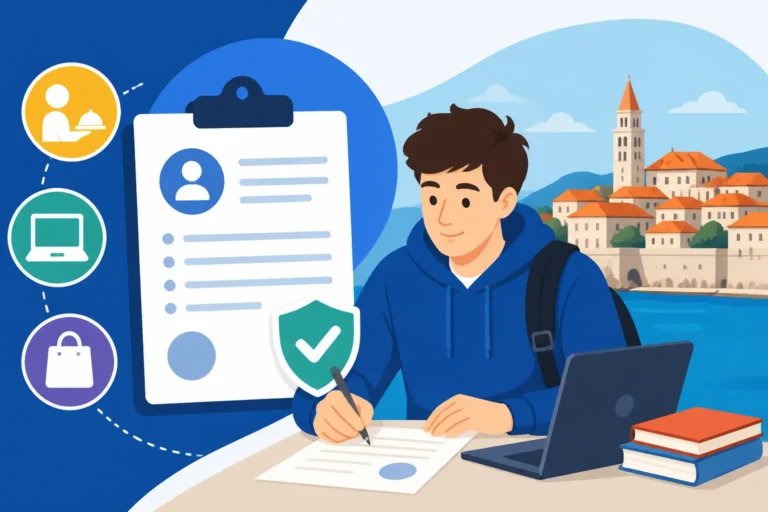
How Do I Get a Croatian Tax Number for Freelancing?
Moving to Croatia to embrace the freelance lifestyle is an incredibly exciting step, isn't it? You've likely envisioned Adriatic sunsets, delicious marenda, and the freedom of working on your own terms. But then reality hits, and you're confronted with a barrage of administrative hurdles, none more perplexing initially than the mysterious "OIB." This guide is designed specifically for freelancers like us, cutting through the confusion to give you a clear, empathetic roadmap to obtaining your essential Croatian tax number.
The All-Important OIB: What It Is and Why You Need It
When you first arrive in Croatia, you'll hear "OIB" mentioned constantly. It’s one of those acronyms that gets thrown around like everyone should inherently know what it means. But for us expats, it can feel like a secret handshake we’re not privy to. Let me tell you, it's not just another piece of paper; it’s your key to almost everything here.
More Than Just a Number: Your Croatian Identity
The OIB, or Osobni identifikacijski broj, is your personal identification number in Croatia. Think of it as your unique tax identification number (TIN) or national insurance number, but for almost every aspect of your life here. It’s a permanent, eleven-digit number that distinguishes you from every other person and legal entity in the country. Without it, you’re essentially a ghost in the system, unable to truly function in the Croatian administrative landscape.
I remember my own struggle, fresh off the boat, trying to understand why I needed this number for everything from setting up utilities to getting a mobile phone plan. It’s not just for official government stuff; it permeates daily life. The officials at the Porezna Uprava (Tax Administration) and even your local bank branch will look at you blankly if you show up without an OIB. It's the bedrock of your financial and legal existence in Croatia, a foundational piece of your new life puzzle. You simply cannot navigate the Navigating the Croatian Healthcare System: An Expat's Roadmap (2027) or The Expat Guide to Opening a Bank Account in Croatia without it.
Why Freelancers Can't Live Without an OIB
For freelancers, the OIB isn't just important; it's absolutely non-negotiable. Your ability to legally operate, issue invoices, and pay taxes hinges entirely on having this number. Without an OIB, you can't even dream of formally registering your freelance business, whether it's a paušalni obrt (flat-rate trade) or something more complex.
Here’s a snapshot of why the OIB is critical for you as a freelancer:
- Tax Obligations: This is the most direct link. Your OIB is how the Croatian tax authority identifies you for income tax, social contributions, and any other levies. Every single tax payment, every declaration you make, will be tied to this number. Trying to operate without it is like trying to drive without a license plate – it simply won’t work, and you'll run into serious legal issues.
- Invoicing and Payments: When you issue an invoice to a Croatian client, or even some international ones, your OIB will often be required. Similarly, when you receive payments through a Croatian bank account (which, surprise, requires an OIB to open!), it’s all linked to your tax number. It creates a clear paper trail for your income and expenses, which is vital for compliance.
- Business Registration: If you plan to formally set up a freelance entity, like a How to Register a Paušalni Obrt (Flat-Rate Trade) in Croatia, the OIB is the very first piece of information you'll need. It's the identifier that ties your personal tax obligations to your business operations. You literally cannot register your business without it.
- Banking: As mentioned, opening a Croatian bank account is practically impossible without an OIB. You’ll need this account to receive payments from clients and to pay your Croatian taxes and social contributions.
- Residence Permit: While the OIB isn't technically part of the residence permit application itself, it is usually requested or issued concurrently if you apply for residence in Croatia. Many expats find they get their OIB during the MUP (Ministry of Interior) process. However, if you're coming on, say, a digital nomad visa, you might need to apply for it separately through the tax office if it wasn't automatically assigned. For more on this, you might want to look into How to Get an OIB (Personal Identification Number) in Croatia.
Essentially, for a freelancer, the OIB is the very first rung on the ladder of legal and financial integration into Croatia. Without it, you can't climb to the next step.
Gathering Your Arsenal: Documents Required for Your OIB
Alright, so you know you need it. Now, how do you actually get it? This is where the Croatian bureaucracy loves to throw a few curveballs. The good news is, for an OIB, the document list isn't outrageously long, but precision and completeness are absolutely key.
The Bare Essentials
To apply for an OIB, you'll need to prepare a few foundational documents. It might seem straightforward, but always have copies and originals, just in case. The Porezna Uprava (Tax Administration) offices, where you'll be applying, are strict about details.
Here’s what you’ll typically need:
- Valid Identification: This means your passport or, if you're an EU citizen, your national ID card. Make sure it's current and not expired. This is your primary proof of identity.
- Proof of Residence or Purpose: This can be where things get a little nuanced for freelancers.
- For Residents (already have a residence permit): If you already have temporary residence (privremeni boravak) in Croatia, your residence card (boravišna iskaznica) will serve as proof of your legal status here. In many cases, if you applied for residence through MUP, an OIB might have been assigned automatically and included in your residence card paperwork.
- For Non-Residents (applying for OIB first or on a short-term stay): This is often the case for digital nomads or those coming to scope out the country before applying for a long-term residence. You’ll need to show a reason for needing the OIB. For freelancers, this usually means providing documentation that demonstrates your intent to conduct economic activity here, or documents showing that you have property or a significant connection.
- A Statement of Intent/Freelance Activity: This could be a simple, signed statement in Croatian (or translated and notarized) declaring your intention to work as a freelancer in Croatia. It helps to specify the type of freelance work you do.
- Lease Agreement: A rental contract for your accommodation in Croatia. This proves you have a physical address here.
- Proof of Property Ownership: If you own property in Croatia, the title deed (vlasnički list) is excellent proof of connection.
- Employment Contract or Offer (less common for pure freelancers): Sometimes, if you're in the process of setting up a company that will employ you, or if you have a contract with a Croatian entity, this can also serve. However, for true independent freelancers, the first two points are more relevant.
- The Application Form (Zahtjev za određivanje OIB-a): You can usually get this form directly at the Porezna Uprava or sometimes download it from their website. It's fairly straightforward, asking for your personal details, citizenship, and the reason for your OIB request. Don't worry if your Croatian isn't perfect; staff can often help, but it helps immensely if you have an idea of what needs to be filled.
Pro-Tip: Always bring both originals and photocopies of everything. Croatian offices often require copies for their files but will want to see the original for verification. It saves a lot of hassle if you have them ready. And breathe deeply; this is often the most frustrating part of the process – the sheer uncertainty.
The Power of Attorney: When You Can't Be There
Life happens, and sometimes you simply can't be in Croatia to apply for your OIB in person. Perhaps you're still abroad finalizing your move, or maybe you're in Croatia but facing a travel constraint. The good news is that you can apply for an OIB through a proxy using a punomoć (power of attorney).
This is a common path for those purchasing property or setting up businesses before physically relocating. The person acting on your behalf (your punomoćnik) will need:
- A Valid Power of Attorney Document: This document must be properly notarized and, if issued outside Croatia, usually apostilled or legalized for use in Croatia. It needs to explicitly state that the person is authorized to apply for and receive your OIB. This can be quite specific, so ensure the wording is correct.
- Your Documents: They will need all the documents you would have provided in person (passport copy, proof of residence/purpose).
- Their Own Identification: The person acting as your proxy will also need their valid ID.
Getting a power of attorney organized from abroad can be a bit of a process, involving contacting the Croatian embassy or consulate in your country, or engaging with a local notary and then having it internationally certified. Professional help, like a local lawyer or agency that specializes in expat services, can be invaluable here to ensure the punomoć is legally sound and accepted by the Croatian authorities. For more complex tax situations, especially with international aspects, organizations like 'Taxes for Expats' often have networks that can assist with understanding these legalities.
Navigating the Porezna Uprava: Step-by-Step to Your OIB
Alright, documents in hand, deep breaths taken. Now for the actual visit to the Porezna Uprava (Tax Administration office). This is where the magic (or the bureaucracy, depending on your luck) happens.
Preparing for Your Visit
Before you even step foot in the door, a little preparation can save you a world of pain.
- Find Your Local Office: The OIB is issued by the Porezna Uprava. While the OIB itself is national, you generally apply at the office closest to your registered address in Croatia. If you’re in a major city like Zagreb, Split, or Rijeka, there will be a main office, sometimes with regional branches. A quick search for "Porezna Uprava [City Name]" will usually point you in the right direction.
- Check Opening Hours: These aren't always consistent, and some offices have specific hours for receiving applications. Confirming this online or with a quick call (if your Croatian is up to it, or with help from a friend) can prevent a wasted trip.
- Language Barrier: This is a common point of frustration for many expats. While some officials, especially in larger cities, might speak English, it's not guaranteed.
- Bring a Croatian Speaker: If possible, bring a Croatian-speaking friend, partner, or even hire a translator. This is often the single biggest factor in having a smooth experience.
- Learn Key Phrases: Even if you have help, knowing a few essential phrases like "Dobar dan" (Good day), "Treba mi OIB" (I need an OIB), and "Hvala" (Thank you) shows respect and can genuinely make a difference. Websites and apps for language learning, like iTalki, offer flexible one-on-one lessons that can get you comfortable with these interactions surprisingly quickly. It’s not just for the OIB; it genuinely helps with everyday life and feeling more integrated.
- Be Patient: This cannot be stressed enough. Government offices in Croatia operate at their own pace. Expect waiting times, and remember that patience and politeness go a very, very long way.
The Process at the Tax Office
Once you're at the Porezna Uprava, here’s a general rundown of what to expect:
- Take a Number: Most larger offices have a queueing system where you take a number from a machine. Look for a button related to "OIB" or "evidencija građana" (citizen registration). If in doubt, ask someone, showing your passport and saying "OIB, molim."
- Wait for Your Turn: Find a seat and prepare for a wait. Bring a book, your phone, or mentally rehearse your freelance business plan.
- Present Your Documents: When your number is called, approach the counter. Hand over your application form and all supporting documents (originals and copies). The official will review them thoroughly. They might ask clarifying questions, especially regarding your reason for needing the OIB as a freelancer. This is where having your statement of intent or lease agreement ready helps.
- Verification and Input: The official will verify your identity and input your details into their system. If everything is in order, they will process your request.
- Receiving Your OIB: In many cases, especially if your documents are complete and clear, you might receive your OIB number right then and there. It's usually printed on a small piece of paper. This isn't a physical card, but the number itself is what's important. Keep this paper safe! If for some reason they need more time or verification, they might tell you to come back or that it will be sent to your address.
Table: Essential Steps to Getting Your OIB as a Freelancer
| Step | Description | What You Need | Common Challenges |
|---|---|---|---|
| 1. Document Gathering | Collect all necessary identification and proof of purpose/residence. | Passport/ID, Lease Agreement/Property Deed, Statement of Intent (for freelancers), Application Form | Incomplete documents, not having copies, documents not translated/notarized |
| 2. Locate Porezna Uprava | Identify the appropriate Tax Administration office based on your address. | Google Maps, local advice | Incorrect office, confusing addresses |
| 3. Prepare for Visit | Check opening hours, plan for language barriers, prepare for waiting. | Croatian speaker/phrases, patience, time | Long queues, limited English speakers, unexpected closures |
| 4. Application & Verification | Take a queue number, present documents, answer questions. | All prepared documents, politeness | Misunderstandings, missing information, official requires further proof |
| 5. Receive OIB | Obtain your OIB number (usually on a slip of paper). | No additional items | Not receiving it immediately, confusion about next steps |
What to Expect After Application
Once you have that slip of paper with your OIB, congratulations! You’ve crossed a major hurdle. Unlike some countries where you get a fancy card, in Croatia, the OIB is simply the number itself. You won't usually receive a physical OIB card, though the number is printed on your residence card if you have one.
It’s crucial to keep this number safe and memorized, or at least easily accessible. You'll need it constantly, often without warning.
Beyond the OIB: What Comes Next for Croatian Freelancers
Getting your OIB is a massive step, but it's really just the beginning of your official freelance journey in Croatia. Once you have it, a whole new world of administrative tasks opens up, allowing you to operate legally and efficiently.
Activating Your Freelance Life
With your OIB in hand, you can now move forward with key steps to legally establish your freelance business in Croatia. This is where things get exciting, as you transition from just dreaming about freelancing in Croatia to actually doing it!
- Opening a Bank Account: As I mentioned earlier, your OIB is essential for opening a Croatian bank account. You'll need this for receiving payments and managing your local finances. Different banks cater to different needs, but they all require your OIB.
- Registering Your Business Entity: For most freelancers, the paušalni obrt is the most popular and tax-efficient option. Your OIB is the very first piece of information required for this registration. This formalizes your self-employment and defines your tax structure. To dive deeper into this, you'll want to read Self-Employment in Croatia: The Paušalni Obrt Guide for Foreigners and How to Register as a Freelancer with the Croatian Tax Administration.
- Health Insurance Registration: Depending on your residence status and nationality, you’ll also need to sort out your health insurance. If you're becoming a resident and registering a paušalni obrt, you'll typically be obligated to register with the Croatian Health Insurance Fund (HZZO), and your OIB will be a key identifier in that process. This links your social contributions to your healthcare access. You'll find more details in How to Register for HZZO Health Insurance as a Foreigner in Croatia.
Tackling Croatian Taxes with Confidence
Once you’re officially registered and freelancing, your OIB becomes the anchor for all your tax obligations. Croatia has a specific tax system, and understanding it is paramount to avoid any unwelcome surprises.
- Understanding Income Tax: The OIB identifies you for income tax purposes. For paušalni obrt owners, the system is quite simplified, involving fixed quarterly payments based on your projected income bracket. However, for other types of self-employment or if you have complex income streams, the income tax rules can be more intricate. You should definitely check out Understanding Income Tax in Croatia: The Full Expat Guide.
- Social Contributions: Beyond income tax, you'll also pay social contributions for health and pension, which are also tied to your OIB. These are crucial for building up your pension rights and ensuring you have access to the public healthcare system.
- Professional Tax Advice: While the paušalni obrt simplifies things considerably, if your freelance activities are complex, or if you have income from multiple countries, it’s always wise to seek professional tax advice. Services like 'Taxes for Expats' specialize in helping foreigners navigate international tax laws and Croatian specifics, ensuring you remain compliant and optimize your financial situation. The Croatian tax administration, the How the Croatian Tax Administration (Porezna Uprava) Works is a system you'll get to know very well, so having expert guidance can really ease the stress.
The OIB is the golden thread that connects all these administrative pieces. It ensures transparency and compliance, allowing you to enjoy your freelance life in Croatia without constant worry about official matters. Embrace the process, be patient, and remember that countless expats have successfully navigated this path before you. You've got this!
Disclaimer
The information provided in this guide is for general informational purposes only and does not constitute legal, financial, or tax advice. While we strive to keep the information up-to-date and accurate, regulations in Croatia can change frequently. It is always recommended to consult with a qualified professional, such as a lawyer, accountant, or tax advisor, for advice tailored to your specific situation. Reliance on any information in this guide is solely at your own risk.