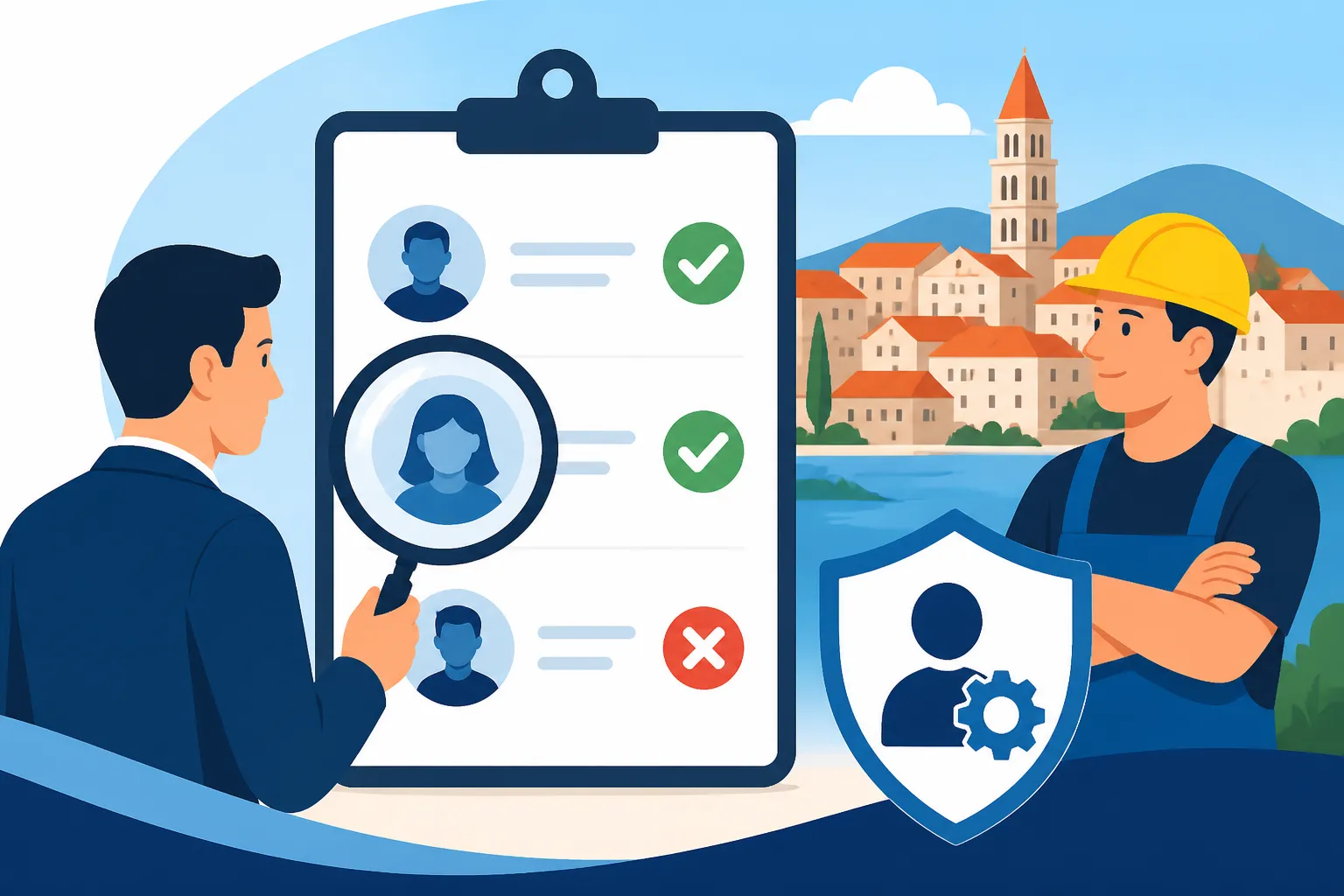
Understanding the Labour Market Test for Croatian Work Permits
Oh, the infamous Labour Market Test! If you’ve been looking into getting a work permit in Croatia as a non-EU citizen, you’ve probably heard whispers or outright groans about this hurdle. It’s one of those uniquely frustrating administrative steps that can leave even the most seasoned expat scratching their head. This guide is here to unravel the mystery of the Labour Market Test, explaining what it is, when you need it, and how to navigate it, so you can hopefully secure your spot in beautiful Croatia.
What Exactly is the Labour Market Test (LMT) in Croatia?
Navigating the Croatian immigration system often feels like trying to solve a Rubik's Cube blindfolded, and the Labour Market Test (LMT) is a prime example of one of those more perplexing sides. Simply put, the LMT is a mechanism put in place by the Croatian government to ensure that any job opening offered to a non-EU/EEA citizen cannot be filled by an already available Croatian or EU/EEA citizen. It's designed to protect the domestic labour market and ensure that expats are only employed when there's a genuine skill gap or lack of local candidates.
The 'Why' Behind the LMT: Protecting the Local Workforce
Let's be real, from an expat perspective, it can feel like a discriminatory hoop you have to jump through, but from the government's side, the rationale is quite clear: prioritize their own citizens and those from other EU/EEA member states for available jobs. Croatia, like many countries, wants to ensure that unemployment among its own population remains low and that foreign workers aren't inadvertently displacing local talent. Imagine a scenario where a local Croatian accountant with years of experience is looking for a job, and a company decides to hire a non-EU accountant instead, without even checking if the local person was available. The LMT is there to prevent this very situation. It's a protectionist measure, plain and simple, aimed at maintaining a balance in the national workforce.
This isn't just about preserving jobs; it's also about retaining skills and fostering local economic growth. When a company needs to hire, the first port of call, legally speaking, must be the Croatian Employment Service (Hrvatski zavod za zapošljavanje, or HZZ). They act as the gatekeepers, ensuring that every possible stone is turned in the local talent pool before approving a foreign hire. It’s a process that, while understandable in principle, can feel incredibly bureaucratic and slow for both employers and prospective employees, adding layers of anxiety to the already complex process of getting a work and residence permit in Croatia.
The Core Principle: 'Can a Local Do This Job?'
At its heart, the Labour Market Test boils down to one fundamental question: "Can a suitable Croatian or EU/EEA citizen fill this particular job?" The burden of proof for answering "no" to this question lies squarely with the employer. They aren't just looking for any local; they are looking for a suitable local. This suitability isn't just about having a pulse and a degree; it's about matching the specific skills, experience, and sometimes even the language proficiency required for the role.
The process involves the employer advertising the position through the HZZ for a specified period. During this time, HZZ will actively search its database for potential candidates from Croatia or the EU/EEA who match the job requirements. If they find suitable candidates, these individuals are referred to the employer. The employer then has an obligation to genuinely consider these local candidates. Only if the employer can objectively demonstrate to HZZ that none of the referred local candidates are suitable for the role – perhaps they lack a very specific technical skill, a crucial language, or the required years of experience in a niche area – will HZZ issue a "positive opinion" on the Labour Market Test. This positive opinion is your golden ticket to the next stage of the work permit application. Without it, your application is dead in the water, unless you fall into one of the exempted categories.
The Step-by-Step Process of the Labour Market Test
Understanding the "why" is one thing, but knowing the "how" is where the rubber meets the road. The Labour Market Test is a structured process, and any misstep can lead to significant delays or outright rejection. This is where your potential employer really needs to know their stuff and be diligent.
Employer's Obligation: Advertising the Vacancy
The first critical step in the LMT is for the Croatian employer to formally register the job vacancy with the Croatian Employment Service (HZZ). This isn't just a casual posting on a job board; it's a mandatory, official advertisement. The advertisement must be public and available through HZZ's channels, allowing any interested and qualified Croatian or EU/EEA citizen to apply. The law stipulates a minimum advertisement period, which usually ranges from 15 to 30 calendar days, depending on the specific regulations in place at the time and the type of role. Employers must adhere strictly to these deadlines; there's no cutting corners here.
The content of the job advertisement is also highly scrutinized. It can't be vague; it must clearly outline the job title, a detailed description of the tasks and responsibilities, the required qualifications (educational background, certifications), specific experience levels, and any essential skills (such as fluency in certain languages or mastery of particular software). Furthermore, it often needs to include the proposed salary range, working hours, and the type of employment contract (e.g., full-time, part-time, indefinite). Any ambiguity or an attempt to tailor the job description too narrowly to exclude local candidates and specifically fit a foreign applicant can raise red flags with HZZ and lead to complications. It’s a delicate balance for employers to define the role accurately without inadvertently making it appear that no local could ever qualify. For more on navigating the job market, you might want to check out The Expat Guide to Finding a Job in Croatia (2027).
Candidate Evaluation and Reporting to HZZ
Once the job has been advertised for the prescribed period, the real evaluation begins. The HZZ doesn't just sit back; it actively works to match suitable candidates from its existing database with the advertised role. These candidates, if deemed a match, are then referred to the employer for consideration. This is where the employer’s due diligence becomes paramount. They are obligated to genuinely review each referred candidate. This means conducting interviews, assessing their qualifications, and comparing their skills against the specific requirements outlined in the job description.
After reviewing the HZZ-referred candidates, the employer must submit a detailed report back to HZZ. This report isn't a simple "yes" or "no." If the employer determines that none of the local candidates are suitable, they must provide objective and compelling reasons for each rejection. For example, stating that a candidate lacked a specific, essential certification that was clearly listed in the job ad, or that they didn't possess the required advanced proficiency in a niche programming language, would be valid reasons. However, vague reasons like "not a good fit" or subjective assessments are almost certainly going to lead to a negative outcome. The key here is objectivity and clear, documented evidence for why a local candidate cannot perform the role. The whole system is quite rigid, and understanding how the Croatian Employment Service (HZZ) works is crucial for employers.
Obtaining the 'Positive Opinion' or 'Negative Outcome'
After the employer submits their evaluation report, the HZZ will review all the documentation. Their decision will culminate in either a "positive opinion" or a "negative outcome." A positive opinion from HZZ means that, based on the employer's advertising efforts and objective evaluation, no suitable Croatian or EU/EEA citizen was found who could adequately fill the advertised position. This is the green light you and your employer have been waiting for! This positive opinion is a mandatory document that must be submitted with your subsequent application for a single work and residence permit at the Ministry of Interior (MUP).
On the other hand, a "negative outcome" means HZZ believes there is a suitable local candidate, or that the employer did not adequately justify why the referred candidates were unsuitable. In this scenario, the employer cannot proceed with hiring a non-EU/EEA citizen for that particular role under the LMT framework. They would either have to reconsider hiring a local candidate, modify the job requirements significantly and restart the entire LMT process, or explore other avenues like quotas or exemptions if applicable. The timeframe for HZZ to issue this opinion can vary, but typically employers can expect a decision within a few weeks of submitting their report. Once issued, a positive opinion usually has a validity period (e.g., 90 days), meaning the work permit application must be submitted within that time frame.
Exemptions from the Labour Market Test: When You Don't Need It
While the Labour Market Test can seem daunting, it's not always a requirement for every non-EU/EEA citizen looking to work in Croatia. There are several categories and situations where an exemption applies, which can significantly streamline the process. Knowing these exemptions can save a lot of time and heartache!
Specific Occupations and Quotas
One of the most common ways to bypass the LMT is through government-mandated annual quotas for foreign workers. Each year, the Croatian government (often with input from HZZ) identifies sectors and professions where there is a demonstrated shortage of local labour. These might be seasonal roles in tourism and hospitality, certain positions in construction, or niche IT specialists. For these pre-approved roles, a specific number of work permits are allocated, and employers hiring for these positions within the quota limits do not need to conduct an LMT. This is a huge relief for industries that heavily rely on foreign seasonal workers, especially along the coast.
For example, if you're a highly sought-after chef in a busy tourist region like Dubrovnik or Split, and your role falls under the annual quota for hospitality workers, your employer can apply directly for your work permit without proving that no Croatian chef could do your job. The quota system effectively pre-approves the need for foreign labour in these areas. It's vital to stay updated on the specific occupations and numbers included in these quotas, as they can change annually based on economic needs and labour market analysis. This simplified path is a significant benefit for many foreign workers and employers in Croatia, and it's a key part of The Complete Guide to Working in Croatia as a Foreigner (2027).
Key Personnel, Intra-Company Transfers, and Highly Qualified Workers
Beyond quotas, specific types of roles and individuals are often exempt from the LMT due to their strategic importance or unique qualifications. This includes key personnel within companies, especially those in executive or highly specialized technical roles where demonstrating unique expertise might be easier than proving no local can do it. Similarly, intra-company transfers, where a multinational company moves an existing employee from one country to its Croatian branch, frequently fall under an exemption. The logic here is that these individuals already possess company-specific knowledge or skills that are not easily transferable or found locally.
Croatia also participates in the EU Blue Card scheme, which aims to attract highly qualified non-EU citizens to work in EU member states. If you meet the stringent criteria for an EU Blue Card (which includes high educational qualifications, a specific salary threshold, and a job offer), you are often exempt from the LMT. This is a pathway for top talent, usually in fields like IT, engineering, or scientific research, and it’s a process that often goes hand-in-hand with verifying your foreign qualifications through AZVO. Understanding how to get your foreign degree recognised in Croatia is therefore essential for many highly qualified individuals considering this route. For these roles, the focus shifts from finding a local replacement to recognizing global talent.
Other Special Categories
The list of LMT exemptions doesn't stop there. Several other special categories exist, recognizing various circumstances and relationships. For instance, researchers and university lecturers brought to Croatia for specific academic or scientific projects are usually exempt. Athletes, artists, and religious workers also often have their own specific rules that allow them to bypass the LMT, recognizing the unique nature of their professions.
Furthermore, individuals seeking a temporary residence permit in Croatia based on family reunification, particularly spouses of Croatian citizens or long-term residents, may have easier access to the labour market without the need for an LMT. While their primary residence permit isn't work-based, their right to work often comes with fewer restrictions. This is another example of how the Croatian system, while complex, does account for a variety of situations beyond purely economic considerations. It's always best to consult the latest official guidelines or an immigration specialist, as these categories can have very specific requirements and conditions.
Challenges and Tips for Navigating the LMT
Even with all the information in the world, the Labour Market Test can still feel like a bureaucratic labyrinth. But don't despair! Understanding the common pitfalls and having a solid strategy can make a world of difference.
Common Pitfalls for Employers and Applicants
One of the biggest pitfalls we see time and again is employers underestimating the strictness of the HZZ's review process. Many employers, perhaps used to more flexible recruitment practices, rush the advertisement phase or don't put enough effort into documenting their reasons for rejecting local candidates. Simply saying "they weren't a fit" without objective criteria and evidence is almost guaranteed to lead to a negative opinion. It's not enough to feel that your foreign hire is the best; you must prove that no suitable local candidate exists.
Another common challenge is the language barrier and overall administrative complexity. Even for local HR departments, navigating the HZZ portal and ensuring all documents are correctly filed and reported can be a headache. For foreign applicants, the lack of transparency or direct communication from HZZ can be frustrating, leaving them in the dark about the status of their employer's LMT application. This is why it’s so important for both parties to be diligent and communicate clearly. The process also demands strict adherence to Croatian labour laws, which means understanding Croatian employment contracts and worker rights, something many foreign employers might overlook.
Strategies for a Successful LMT Application
For employers, the most crucial strategy is meticulous preparation and precision. When drafting the job description for HZZ, be as specific as possible about the essential skills, qualifications, and experience required, but avoid making it so niche that it seems designed to exclude everyone but your chosen foreign candidate. If you need someone with 10 years of experience in a very specific software framework and fluent in, say, both English and Korean, make sure that's clearly justified as essential for the role. When evaluating local candidates referred by HZZ, document every step. Keep records of interviews, skill assessments, and detailed notes explaining why each candidate didn't meet the essential criteria. Objectivity and thoroughness are your best friends here.
For applicants, while you can't directly influence the LMT, you can certainly support your employer. Ensure all your qualifications and past work experience are clearly documented and, if necessary, officially translated and apostilled. The more unique and specialized your skillset, especially if it aligns with an industry where Croatia faces talent shortages (like IT or certain engineering fields), the stronger your case. If you have niche expertise that is genuinely difficult to find, highlight it. Many expats also find relief in knowing their health is covered from day one. Companies like Cigna Global offer comprehensive international health insurance plans that satisfy permit requirements and give peace of mind, demonstrating a commitment to your long-term stay. Thinking about the big picture and the move itself, Sirelo can be a great resource for comparing international moving companies, helping you plan the logistics of bringing your life here once that work permit is in hand.
What Happens After the LMT (or Exemption)?
It’s important to remember that a positive LMT opinion or an exemption is a significant step, but it’s not the end of the road. It’s a prerequisite for the next, equally crucial phase: applying for your single work and residence permit at the Ministry of Interior (MUP). Once the HZZ grants the positive opinion, your employer will collect this document along with a host of other paperwork related to your employment contract, your passport, proof of accommodation, and often proof of sufficient funds and health insurance.
All these documents are then submitted to the MUP, either by your employer or, in some cases, by you personally if you’re already in Croatia and authorized to do so. This is where the MUP assesses your eligibility for residence based on work. They will conduct background checks, verify all documents, and eventually, if all is in order, issue your approval for a temporary residence permit with the purpose of work. This permit will allow you to legally live and work in Croatia. The entire process, from LMT to permit issuance, can take several weeks or even months, so patience is absolutely key. Don't forget, even once you have your permit, you'll still need to formally register your residence with the MUP and obtain your OIB – your personal identification number, crucial for everything from banking to healthcare.
Labour Market Test vs. Exemption: Key Differences
To help visualize the difference and understand which path might apply to your situation, here's a quick comparison:
| Feature | Labour Market Test (LMT) Path | Exemption Path |
|---|---|---|
| Primary Goal | Prove no suitable Croatian/EU candidate for the specific job. | Acknowledge existing labour shortage or specific role importance. |
| Involves HZZ Ad | Mandatory – employer must advertise through HZZ for 15-30 days. | Not required – direct application for work permit. |
| HZZ Candidate Review | Mandatory – HZZ refers candidates, employer must objectively justify rejections. | Not applicable – no local candidate search. |
| Employer Burden of Proof | High – requires detailed documentation & justification of why local candidates aren't suitable. | Low – generally, proof of falling into an exemption category suffices. |
| Common Scenarios | Jobs where local talent might exist, or new/unlisted roles. | Quota-based jobs (e.g., seasonal tourism), EU Blue Card, key personnel, intra-company transfers, specific academic/artistic roles. |
| Processing Time | Can add weeks to the overall work permit process due to ad and review periods. | Generally faster as the LMT step is skipped. |
| Risk of Rejection (LMT) | Higher if employer fails to adequately prove lack of local suitability. | Lower for the 'labour market' aspect, but other permit criteria still apply. |
| Cost | May involve minor HZZ fees for advertising, plus employer's time for process management. | Generally no specific LMT-related fees. |
Disclaimer
The information provided in this guide is for general informational purposes only and does not constitute legal or professional advice. While we strive to keep the information up-to-date and accurate, regulations regarding labour market tests and work permits in Croatia can change. Always consult with the official Croatian Employment Service (HZZ), the Ministry of Interior (MUP), or a qualified legal expert for the most current and personalized advice regarding your specific situation.