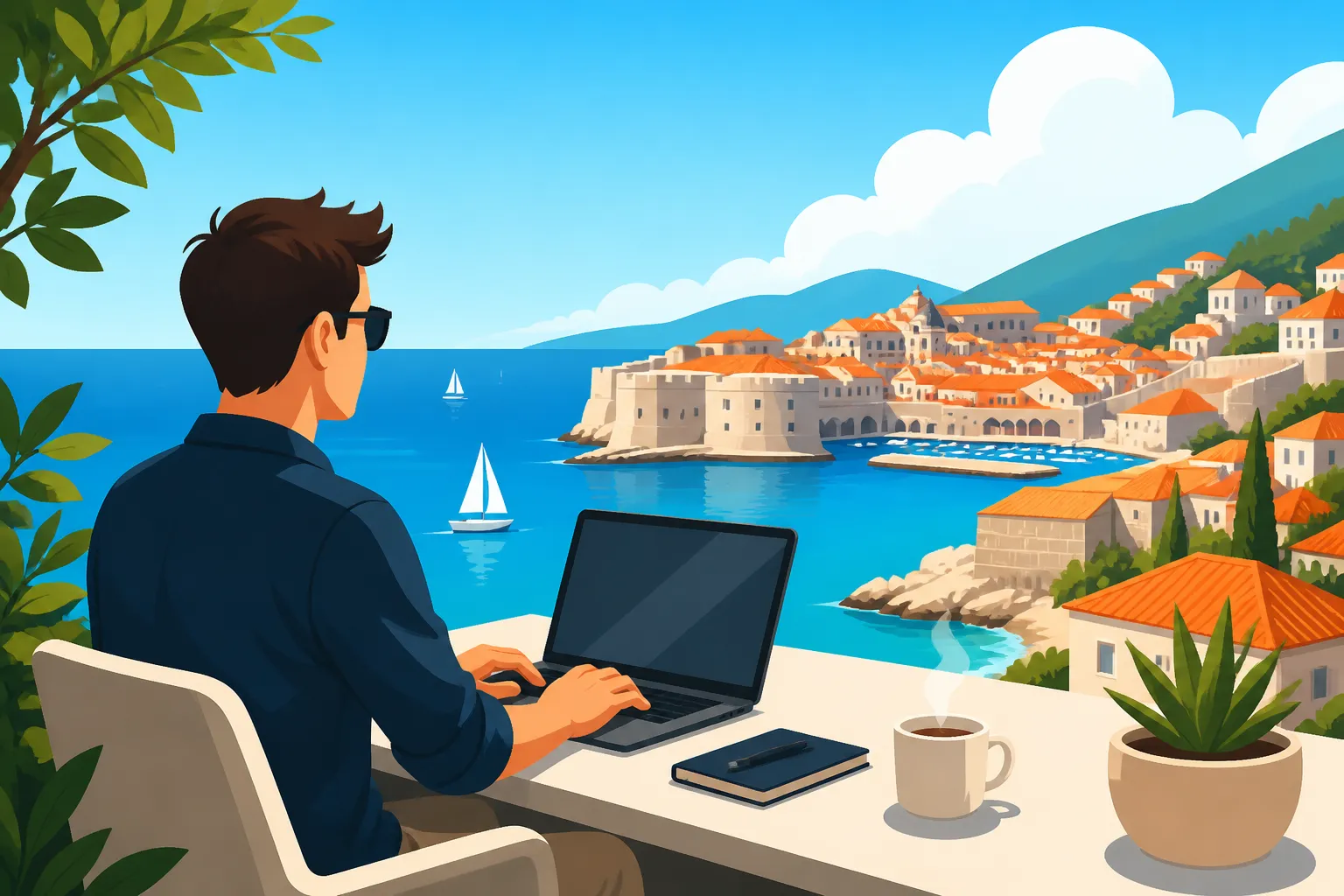
Working Remotely from Croatia: The Definitive Expat Guide (2027)
Many remote workers arrive in Croatia dreaming of seaside sunsets only to be blindsided by the "MUP" bureaucracy, the hunt for a localized tax ID, and the confusion of mandatory health insurance. It is one thing to visit for a week, but quite another to navigate the administrative labyrinth of the Adriatic. This guide solves the complexity of working remotely from Croatia, covering everything from the Digital Nomad Permit and tax residency to finding a community and managing your health coverage.
The Reality of the Remote Work Lifestyle in Croatia
The dream of answering emails from a stone house in Dalmatia is entirely achievable, but it requires a mental shift. Croatia is a country that operates on "pomalo"— a philosophy of taking things slowly. For a fast-paced remote worker, this can be the ultimate relaxation or a source of immense frustration when your internet goes down or a document needs a notarized stamp. The infrastructure has improved significantly, but the cultural pace remains delightfully, and sometimes maddeningly, steady.
Coastal vs. Continental Living for Remote Workers
Choosing where to plant your laptop is the first major hurdle. Many nomads flock to the coast, specifically to cities like Split or Zadar. During the summer, these places are vibrant, but they can become "ghost towns" in the winter months when many local businesses shutter for the season. If you are someone who needs year-round social stimulation, Zagreb is often a better choice. The capital offers a more traditional European city feel with a robust coffee culture that rivals any coastal café.
If you choose the coast, be prepared for the "Bura"—a cold, powerful wind that can shut down ferry lines and keep you indoors for days. On the other hand, living in a place like Osijek in the east provides a much lower cost of living and a burgeoning tech scene. Each region has a different vibe; the Istrian peninsula feels more Italian and organized, while southern Dalmatia is rugged and raw. Before committing to a long-term lease, I highly recommend spending a month in two different regions to see which tempo matches your workflow.
The Expat Community and Social Integration
Finding your tribe is essential to surviving the "expat blues." In 2026, the remote work community in Croatia is more organized than ever. There are dedicated digital nomad hubs in Zadar and Zagreb that host weekly meetups. However, the real challenge is breaking out of the expat bubble. Croatians are incredibly hospitable, but friendships are often forged over many, many hours of coffee. Do not expect to make a local best friend in a week.
Social life here often revolves around "idemo na kavu" (let’s go for coffee), which is rarely about the caffeine and always about the conversation. If you are working for a US or UK company, the time zone difference can make this difficult. You might find yourself finishing work just as the local social scene is winding down. To balance this, many remote workers join local sports clubs or traditional "klapa" singing groups to meet locals outside of the workspace.
Understanding the Croatian Digital Nomad Permit
The Digital Nomad Permit is not technically a "visa" but a temporary residence permit. It allows non-EU/EEA citizens to stay in Croatia for up to one year while working for companies registered outside of the country. By 2026, the application process has been refined, but it still requires meticulous attention to detail. You cannot work for a Croatian company or provide services to Croatian clients under this specific permit.
Eligibility and Financial Requirements
To qualify, you must prove that you have a consistent monthly income. As of 2026, this threshold is tied to the average gross salary in Croatia and generally hovers around €2,550 per month. If you are bringing family members, this amount increases per person. You will need to provide certified bank statements or employment contracts that clearly state your remote status. The authorities are strict about this; a simple letter from your boss might not suffice if it doesn't meet their specific formatting requirements.
You also need a clean criminal record from your home country, which must be apostilled and translated into Croatian by an official court translator. This is often the part that trips people up, as apostilles can take weeks to procure from abroad. Furthermore, you must have valid health insurance that covers you for the duration of your stay. While many use global travel insurance for the application, you will likely need to understand Health Insurance in Croatia: Mandatory, Supplementary and Private Options Explained once you are officially a resident.
The Application Process Step-by-Step
You can apply for the permit online, at a Croatian consulate abroad, or at a local police station (MUP) if you are already in the country on a tourist stay. I usually recommend the online portal for the initial submission to save time, but eventually, you will have to visit the MUP in person to provide fingerprints and pick up your biometric card. This is where "pomalo" comes into play. You might be given a "red slip" of paper that acts as your temporary ID while the card is being printed.
One of the most critical steps is obtaining your OIB (Personal Identification Number). This number is the key to everything in Croatia—from signing a rental contract to getting a SIM card. If you are wondering How to Get an OIB as a Foreigner in Croatia, it is best to do this as your very first task. Without it, your residence application will stall. Once approved, your permit is valid for up to a year, but it is important to note that it cannot be extended. You must leave the country for 90 days after it expires before you can apply for a new one.
| Requirement | Description | Estimated Cost (2026) |
|---|---|---|
| Monthly Income | Minimum €2,539.31 (approx.) | N/A |
| Application Fee | Administrative stamps and card fee | €60 – €100 |
| Criminal Record | Must be apostilled and translated | €50 – €150 |
| Health Insurance | Must cover the full stay | €500 – €1,200/year |
| Accommodation | Notarized lease agreement | Varies by city |
Tax Obligations for Remote Workers
Taxes are the "boogeyman" of the remote work world. Croatia offers a very attractive deal for those on the Digital Nomad Permit: your income derived from remote work is generally exempt from Croatian income tax. However, this only applies to the specific DN permit. If you are an EU citizen or staying on a different type of residence permit, the rules change drastically.
Tax Residency and the 183-Day Rule
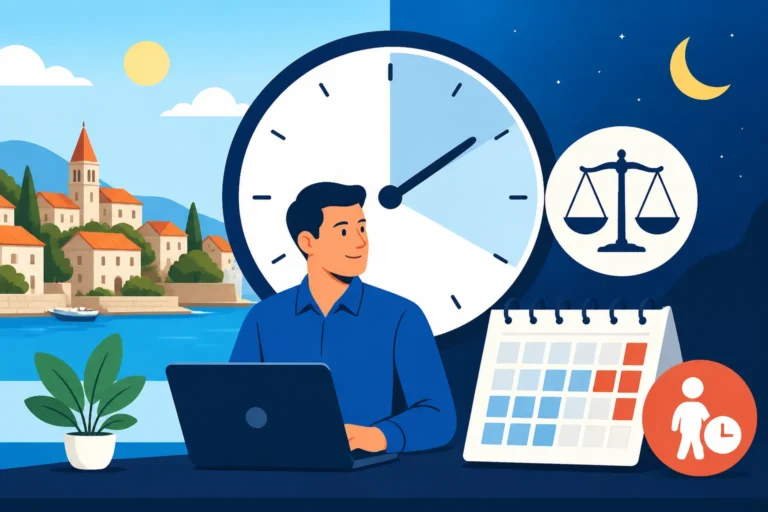
If you spend more than 183 days in Croatia during a calendar year, you are technically considered a tax resident. This means the Croatian Tax Administration (Porezna Uprava) may expect you to report your global income. For digital nomads on the official permit, the exemption usually overrides this, but it is a complex area. You must be careful not to accidentally trigger tax residency in two countries at once.
To navigate this, many expats use services like Taxes for Expats to ensure they are compliant with both their home country and Croatia. This is especially vital for US citizens who are taxed on their global income regardless of where they live. Understanding Tax Residency in Croatia: A Definitive Guide for Expats (2027) is crucial if you plan on staying longer than a single year or if you decide to switch to a work permit.
Double Taxation Treaties
Croatia has signed double taxation treaties with dozens of countries, including most of Europe, the US, and Canada. These treaties prevent you from paying tax on the same dollar twice. However, these treaties don't apply automatically. You often need to provide a "Tax Residency Certificate" from your home country to the Croatian authorities.
If you are working as a freelancer, you might consider Self-Employment in Croatia: The Paušalni Obrt Guide for Foreigners. This is a popular way for residents to pay a low, flat-rate tax if their income is below a certain threshold. However, this requires a different residency status than the Digital Nomad Permit. Always consult with a local accountant who specializes in international tax law to avoid nasty surprises three years down the line.
Healthcare and Social Security for Expats
Navigating the healthcare system is often the biggest shock for new arrivals. Even if you have private insurance, the law often requires you to register with the state health fund, HZZO. This can feel redundant, but it is the only way to access the local network of "Dom Zdravlja" (health centers).
Mandatory HZZO Registration
Once your residence is approved, you have a short window to register with HZZO. For remote workers not employed by a Croatian company, this usually involves a monthly contribution of around €90 to €100. It sounds like an extra expense, but it provides you with a health card that is recognized by every pharmacy and hospital in the country. For a deep dive into this, see Registering with HZZO in Croatia: The Complete Expat Guide (2027).
The public system is robust but can have long waiting lists for specialist appointments. This is why many expats choose to supplement their state coverage. Knowing the difference between Public vs Private Healthcare in Croatia: Which Should Expats Choose? is vital. Most of my friends use the public system for emergencies and routine prescriptions but go private for dental work or seeing a dermatologist to avoid the six-month wait.
Supplementary Insurance (Dopunsko)
If you are using the public system, you will quickly encounter "participacija"—a small co-payment for every visit or prescription. These fees are small, usually a few euros, but they can add up. To avoid this, almost everyone in Croatia pays for "Dopunsko Zdravstveno Osiguranje." It costs about €10 per month and covers all your co-payments.
If you find yourself in a situation where you need an MRI or a specific specialist, having Dopunsko makes the process much smoother. For more information on why this is a "must-have," check out Understanding Dopunsko Zdravstveno Osiguranje (Supplementary Insurance) in Croatia. It is one of the few administrative things in Croatia that is actually cheap and incredibly efficient.
Infrastructure: Internet, Coworking, and Housing
For a remote worker, your life is only as good as your Wi-Fi connection. While Croatia has made leaps in fiber-optic availability, the "last mile" to an old stone house on an island can still be a copper wire from the 1980s.
Internet Connectivity and Providers
In major cities like Zagreb, Split, and Rijeka, you can easily find 100 Mbps or higher speeds. The main providers are Hrvatski Telekom (HT), A1, and Telemach. If you are renting an apartment, always ask the landlord for a speed test before signing. Some older buildings in the "Donji Grad" of Zagreb have thick stone walls that kill Wi-Fi signals.
If you are planning to live on a more remote island, I highly recommend looking into Starlink. It has become a game-changer for nomads in Croatia. Additionally, the 5G network is surprisingly good in coastal areas. Many remote workers keep a local SIM card with a large data plan as a backup. You can find more details on setting this up in The Expat Guide to Setting Up Utilities in Croatia.
Finding Long-term Accommodation
The rental market in Croatia is heavily influenced by tourism. In coastal cities, many landlords will only rent to you "until June 1st," at which point they want to put the apartment on Airbnb for triple the price. Finding a true long-term rental requires patience and often a bit of networking. Sites like Njuškalo are the local standard, but the best deals are found through Facebook groups or local word-of-mouth.
When you do find a place, you must ensure the landlord is willing to provide a "notarized" contract. This is a requirement for your residence permit. Many landlords try to avoid this to dodge taxes, but you must insist. For more tips on navigating this, read The Complete Guide to Renting an Apartment in Croatia (2027). Also, keep in mind that Understanding the Real Estate Transfer Tax (Porez na Promet Nekretnina) is only relevant if you decide to buy, but knowing the local market helps when negotiating rent.
Culture and Language Integration
You can get by in Croatia with English, especially in the bigger cities and among the younger generation. However, if you want to truly feel at home, learning the language is the best investment you can make. It transforms you from a "tourist" into a "susjed" (neighbor).
Navigating the Bureaucracy (The MUP Experience)
The Ministry of the Interior, or MUP, is where dreams go to wait in line. You will likely spend several mornings sitting on a plastic chair waiting for your number to be called. The key to surviving MUP is preparation. Bring three copies of every document, even if they only asked for one. Bring a smile, and if possible, bring a local friend.
The bureaucracy is where the "pomalo" attitude can feel most obstructive. Documents that should take a day might take three weeks. It is important to stay patient. If you get frustrated with a clerk, your application will likely find its way to the bottom of the pile. This is part of The Complete Guide to Moving to Croatia: Your First 90 Days (2027), and learning to navigate these "hiccups" is a rite of passage for every expat.
Learning the Language
Croatian is a Slavic language with seven cases, which makes it notoriously difficult for English speakers. However, knowing even basic phrases like "Dobar dan" (Good day) and "Hvala" (Thank you) opens doors. I highly recommend using a platform like iTalki to find a Croatian tutor before you even arrive. Having a few lessons a week can help you understand the grammar enough to read your utility bills.
For those who want a more immersive experience, the University of Zagreb offers a famous course called Learning Croatian: A Complete Guide to Language Courses and Levels. It is intensive, but it is also one of the best ways to meet other expats who are in the same boat as you. Plus, if you ever decide to stay long-term, you will eventually need to understand the Croatian Citizenship: Routes to Naturalisation and Descent (2027) requirements, which include a language test.
Financial Management for Remote Workers
Managing money across borders requires a bit of strategy. While Croatia is now part of the Eurozone, which makes things easier for Europeans, those coming from the US or UK still have to deal with exchange rates and international transfer fees.
Opening a Bank Account
As a remote worker with a residence permit, you are entitled to open a "non-resident" or "resident" bank account. I suggest opening a resident account as soon as your ID card arrives. Banks like Zagrebačka Banka (Zaba) and PBZ have decent mobile apps and English-speaking staff. You will need your OIB and your residence card to get started.
You should also look into The Expat Guide to Opening a Bank Account in Croatia for a comparison of fees. Most Croatian banks charge a small monthly maintenance fee. While digital banks like Revolut or Wise are great for daily spending, having a local IBAN is often necessary for paying certain utility bills or receiving a local salary if you ever switch to a The Complete Guide to Working in Croatia as a Foreigner (2027) status.
Managing Foreign Income
If you are getting paid in USD or GBP, you will want to minimize the "bite" taken by currency conversion. Most expats receive their salary into a Wise or Revolut account and then transfer only what they need for monthly expenses into their Croatian account. This protects you from the somewhat unfavorable exchange rates offered by traditional Croatian banks.
Always keep a record of your transfers. If you ever need to prove your income for a permit renewal or a future mortgage, the Porezna Uprava may ask for a clear trail of where your money is coming from. Understanding Banking in Croatia: A Complete Guide for Foreigners (2027) will help you set up a system that is both tax-compliant and cost-effective.
Health & Medical Disclaimer
The information provided in this guide is for informational purposes only and does not constitute legal, financial, or medical advice. Immigration laws, tax regulations, and healthcare policies in Croatia are subject to change. Always consult with official government sources, such as the Ministry of the Interior (MUP) or the Croatian Tax Administration, and seek professional counsel from qualified lawyers or accountants before making any decisions regarding your residency or tax status in Croatia.