Can I Open a Croatian Bank Account Without Residency?
Oh, the Croatian bank account dilemma! It's one of those classic expat hurdles that catches so many of us off guard when we first arrive. You’ve just landed, you’re trying to set up your life, and the idea of managing your finances locally seems like the most logical first step. But then you hit the wall: many banks will look at you with a blank stare when you mention opening an account without a solid residence permit. This guide is here to shed light on whether you can indeed open a Croatian bank account without formal residency and, more importantly, what your actual options are for managing your money effectively in the early days.
The Straight Answer: Opening a Croatian Bank Account Without Residency (The Catch-22)
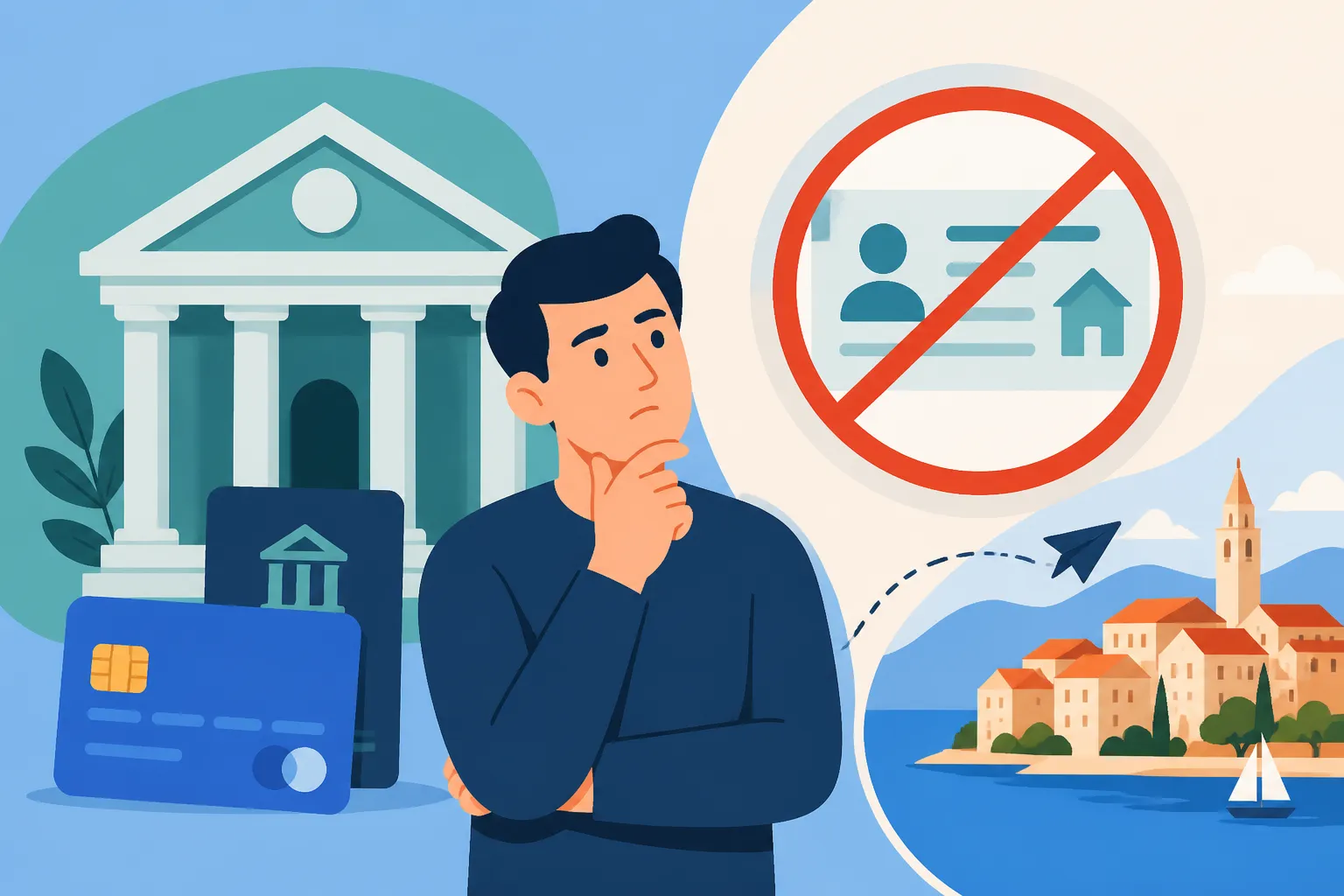
Let's not beat around the bush, because the Croatian bureaucracy certainly won't: generally speaking, opening a full Croatian bank account is incredibly difficult, if not impossible, without a valid residence permit. This isn't just a quirky local rule; it's deeply rooted in international anti-money laundering (AML) and know-your-customer (KYC) regulations. Banks need to know who you are, where you're officially based, and why you're banking with them. Without a local residence, you're essentially a ghost in the system for their purposes.
The Official Stance and Bureaucratic Reality
From the perspective of major Croatian banks like Zagrebačka Banka, PBZ, or Erste, a non-resident without a clear, established link to Croatia (like a registered company or a property purchase already in progress) presents a significant risk. The official stance is almost universally that you need a valid Croatian residence permit (privremeni boravak or stalni boravak) to initiate the account opening process.
I remember when I first tried, fresh off the boat with just my passport and a hopeful smile. The bank teller, bless her heart, was polite but firm. "Do you have your OIB? Your residence permit?" she asked in Croatian, looking at me as if I'd requested to pay my utilities in seashells. The frustration is real because you feel like you're stuck in a loop: you need a bank account for so many things, but you need residency for the bank account, and sometimes you even need funds to prove you can support yourself for residency. It's a classic expat Catch-22, and it’s a feeling many foreigners experience when trying to get their financial footing here.
Essential Documents: The Residency Requirement's Ripple Effect
The core of the issue lies in the documentation. To open a typical bank account in Croatia, you'll generally need:
- A valid ID: Your passport is usually sufficient.
- Your OIB (Osobni identifikacijski broj): This is your personal identification number, crucial for almost all administrative tasks in Croatia, including banking, taxes, and healthcare.
- Proof of residence: This is the big one. It usually means showing your valid residence permit (boravišna iskaznica) issued by the MUP (Ministry of Interior).
The ripple effect is that without that little plastic card proving your temporary or permanent stay in Croatia, the other documents become secondary for a full account. You can sometimes get an OIB without residency – for example, if you're purchasing property, inheriting something, or have a specific legal interest that requires it. However, an OIB obtained for such purposes still doesn't automatically unlock a full personal bank account for everyday transactions unless you also meet the residency criteria. The bank wants to see that you are officially a part of the Croatian system, even if temporarily. This is why understanding How to Get an OIB (Personal Identification Number) in Croatia is often one of the first deep dives expats make.
Temporary Solutions and Limited Options for New Arrivals
So, what do you do when you first arrive and haven't secured that precious residence permit yet? You're not entirely out of luck, but your options will be limited and won't replace a proper local bank account for long.
For the initial days or weeks, most expats rely on:
- Cash: Always a good idea to have some Euros on hand for immediate expenses.
- International Debit/Credit Cards: Your cards from your home country will work for purchases and ATM withdrawals, but be mindful of foreign transaction fees and ATM charges. These can quickly add up, turning small everyday expenses into slightly larger ones.
- Digital Wallets/Apps: Services like Google Pay or Apple Pay linked to your existing foreign cards can be convenient for contactless payments where accepted.
These are purely stop-gap measures. They don't offer a Croatian IBAN, which you'll inevitably need for things like receiving local salary payments, paying utility bills via direct debit, or registering with certain government services. They certainly don't simplify your tax situation once you establish tax residency.
Navigating the System: What Might Be Possible and When
While a full personal bank account without residency is generally a no-go, there are specific scenarios where financial services become accessible, often because your path to residency is already established or your purpose for being in Croatia is clearly defined.
The Digital Nomad Permit Exception and Other Specific Cases
Croatia has been forward-thinking with its digital nomad permit, and thankfully, this specific permit smooths the way for banking. If you've successfully obtained a [Croatian Digital Nomad Permit], you are, by definition, granted temporary residence in Croatia for up to a year. This permit is your proof of residence. Once you have your boravišna iskaznica (residence card) from the MUP, coupled with your OIB, opening a bank account becomes a standard process. You walk into the bank, present your ID, OIB, and residence card, and voilà, you're usually good to go.
Other situations that also come with an inherent right to residence and thus access to banking include:
- Employment in Croatia: If you're employed by a Croatian company, they will sponsor your work and residence permit. Once that's approved and you have your residency card, you can open an account.
- Students: International students enrolled in Croatian educational institutions are granted student residence permits, which then allow them to open bank accounts for managing their funds.
- Family Reunification: If you've obtained residence through family reunification with a Croatian citizen or another resident, your permit is your golden ticket.
- Property Owners: While owning property alone doesn't grant automatic residence, if you're going through the process of buying, having an OIB for property purposes helps, and once your long-term stay is officially recognized (e.g., through a residence permit based on sufficient funds, if applicable to your nationality), then banking becomes straightforward.
In all these scenarios, the key is the residence permit. It’s the formal recognition by the Croatian state that you are living here, and it's what the banks need to see. This journey often starts with How Do I Get an OIB as a Foreigner in Croatia?, as the OIB is the fundamental identifier.
The OIB First Approach: A Key to Unlocking Financial Services
The OIB, your personal identification number, is fundamental to financial life in Croatia. You can, in fact, obtain an OIB even without being a resident. This is typically done if you have a legitimate interest in Croatia that requires one, such as:
- Purchasing property: You’ll need an OIB to register the property in your name and pay the Real Estate Transfer Tax (Porez na Promet Nekretnina).
- Inheritance: If you inherit assets in Croatia.
- Opening a business (e.g., d.o.o. or obrt): A legal entity requires an OIB for its founder/owner.
While obtaining an OIB is a crucial first step for many things, it's important to understand its limitations for banking without residency. An OIB alone, without a residence permit, is usually insufficient for opening a personal checking account for daily use. Banks typically insist on seeing proof of your official tie to Croatia.
However, if you're opening a company (like a d.o.o. or a paušalni obrt), you will need a business bank account. In this specific scenario, the company itself becomes the "entity" with a legal presence, and your OIB is used in conjunction with the company's registration documents. So, if your long-term plan involves self-employment, getting your OIB and then registering your business often precedes the bank account opening, making it a viable route.
The Role of Specific Banks and Branch Discretion
While the general rule is strict, some expats report varied experiences depending on the specific bank or even the individual branch and teller they encounter. However, this is largely anecdotal and should not be relied upon as a strategy. It's more about occasional flexibility within very narrow parameters rather than a consistent policy.
For instance, if you have signed a long-term rental contract, some banks might consider it along with your OIB if you are an EU citizen and registering your stay. However, for non-EU citizens, the requirement for a residence permit from MUP is almost always absolute.
Generally, you'll find that the larger, more established banks like Zagrebačka Banka, Privredna Banka Zagreb (PBZ), Erste Bank, and OTP Bank are the most common choices for expats. They have more experience with foreign clients and often have English-speaking staff, especially in larger cities like Zagreb, Split, and Rijeka. However, their core requirements for personal accounts remain consistent: valid ID, OIB, and proof of residence. For a comprehensive overview of how to get started, our guide on The Expat Guide to Opening a Bank Account in Croatia offers a deeper dive into the standard process once you meet the prerequisites.
Practical Alternatives and Workarounds for Early Days in Croatia
Given the tight restrictions on opening a traditional Croatian bank account without residency, it's vital to have robust alternatives for managing your finances, especially during those initial months. These aren't just temporary fixes; they can be incredibly powerful tools for expats.
Relying on International Digital Banks and Money Transfer Services
This is where digital solutions truly shine for new arrivals. Companies like Wise (formerly TransferWise) have revolutionized how expats handle their money across borders. A Wise account isn't a Croatian bank account, but it offers many of the benefits, particularly if you're receiving international payments or need to spend locally.
Here’s how Wise becomes a lifesaver:
- Multi-Currency Account: You can hold balances in over 50 currencies, including Euros.
- Local Bank Details: You can get local bank details for several countries (e.g., a German IBAN, a UK account number, US routing number). This means you can receive payments as if you had a local account in those countries, often without fees. While it doesn't give you a Croatian IBAN, it's incredibly useful if you're still paid in USD, GBP, or another Eurozone currency.
- Debit Card: The Wise debit Mastercard allows you to spend money in Euros in Croatia directly from your Euro balance without foreign transaction fees. You can also withdraw cash from ATMs, often with a generous free monthly limit before a small fee applies.
- Cheap International Transfers: Sending money to or from Croatia (or any other country) is typically much cheaper and faster than traditional bank transfers. This is invaluable if you're transferring savings from your home country.
I've personally used Wise for years while living in Croatia, long before it was a mainstream option, and it saved me a fortune in exchange rate markups and transfer fees. It's an indispensable tool for many expats, whether they have a Croatian bank account or not. It's especially useful for those working remotely for foreign companies or running a freelance business with international clients.
Traditional International Banking and EU-Based Accounts
If you're an EU citizen, your existing bank account from another EU country can serve you well in Croatia, particularly after Croatia joined the Eurozone.
- Existing EU Accounts: You can use your debit card from your German, French, or Italian bank for purchases and ATM withdrawals. Since Croatia now uses the Euro, you won't incur currency conversion fees within the Eurozone, which is a massive improvement from pre-2023. However, be aware that some foreign banks might still charge ATM withdrawal fees or have limits on foreign ATM transactions.
- Digital-First EU Banks: Neobanks like Revolut, N26, and Monese are also popular choices. They operate similarly to Wise, offering multi-currency accounts and debit cards that work seamlessly in Croatia. They generally have very competitive exchange rates and low or no fees for spending in Euros.
These solutions are fantastic for spending and receiving funds, but they still don't give you that all-important Croatian IBAN for local administrative tasks. If a Croatian employer needs to pay your salary or you need to set up a direct debit for your HEP electricity bill, a Croatian bank account is usually required.
The Importance of Planning Your Financial Onboarding
Ultimately, the smartest approach is to plan your financial onboarding in Croatia in conjunction with your immigration process. Prioritizing the acquisition of your temporary residence permit and OIB should be at the top of your to-do list after arriving. The moment you have your residence card in hand, the path to opening a local bank account becomes straightforward. Our comprehensive guide The Complete Guide to Croatian Residence Permits for Expats (2027) walks you through the various avenues to get your residency sorted.
While you're waiting for your official documents, digital tools like Wise and your existing international cards will bridge the gap. Just remember that once you establish tax residency in Croatia (which can happen surprisingly quickly depending on your circumstances), you'll need to report all your income, regardless of where it's held. Services like Taxes for Expats can provide invaluable guidance on navigating the intricacies of declaring foreign income and understanding How Much Income Tax Will I Pay in Croatia in 2026? and the broader The Complete Guide to Taxes in Croatia for Expats (2027). The transition to having a local bank account will make your life significantly easier for those tax obligations.
Here's a quick comparison of opening a full Croatian bank account versus using an international digital bank:
| Feature | Full Croatian Bank Account (with Residence) | International Digital Bank (e.g., Wise) |
|---|---|---|
| Residency Required | Yes, generally | No, can open with foreign residence |
| OIB Required | Yes | No (unless setting up a specific Croatian business) |
| Local Croatian IBAN | Yes | No (typically provides other EU IBANs like German) |
| ATM Withdrawals | Easy, low/no fees from own bank's ATMs | Easy, often free up to a limit, then small fee |
| Online Payments (Local) | Seamless for Croatian services (utilities, etc.) | Possible via card, but direct debit might be tricky |
| Receiving Salary | Ideal for Croatian employers | Great for foreign employers (e.g., EUR, USD, GBP) |
| International Transfers | Possible, but often higher fees/worse rates | Core service, low fees, competitive rates |
| Setup Time | Few days to weeks (after residence) | Minutes to a few days (online verification) |
| Administrative Ease | Essential for formal Croatian processes | Excellent for personal spending/international income |
So, while the answer to "Can I open a Croatian bank account without residency?" is almost universally "no" for a full personal account, there are very effective ways to manage your money in Croatia before you get your residency sorted. Just make sure you understand the nuances and plan accordingly.
Disclaimer
The information provided in this article is intended for general guidance and informational purposes only, and does not constitute professional financial, legal, or immigration advice. While every effort has been made to ensure the accuracy and timeliness of the information, regulations and procedures in Croatia can change rapidly. It is strongly recommended that you consult with a qualified Croatian financial advisor, legal professional, or the relevant government authorities (such as the MUP or Porezna Uprava) for advice tailored to your specific situation. Reliance on any information provided in this article is solely at your own risk.