How Do I Set Up Direct Debit for Utility Bills in Croatia?
One of the trickiest parts of settling into life in Croatia, especially when you’re still getting your feet wet, is figuring out how to manage those endless utility bills. Remembering due dates, deciphering cryptic uplatnice (payment slips), and making trips to the post office or bank can quickly become a significant source of stress. This guide is here to walk you through the often-confusing process of setting up direct debit for your utility bills in Croatia, making your expat life a whole lot smoother.
The Expat's Lifeline: Why Direct Debit is a Must-Have in Croatia
Let's be honest, nobody moves to a beautiful country like Croatia to spend their days stressing over bills. Yet, for many of us, the administrative side of things quickly becomes a recurring headache. Direct debit, or what Croatians call a trajni nalog, is a real game-changer here, alleviating a massive chunk of that bureaucratic burden.
Why Direct Debit is a Game Changer for Expats
Imagine this: you're enjoying a coffee on the Riva in Split, or hiking through Plitvice Lakes, and suddenly a wave of panic hits you – "Did I pay the electricity bill?" We've all been there, and it's not a fun feeling. Croatia's system for paying bills can feel a bit antiquated if you're used to everything being automated back home. Most utilities send out paper bills, known as uplatnice, which require you to manually go to a bank, post office (Hrvatska pošta), or FINA office to make a payment. Each bill has a unique reference number, and a single mistake can lead to your payment not being correctly allocated, or even worse, late fees and potential service interruption.
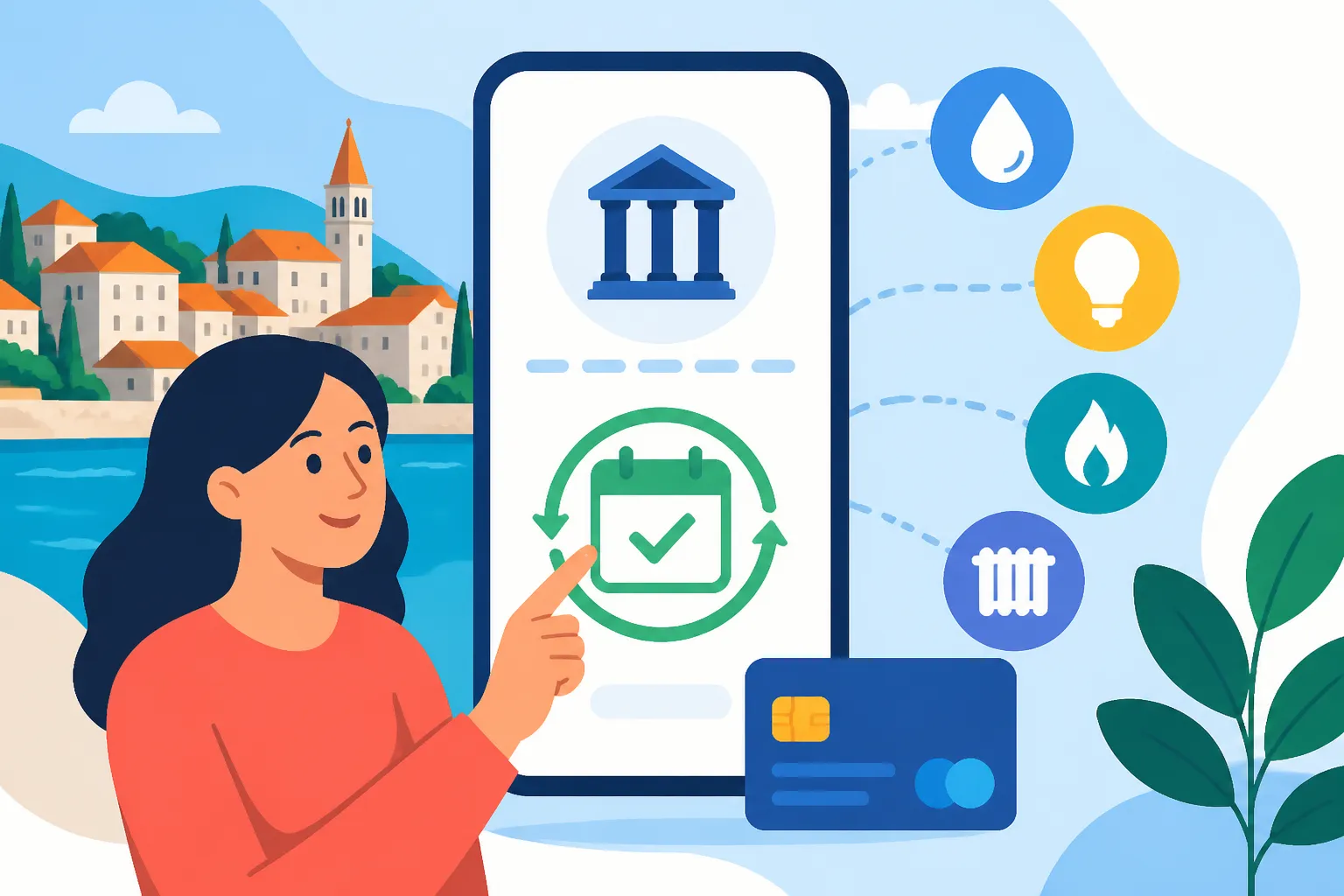
This is where direct debit shines. It automates the process entirely. Once set up, the utility provider simply takes the correct amount directly from your bank account on or around the due date. No more scrambling for bills, no more standing in lines, no more worrying about missing a payment while you're away exploring this gorgeous country. For those of us who juggle work, family, and trying to learn Croatian, this level of convenience isn't just nice-to-have, it's essential for maintaining sanity. It's truly a small act of self-care that will save you countless hours and anxieties.
Understanding 'Trajni Nalog' Standing Order in Croatia
The term you'll encounter at the bank is trajni nalog. While it functions very similarly to a direct debit you might know from other countries, it's literally translated as a "standing order." The key difference, for practical purposes, is that you're authorizing your bank to make recurring payments to a specific beneficiary (the utility company) based on the amount they request, rather than the utility company pulling directly from your account. Functionally, for the end-user, the result is the same: hands-free bill payment.
This system is widely accepted across Croatia for standard utilities. It typically involves filling out a form at your bank, providing them with the necessary details from your utility bill. The bank then takes responsibility for executing these payments. It’s a secure and reliable method, removing the onus from you to remember each individual payment. It becomes particularly invaluable when you're dealing with multiple providers for your apartment – electricity, water, gas, communal waste, and maybe even shared building maintenance fees (pričuva).
Which Utility Providers Typically Offer Direct Debit?
Most major utility providers in Croatia offer the option for trajni nalog. This includes the big ones that everyone deals with:
- HEP ODS (Hrvatska Elektroprivreda Operator Distribucijskog Sustava): This is your national electricity provider. No matter where you are in Croatia, be it Zagreb, Dubrovnik, or a small island village, HEP is likely your electricity supplier, and they absolutely support direct debit. Setting up electricity in your Croatian home is one of the first things you'll do, and this should be a priority.
- Local Water Companies (e.g., Vodoopskrba i odvodnja for Zagreb, Vodovod i kanalizacija for Split): Water services are managed by municipal or regional companies. While their names vary by city and region, the vast majority offer direct debit. You'll find their details on your water bill.
- Gas Suppliers (e.g., Gradska Plinara Zagreb): If your home has gas heating or cooking, you'll have a separate gas provider. Again, these are typically regional and support trajni nalog.
- Communal Waste Collection (e.g., Čistoća Zagreb, Split Parking for waste in Split): Even your trash collection can often be automated this way. Like water and gas, these are managed at the local level.
- Telecommunications and Internet Providers: Companies like Hrvatski Telekom, A1, and Telemach also readily accept direct debit for your monthly phone, internet, and TV packages.
It’s always a good idea to check your specific bill or the provider's website, but you’ll find that the option is almost universally available for these core services. This means you can essentially automate the bulk of your monthly household expenditures, freeing up your time and mental energy for other aspects of expat life in Croatia.
Your Step-by-Step Guide to Setting Up a Trajni Nalog
So, you're ready to ditch the paper uplatnice and embrace the ease of direct debit. Excellent choice! Here's a detailed walkthrough of how to get your trajni nalog set up at a Croatian bank. It might feel like a bit of a process initially, but trust me, it’s worth every minute.
Gathering Your Essential Documents
Before you even step foot in a bank or log into your online portal, make sure you have these critical items on hand:
- Your OIB (Personal Identification Number): This is non-negotiable for almost any administrative task in Croatia, including banking. If you don't have one yet, you'll need to sort this out first. Understanding how to get your OIB and why it matters for healthcare access, banking, and pretty much everything else, is crucial for any expat.
- Your Croatian Bank Account Details: Obviously, you need an account from which the payments will be drawn. This includes your account number (IBAN). If you haven't opened a bank account yet, you'll need to do that first. Major banks like Zagrebačka banka, Privredna banka Zagreb (PBZ), Erste&Steiermärkische Bank, OTP Banka, and Raiffeisenbank are popular choices among expats. Make sure your account is active and has sufficient funds.
- A Recent Utility Bill (Račun) from Each Provider: This is perhaps the most important document for setting up a trajni nalog. On each bill, you'll find:
- The Beneficiary's Name: The full name of the utility company (e.g., HEP ODS, Vodoopskrba i odvodnja).
- The Beneficiary's IBAN: The bank account number of the utility company where the payment needs to go.
- The Reference Number (Poziv na broj odobrenja): This is a crucial, unique code that tells the utility company which customer and specific bill the payment pertains to. It typically follows a format like HRxx xxxxxxxxxxxxxxxxx. Make sure you copy this accurately.
Having these documents ready will streamline your interaction with the bank considerably. A common expat frustration is arriving at an office only to be told you're missing one key piece of paper, so a little prep goes a long way.
Contacting Your Bank and Setting It Up
This is where the magic happens. You have two primary ways to set up your trajni nalog:
-
In-Person Visit: This is often the most straightforward method, especially if you're new to Croatian banking or if your Croatian isn't quite fluent yet.
- Head to your branch: Go to your local branch of Zagrebačka banka, PBZ, or whichever bank you use. Take a deep breath and prepare for a bit of a wait; Croatian banks can sometimes have queues.
- Explain your request: Clearly state that you want to set up a trajni nalog for your utility bills. You might say, "Želim postaviti trajni nalog za račune za komunalije," or simply, "Želim plaćati račune putem direktnog terećenja."
- Provide your documents: Hand over your OIB and the utility bill(s). The bank teller will likely use the information from the bill to fill out a form for you.
- Sign the authorization: You'll be asked to sign a form authorizing the bank to make these recurring payments. Read it carefully, or ask for clarification if anything is unclear. Don't be shy about asking for an English translation if available, or bringing a Croatian-speaking friend.
- Confirmation: Ask for a confirmation document or at least verbally confirm that the trajni nalog has been successfully set up. They might tell you it will become active with the next billing cycle.
-
Via Online Banking (e-bankarstvo): Many Croatian banks now offer the option to set up trajni nalog through their online banking portals. This is incredibly convenient once you're comfortable with the platform.
- Log in: Access your online banking account.
- Navigate to payments: Look for a section related to "Payments" (Plaćanja), "Standing Orders" (Trajni nalozi), or "Direct Debit" (Direktno terećenje).
- Initiate new order: Follow the prompts to create a new trajni nalog. You'll typically need to input the utility company's IBAN, the reference number from your bill (poziv na broj odobrenja), and sometimes the company's name.
- Confirm: Review all the details carefully before confirming the setup. You'll usually receive an electronic confirmation.
Using online banking can be a massive time-saver. If you're struggling with the online interface, don't hesitate to visit your bank in person for assistance – they can often guide you through it on a computer at the branch. Learning how to set up online banking and IBAN transfers in Croatia is a valuable skill for any resident.
Authorizing the Direct Debit
When you sign the form, either physically at the bank or digitally through online banking, you are essentially giving your bank permission to process payments to that specific utility company. The authorization will stipulate:
- The Payee: The utility company's official name.
- The Payee's Bank Account (IBAN): Where the money goes.
- Your Unique Reference Number: This poziv na broj odobrenja is critical. It ensures your payment is correctly matched to your account with the utility provider. Without it, your payment might go into a general fund or be misallocated, leading to major headaches.
- Payment Frequency: Typically monthly, but this is managed by the utility's billing cycle, not a fixed date you set.
Make sure you understand the terms, especially if there's a limit to the amount that can be debited or if there are any conditions. In most cases, for utilities, it’s an open-ended authorization for the billed amount.
Confirming with the Utility Provider (Optional but Recommended)
Once you’ve set up the trajni nalog with your bank, it’s not a bad idea to do a quick double-check with the utility provider directly. This isn't strictly necessary as the bank handles the activation, but it can give you peace of mind.
- Check your next bill: The most straightforward way is to simply wait for your next bill. Often, there will be a note indicating that future payments will be handled by direct debit, or the section for manual payment will be left blank.
- Call customer service: If you're anxious, you can call HEP ODS, your water company, or your gas provider's customer service number. With your customer number (which you'll find on any bill), you can inquire about the status of your payment method. Be prepared for a potential language barrier here, so having a Croatian friend help out can be invaluable.
- Monitor your bank statements: This is perhaps the most reliable method. After the first due date post-setup, check your bank statement (izvod) to ensure the payment was successfully debited.
Remember that it usually takes one billing cycle for the trajni nalog to become active, so you might still need to manually pay your very next bill after setup. Don’t get caught out!
Navigating Common Hurdles and Best Practices
Living in Croatia as an expat means learning to navigate a system that often operates a little differently from what you’re used to. Setting up direct debit for your utilities is a massive step towards simplification, but it doesn't hurt to be aware of potential bumps in the road and how to manage them.
Language Barriers at the Bank
This is probably the most common frustration for new arrivals. While many bank employees, especially in larger cities like Zagreb, Split, Rijeka, or Dubrovnik, might speak English, it’s not a guarantee. And when you’re dealing with financial or administrative tasks, you want to be absolutely sure you understand everything.
- Bring a Croatian speaker: If you have a Croatian friend, colleague, or even a landlord you trust, ask them to accompany you to the bank. Their presence can make a world of difference in ensuring clear communication and accurate setup.
- Use translation apps: Have Google Translate or a similar app ready on your phone. You can type out your questions and show the translation, or even use the voice translation feature.
- Be patient and polite: Even if communication is difficult, a positive attitude goes a long way. The staff are usually trying to help, even if language limits their ability to explain things perfectly.
- Choose expat-friendly banks: Some banks might have dedicated international client desks or staff who are more accustomed to dealing with foreigners. It’s worth asking around in expat groups for recommendations.
Dealing with Variable Bills
Unlike a fixed subscription, utility bills in Croatia (especially electricity and gas) often vary significantly from month to month, largely depending on your consumption. This is completely normal and trajni nalog is designed to handle this.
- No fixed amount: When you set up a trajni nalog for a utility bill, you're not setting a fixed amount to be paid each month. Instead, you're authorizing the bank to pay whatever amount the utility provider invoices you for that specific month, using the unique reference number on the bill.
- Estimates and actuals: Sometimes, you might receive bills based on estimated consumption (procjena), followed by an adjustment bill after an actual meter reading. Your direct debit will automatically adjust to these different amounts, provided the utility company uses the same reference number. This is usually the case.
Monitoring Your Payments
Just because you've automated something, doesn't mean you should completely forget about it! It's always a good practice to monitor your bank statements.
- Regular checks: At least once a month, take a few minutes to review your bank statements. Confirm that your utility payments have been made correctly and that the amounts match what you were expecting based on your bills.
- Catching discrepancies: This allows you to catch any errors early. For example, if a trajni nalog fails due to insufficient funds, or if a payment isn't showing up, you'll be able to address it promptly with your bank or the utility provider.
- Digital notifications: Many Croatian banks offer push notifications or email alerts for transactions. Consider setting these up for your utility payments.
Changing Banks or Moving House
Life as an expat is often fluid, and you might find yourself changing banks or, more commonly, moving to a new apartment or house.
- Canceling a Trajni Nalog: If you're moving to a new address or switching banks, you must explicitly cancel your old trajni nalog. You can do this at your bank branch or often through online banking. Do not assume it will automatically cease. Failing to cancel could result in you paying bills for a property you no longer inhabit.
- Setting up new ones: When you move to a new place, you’ll need to set up entirely new trajni nalog arrangements for your new utility accounts, as the customer numbers and reference numbers will be different. This is part of the process of registering your residence at the MUP, and updating all your details.
- Transferring funds: If you're switching banks, services like Wise can be incredibly useful for quickly and affordably transferring funds from your old account to your new one, or for bringing money into Croatia to cover your initial bills before your new bank account is fully operational. Many expats find these services invaluable for managing international finances.
Considering Payment Alternatives
While direct debit is highly recommended, it's not the only way to pay bills in Croatia. Knowing the alternatives can be useful in specific situations, like if a provider doesn't offer direct debit or if you need to make a one-off payment.
- Online Banking (e-bankarstvo): Most Croatian banks have robust online banking platforms. You can manually enter the payment details from your uplatnica (IBAN, reference number, amount) and make a payment. This is far better than physically going to the post office. This is a manual, month-to-month version, but still convenient.
- Payment Services: Some apps or services might offer bill payment options, but generally, directly through your bank or trajni nalog is most reliable.
- Specialized Tax Services: For those with more complex financial situations, especially self-employed individuals running a paušalni obrt, managing payments for taxes can be a separate challenge. Companies like Taxes for Expats offer professional assistance in navigating the intricacies of Croatian tax payments, which often require precise adherence to specific payment codes and schedules. While not direct debit, these services simplify the payment process for those particular obligations.
Understanding your options and proactively setting up trajni nalog for your regular utilities will undoubtedly make your financial life in Croatia much less stressful. It's one of those small, administrative victories that truly enhances the expat experience.
Here’s a quick overview to compare different bill payment methods in Croatia:
| Feature | Manual Payment (Post Office/Bank Counter) | Online Banking (Manual Transfer) | Direct Debit (Trajni Nalog) |
|---|---|---|---|
| Convenience | Low (requires physical presence) | Medium (from home, but manual) | High (fully automated) |
| Risk of Late Fees | High (if you forget) | Medium (if you forget) | Low (automated on due date) |
| Accuracy | Medium (prone to human error in data entry) | Medium (prone to human error in data entry) | High (bank and utility communicate) |
| Time Savings | None | Moderate (saves travel time) | High (saves all effort) |
| Record Keeping | Physical receipts | Digital transaction history | Digital transaction history |
| Language Barrier | High (at counter) | Low (if familiar with platform) | Low (one-time setup with assistance) |
| Good for Expats? | No | Yes, but still requires monthly action | Absolutely Yes! |
Disclaimer
The information provided in this guide is intended for general informational purposes only and does not constitute financial, legal, or professional advice. While we strive to provide accurate and up-to-date information, administrative processes in Croatia can change. It is always recommended to consult with your bank, the specific utility provider, or a qualified professional for advice tailored to your individual circumstances.