What Is the 90/180 Rule for Non-EU Citizens in Croatia?
Ah, the infamous 90/180 rule! If you're a non-EU citizen dreaming of spending extended time soaking up the Croatian sun, exploring its ancient cities, or just getting a feel for expat life here, this rule is probably keeping you up at night. It's one of those administrative hurdles that can feel incredibly restrictive and confusing, making you wonder just how long you can actually stay without running afoul of the law. This guide is here to untangle the complexities of the 90/180 rule, explaining what it means for your visits to Croatia and how to navigate it as a non-EU national.
Unpacking the 90/180 Rule: What It Really Means for Your Stay
For many non-EU citizens, the dream of an endless summer in Croatia clashes with the reality of immigration laws. The 90/180 rule is at the heart of this challenge, dictating how long you can legally remain in the Schengen Area – and now, critically, Croatia – on a short-stay visa or visa-free status. It's a fundamental concept that every non-EU visitor needs to grasp thoroughly, as misunderstanding it can lead to serious headaches down the line.
The Core Mechanics: How It's Calculated
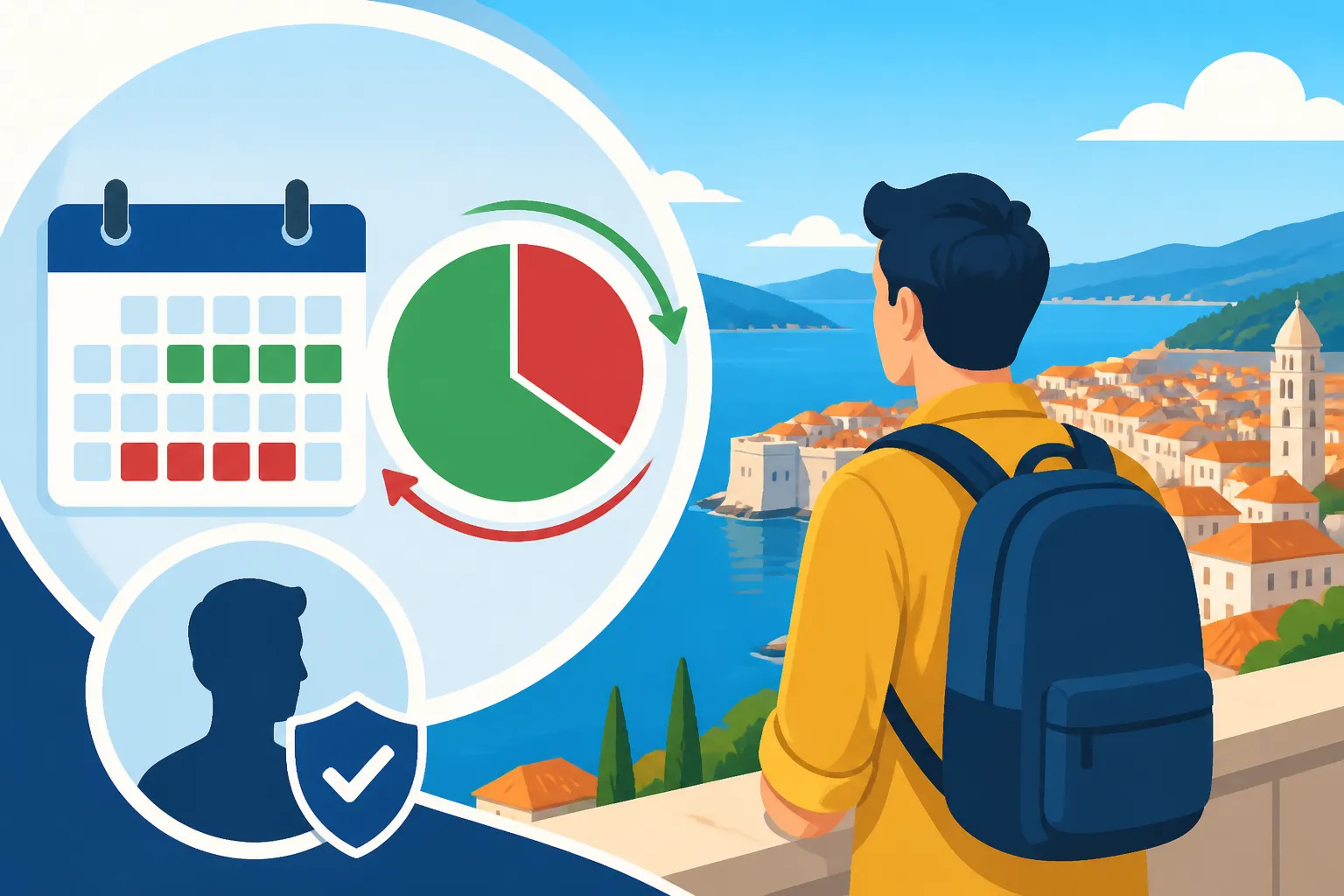
At its simplest, the 90/180 rule means you can stay in the Schengen Area for a maximum of 90 days within any 180-day period. The crucial part here is "any 180-day period." It's not a fixed calendar half-year, and it doesn't reset on January 1st or July 1st. Instead, it's a rolling window. Imagine looking back 180 days from each day you are present in the Schengen Area. Within that rolling 180-day window, your total cumulative stay cannot exceed 90 days.
This rolling calculation is where many people get tripped up. Let's say you spend 60 days in Croatia in June and July. You then leave for 30 days. When you consider re-entering in September, you need to count back 180 days from your intended re-entry date. All your days spent in the Schengen Area within that 180-day window will be tallied. If you've used up your 90 days, you simply can't re-enter until enough days have passed outside the Schengen Area to bring your total within the 90-day limit for the preceding 180 days. This applies to all Schengen countries collectively, not just Croatia. So, if you've spent 30 days in Italy, 30 days in Germany, and then want to spend time in Croatia, those 60 days already used will count towards your 90-day limit. It’s a collective allowance for the entire Schengen zone.
Croatia's Integration into Schengen: The Impact
For years, Croatia had its own separate 90-day rule for non-EU citizens, operating somewhat independently of the full Schengen zone. This allowed for a loophole where non-EU citizens could spend 90 days in the Schengen Area, then pop over to Croatia for another 90 days, essentially getting a double dip. Well, those days are firmly in the past.
On January 1, 2023, Croatia officially joined the Schengen Area for land and sea borders, with air borders following on March 26, 2023. This was a monumental change, simplifying travel within Europe but fundamentally altering the immigration landscape for non-EU visitors to Croatia. Now, any day you spend in Croatia as a tourist or visa-free visitor counts directly towards your 90-day Schengen limit. There's no separate "Croatian 90 days" anymore. This means that if you're traveling through other Schengen countries before arriving in Croatia, you need to be acutely aware of how many days you've already accumulated. The entire bloc operates as one border-free zone for the purpose of this rule. This integration has been a blessing for seamless travel, but it has certainly tightened the reins on longer, informal stays for those outside the EU. You can learn more about how this works in general by reading our guide on Understanding Schengen Rules for Croatia After 2023.
Navigating the Rule: Practical Scenarios and Common Pitfalls
Understanding the mathematical side of the 90/180 rule is one thing, but applying it to real-life travel plans can be quite another. The rule can feel like a constantly moving target, and many expats have found themselves in tricky situations by miscalculating or not fully appreciating its implications. Let's look at some practical scenarios and the pitfalls to watch out for.
Overstaying: The Consequences and How to Avoid Them
Let me be blunt: overstaying your 90-day limit in the Schengen Area, including Croatia, is a serious matter. It's not just a minor infraction that gets a slap on the wrist. Croatian border authorities, like those across the Schengen zone, take this very seriously. The consequences can range from hefty fines that can put a serious dent in your travel budget to deportation. In severe cases, particularly if you've overstayed significantly or repeatedly, you could face an entry ban from the entire Schengen Area for several years. Imagine not being able to visit Croatia, or any other beloved European destination, for three to five years because of a miscalculation. It's a truly disheartening situation that's easily avoidable with careful planning.
To avoid this stressful scenario, diligent tracking of your days is paramount. Don't rely on guesswork or vague recollections of your past trips. Every entry and exit stamp in your passport is a record, and the border police will use these to calculate your total stay. You can use online Schengen calculators or simply keep a detailed log in a spreadsheet. Always err on the side of caution. If your plans are flexible, always aim to leave a few days before your 90-day limit, just to be safe. Remember, if you get sick or have an unexpected delay that forces you to overstay even by a day or two, you might need to provide extensive documentation to prove it was unavoidable, and even then, leniency isn't guaranteed.
When the 90/180 Rule Doesn't Apply: Exceptions and Alternatives
The 90/180 rule is primarily for short-term visits, for tourism or short business trips, where you don't intend to establish residence. However, if your goal is to stay longer in Croatia, then the 90/180 rule becomes irrelevant because you'll be applying for a different type of permit that grants you legal long-term stay. This is where your options really open up.
- Long-Stay (Type D) Visas: These are national visas issued by individual Schengen countries, including Croatia, for stays longer than 90 days but typically leading to a temporary residence permit. For instance, if you're coming to Croatia for study, work, or family reunification, you might apply for a Type D visa first, which then allows you to enter Croatia and apply for your residence permit without violating the 90/180 rule. You can find detailed information on How to Apply for a Long-Stay (Type D) Visa for Croatia.
- Temporary Residence Permits (Privremeni Boravak): This is the most common pathway for non-EU citizens who want to live in Croatia for an extended period. These permits are issued for various purposes, such as work, study, self-employment (like a Paušalni Obrt), family reunification, or even for property owners under certain conditions. Once you have a temporary residence permit, you are no longer limited by the 90/180 rule within Croatia. Your stay is governed by the validity of your permit. However, be aware that you might still be subject to the 90/180 rule when visiting other Schengen countries if your permit doesn't grant you long-term residence status across the entire zone. Our comprehensive guide, The Expat Guide to Temporary Residence (Privremeni Boravak) in Croatia, delves deep into this.
- Digital Nomad Permits: This has been a game-changer for many remote workers. Croatia was one of the first countries to offer a specific permit for digital nomads, allowing non-EU citizens to live and work remotely from Croatia for up to a year, with the possibility of renewal after a cooling-off period. This permit explicitly allows you to bypass the 90/180 rule. If you're considering this exciting option, be sure to read How to Get a Croatian Digital Nomad Permit: The Full Guide (2027).
- Permanent Residence (Stalni Boravak): For those who truly make Croatia their long-term home, permanent residence is the ultimate goal. After a certain period of continuous temporary residence (usually five years), you can apply for permanent residence, which grants you a much more stable and enduring right to live in Croatia. This, of course, completely overrides the 90/180 rule. You can learn more about this pathway in How to Apply for Permanent Residence (Stalni Boravak) in Croatia.
For any of these long-term options, you'll need to demonstrate sufficient financial means and, critically, comprehensive health insurance. Providers like Cigna Global offer excellent international health insurance plans that specifically cater to expats, ensuring you meet the requirements for your residence permit application.
Managing Your Stay: Tools and Strategies for Non-EU Visitors
The key to a stress-free experience in Croatia as a non-EU citizen is meticulous planning and proactive management of your stay. You absolutely don't want to find yourself in a situation where you're scrambling to figure out your exit strategy or facing border control with an overstay.
Tracking Your Days: Essential Tools and Methods
Since the 90/180 rule is calculated on a rolling basis, keeping accurate track of your days is paramount. Relying on memory is a recipe for disaster. Here are a few reliable methods:
- Manual Log or Spreadsheet: This is old-school but effective. Create a spreadsheet where you log every entry and exit date for all Schengen countries you visit. You can then easily calculate your total days within any 180-day window. This gives you complete control and visibility.
- Online Schengen Calculators: There are several free tools available online that help you calculate your remaining days. You input your entry and exit dates, and the calculator shows you how many days you have left. Always use a reputable one, and ideally, double-check with your own manual log.
- Passport Stamps: While not a tracking tool in itself, your passport stamps are the official record. Make sure you get clear entry and exit stamps every single time you cross a Schengen border. If you're traveling within the Schengen zone, you won't get stamps between countries (e.g., flying from Germany to Croatia). The stamps will only appear when entering and exiting the entire Schengen zone. Always carry your passport and be prepared to show it if asked, even if you don't expect a stamp.
My advice? Use a combination of methods. Maintain a personal log, cross-reference with an online calculator, and always verify with your passport stamps. It might seem tedious, but it saves immense stress and potential legal trouble.
Planning for Longer Stays: Beyond the Tourist Visa
If your heart is set on more than just a 90-day fling with Croatia, it's time to explore the various residence permit options. Many expats, myself included, started with short visits and then fell in love with Croatia, prompting a deeper dive into how to live here long-term.
The initial steps often involve deciding why you want to stay longer. Are you looking to work for a Croatian company? Start your own business? Study at one of Croatia's universities? Marry a Croatian national? Each of these reasons has a specific pathway for a residence permit. Our comprehensive guide to The Complete Guide to Croatian Residence Permits for Expats (2027) is an excellent starting point.
When you decide to move beyond the 90/180 rule, you'll need to prepare a significant amount of documentation. This includes proof of accommodation, sufficient funds, comprehensive health insurance (as mentioned, companies like Cigna Global are invaluable here), and often a clean criminal record check. The process usually involves applying at a Croatian embassy or consulate in your home country or, in some cases, directly at the local police station (MUP) in Croatia. Getting an OIB (personal identification number) is one of the foundational steps for any long-term stay, and our article on How to Get an OIB (Personal Identification Number) in Croatia can guide you through that. If you're coming from afar, planning the logistics of an international move can be overwhelming. Companies like Sirelo are great resources for comparing moving services and getting quotes for bringing your belongings to Croatia, making the transition smoother.
Making the leap to a longer stay requires patience and a good understanding of Croatian bureaucracy, which can be, shall we say, a unique experience. Don't be discouraged, but do be prepared for paperwork and potential delays. It's a journey, but a rewarding one for those who truly want to make Croatia their home.
Schengen Area Stay Limits at a Glance
| Stay Type | Maximum Duration | Applies to Schengen Area | Requirements/Purpose |
|---|---|---|---|
| Schengen Tourist/Visa-Free | 90 days within any 180-day rolling period | Yes (all Schengen countries) | Tourism, short business, visiting friends/family. No work allowed. |
| National Long-Stay (Type D) Visa | Varies (e.g., 91-365 days) | No (single country, but allows transit through Schengen) | Leads to temporary residence, issued for work, study, family, etc. |
| Temporary Residence Permit | Varies (usually 1 year, renewable) | No (specific country, but allows limited travel within Schengen) | Work, study, family, digital nomad, property ownership, self-employment. Requires application in Croatia. |
| Permanent Residence | Indefinite | No (specific country, but extensive rights within Schengen) | Granted after 5+ years of continuous temporary residence. Gives long-term stability. |
Disclaimer
The information provided in this guide is intended for general informational purposes only and does not constitute legal advice. While we strive to keep the content up-to-date and accurate, immigration laws and regulations in Croatia and the wider Schengen Area can change frequently. It is always recommended to consult with the official Croatian Ministry of Interior (MUP) or a qualified immigration lawyer for advice tailored to your specific situation. We cannot be held responsible for any outcomes resulting from the use of this information.