What Is the Withholding Tax Rate on Royalties in Croatia?
The world of tax can feel like a labyrinth even in your home country, but when you throw in the complexities of international income like royalties and the unique administrative quirks of Croatia, it can quickly become overwhelming. This guide aims to demystify the Croatian withholding tax (WHT) rates on royalties, providing clear, empathetic advice so you can understand your obligations without pulling your hair out.
Decoding Withholding Tax (WHT) in Croatia: The Expat Perspective
Let's be honest, just hearing "withholding tax" can make your eyes glaze over. But for us expats receiving income from abroad, or for those of us living here and paying out certain types of income internationally, understanding this concept is absolutely crucial. It's not just a technicality; it directly impacts how much money actually lands in your pocket or how much you need to set aside.
What is Withholding Tax?
In simple terms, withholding tax, often abbreviated as WHT, is a tax deducted at the source of payment, meaning the entity making the payment (the payer) is responsible for taking a portion of that payment and sending it directly to the tax authorities on behalf of the recipient (the payee). Think of it like a preliminary income tax, but for specific types of income that often cross international borders. It's a mechanism for governments to collect tax from non-residents on income generated within their borders, or from residents on certain types of income.
For example, if a Croatian company pays a royalty to an individual or company in another country for the use of intellectual property (like a patent, software, or a book), Croatia might require that company to "withhold" a percentage of that payment before sending the rest to the foreign recipient. This ensures that Croatia gets its piece of the pie from economic activity happening here, even if the ultimate beneficiary isn't a Croatian tax resident. It can feel a bit like an extra step in an already convoluted process, but it's a standard practice globally.
Who Does WHT Apply To?
Withholding tax primarily applies to specific types of income, with royalties being a significant one, but also commonly includes dividends (payments to shareholders), interest (earnings from loans or deposits), and sometimes service fees, especially when payments are made from a Croatian entity to a foreign entity or individual.
The key distinction for WHT in Croatia often boils down to the tax residency of the recipient:
- Non-residents: If you're a non-resident individual or company receiving royalty income from a Croatian source, you'll almost certainly encounter WHT. Croatia wants to tax the income generated within its borders, regardless of where the recipient lives. This is where most of the complexity and frustration for expats usually lies, as your home country might also want to tax that income, leading to potential double taxation – a real headache! This is precisely why services like How to Report Foreign Income to the Croatian Tax Administration exist to help streamline the process.
- Residents: For Croatian tax residents, royalty income is typically treated as regular income and is subject to standard Croatian income tax rates, not usually WHT at a separate rate. However, there can be nuances depending on how the income is structured (e.g., through a company, a self-employed obrt, or as an individual). If you're pondering Tax Residency in Croatia: A Definitive Guide for Expats (2027), understanding your status is foundational for all your tax obligations here.
It's a system designed to ensure that the source country of the income gets its share, and it’s something you absolutely need to be aware of if you're involved in any cross-border payments of this nature. Ignoring it can lead to penalties and a whole lot of extra paperwork down the line.
The Nitty-Gritty: Croatian Withholding Tax Rates on Royalty Income
Alright, let's get to the numbers that everyone wants to know. Pinpointing the exact withholding tax rate on royalties in Croatia isn't always as simple as a single number, primarily because it heavily depends on the tax residency of the recipient and whether Croatia has a double taxation treaty with their country.
Standard Rates for Non-Residents
For non-resident legal entities (companies) or individuals receiving royalty income from a Croatian source, the standard withholding tax rate that applies in Croatia is 10%. This rate is generally applied to gross royalty payments. This means if a Croatian company pays you or your foreign company €1,000 for the rights to use your software, they are legally obliged to deduct €100 and pay it to the Croatian Tax Administration (Porezna Uprava), sending you only €900.
This 10% rate is legislated under the Croatian Profit Tax Act (Zakon o porezu na dobit) for legal entities and, by extension, similar principles apply to individuals under the Income Tax Act (Zakon o porezu na dohodak) when dealing with non-residents. These rates apply to various forms of intellectual property, including:
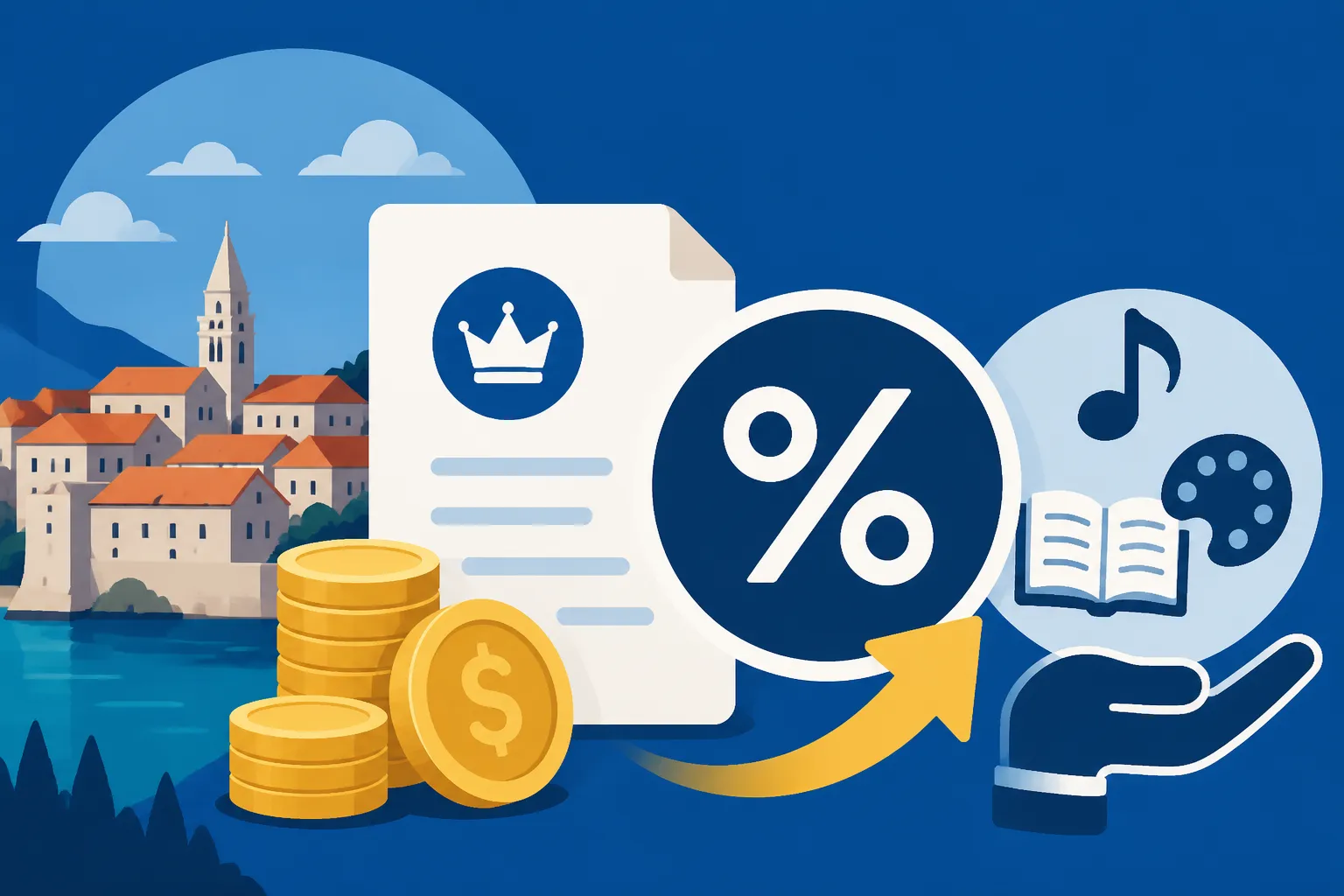
- Payments for the use of copyrights (e.g., books, music, art, software)
- Payments for the use of patents, designs, models, or trademarks
- Payments for the use of industrial, commercial, or scientific equipment
- Payments for information concerning industrial, commercial, or scientific experience (know-how)
It’s crucial to remember that this 10% is the default rate. If you're a Croatian resident, your royalty income will be taxed differently, usually as part of your regular income, potentially subject to social contributions depending on how it's earned. Understanding Income Tax in Croatia: The Full Expat Guide will give you a broader picture of how your total income is assessed.
Special Considerations for EU/EEA Payees
The European Union's principles of free movement and the elimination of barriers often lead to more favorable tax treatment within the bloc. For certain types of payments, including royalties, between associated companies within the EU/EEA, withholding tax can be reduced to 0%.
However, this isn't an automatic right for all royalty payments. It typically applies under specific conditions, often requiring that:
- The paying and receiving companies are associated (e.g., one holds a significant stake in the other).
- Both companies are residents of an EU or EEA Member State.
- The recipient is the "beneficial owner" of the royalties.
- Certain minimum holding periods are met.
If these conditions are not met, or if the recipient is an individual rather than an associated company, the standard 10% WHT rate for non-residents, or a rate specified by a Double Taxation Treaty, would apply. So, while the 0% rate is great news for eligible intra-EU corporate structures, it's not a blanket exemption for all EU-based royalty recipients. It really highlights the need to scrutinize your specific situation, possibly with professional advice from entities like Taxes for Expats.
Navigating Double Taxation Treaties (DTTs) for Royalty Income
This is where things get really interesting, and often, really beneficial for expats. The standard 10% WHT rate for non-residents can often be reduced or even eliminated entirely if the recipient is a tax resident of a country with which Croatia has an active Double Taxation Treaty (DTT). Trust me, understanding these treaties is your best friend when dealing with international income. If you're struggling to figure out if your country has a DTT with Croatia, seeking help for How Do I Get Help Filing My Croatian Tax Return in English? can be invaluable.
How DTTs Reduce or Eliminate WHT
Croatia has signed numerous Double Taxation Treaties with countries around the world. These treaties are international agreements designed to prevent the same income from being taxed twice – once in the country where the income originates (the source country, in this case, Croatia) and once in the country where the recipient is a tax resident. This is a common pain point for many foreigners, and thankfully, DTTs offer a solution. For a broader understanding of how these treaties function, check out How to Avoid Double Taxation as an Expat in Croatia.
When it comes to royalties, DTTs typically specify a maximum withholding tax rate that the source country (Croatia) can impose. This rate is almost always lower than Croatia's standard 10% WHT, and in many cases, it can be as low as 0% or 5%. The exact percentage varies significantly from treaty to treaty.
For example, a DTT might state:
- "Royalties arising in Croatia and paid to a resident of [Treaty Partner Country] may be taxed in that other country. However, such royalties may also be taxed in Croatia according to the laws of Croatia, but if the beneficial owner of the royalties is a resident of [Treaty Partner Country], the tax so charged shall not exceed X% of the gross amount of the royalties."
Here's a simplified table illustrating how DTTs can impact the WHT rate on royalties, though always confirm with the specific treaty relevant to your situation:
| Recipient's Residency | Standard Croatian WHT Rate (without DTT) | Example DTT Rate (Varies per country) | Notes |
|---|---|---|---|
| Non-EU/EEA Country | 10% | 0%, 5%, 7%, 10% | Depends entirely on the specific DTT. Many commonly reduce the 10% rate. |
| EU/EEA Country | 10% | 0%, 5%, 7%, 10% | Can be 0% for associated corporate entities under specific EU directives; otherwise, DTTs apply. |
| Croatia (Resident) | N/A (income tax applies) | N/A | Royalty income is subject to regular Croatian income tax rules, not withholding tax at source in the same way as non-residents. |
It's critical to note that for the reduced DTT rate to apply, the Croatian payer needs to have proof of the recipient's tax residency in the treaty partner country. Without this documentation, the payer is usually obligated to apply the higher standard Croatian WHT rate.
Proving Your Tax Residency to Claim DTT Benefits
This is the procedural hurdle that often trips people up. To benefit from a DTT and reduce your WHT, you, as the royalty recipient (or your company), must provide the Croatian payer with a valid Certificate of Tax Residency (Potvrda o poreznoj rezidentnosti) issued by the tax authorities in your country of residence.
This certificate officially states that you (or your company) are considered a tax resident in that specific country for a given tax period. Without it, the Croatian payer cannot legally apply the reduced DTT rate and must, by law, withhold the standard 10%.
The process usually involves these steps:
- Obtain the certificate: Contact your home country's tax authority to request a Certificate of Tax Residency. They often have specific forms or procedures for this.
- Submit to the Croatian payer: Provide the original or a certified copy of this certificate to the Croatian entity that is paying you the royalties. It's often required annually, or whenever your tax residency status changes.
- Ensure timely submission: It's best to provide this before the payment is made. If WHT is withheld at the standard rate because the certificate wasn't provided in time, it's possible to claim a refund from the Croatian Tax Administration, but this is a much more complex and time-consuming process.
For any kind of international payment, especially if you're working with a Croatian entity or being paid from abroad, understanding this mechanism is vital. It’s also important to consider efficient ways to manage your funds internationally; services like Wise can make a big difference when How Much Money Can I Transfer Without Declaring It in Croatia? becomes a question.
Practical Guide: Managing Your Royalty Income and Tax in Croatia
Dealing with royalty income and the associated taxes in a foreign country can feel like navigating a maze blindfolded. But with a bit of foresight and organization, you can make the process much smoother. This section will walk you through the practical steps, from reporting to payment, making sure you stay compliant with Croatian tax law. Remember, this isn't just about avoiding penalties; it's about optimizing your financial situation while living your expat dream.
Reporting and Compliance for Royalty Recipients
Whether you're the recipient of royalties (and therefore need to declare them) or the payer (and thus need to withhold tax), understanding the reporting requirements in Croatia is paramount.
-
For the Recipient (especially non-residents):
- Understand the WHT implications: If a Croatian entity is paying you, ensure they are aware of your tax residency and any applicable DTTs. Provide your Certificate of Tax Residency proactively. If they withhold tax, they should issue you a certificate of paid tax, which you'll need for claiming foreign tax credits in your country of residence.
- Income declaration in your home country: Even if Croatia withholds tax, you'll still typically need to declare this royalty income in your country of tax residence. Your DTT will determine how you get credit for the tax already paid in Croatia, preventing double taxation. This usually involves claiming a "foreign tax credit."
- If you are a Croatian tax resident: Royalty income you receive from foreign sources must be declared on your annual income tax return (Obrazac DOH) in Croatia. This falls under other income, and you'll be taxed at Croatian income tax rates. It's vital to keep detailed records of all payments and any foreign tax withheld, as Croatia might offer a credit for tax paid abroad based on a DTT. This is part of the broader process of Filing Your Annual Tax Return in Croatia: The Complete Walkthrough (2027).
- Professional advice: For complex royalty structures or significant income, seriously consider engaging a tax advisor specializing in international taxation or expat affairs. Firms like Taxes for Expats often have the expertise to navigate the nuances of DTTs and ensure optimal tax planning.
-
For the Payer (Croatian entity making royalty payments):
- Due diligence: Before making a royalty payment to a non-resident, the Croatian payer must ascertain the recipient's tax residency.
- Obtain documentation: Request a Certificate of Tax Residency from the non-resident recipient.
- Apply correct WHT rate: Based on the recipient's residency and applicable DTT, apply the correct withholding tax rate (0%, 5%, 7%, 10%, etc.). If no DTT applies or no certificate is provided, the standard 10% rate applies.
- Remit tax to Porezna Uprava: The withheld tax must be paid to the Croatian Tax Administration (Porezna Uprava) by the specific deadline, usually the last day of the month following the payment.
- Reporting: The payer must also report these payments and the withheld tax to the Porezna Uprava, often through forms like JOPPD.
- Issue certificate: Provide the non-resident recipient with a certificate proving the amount of WHT paid in Croatia. This is crucial for the recipient to claim a foreign tax credit in their own country.
Making Payments and Transferring Funds
Once you’ve navigated the intricacies of WHT, the actual process of making or receiving the payments needs to be managed efficiently. This isn't just about taxes; it's about minimizing fees and ensuring your money moves seamlessly across borders.
- Bank transfers: Traditional banks in Croatia, like Zagrebačka Banka or PBZ, can facilitate international transfers. However, they often come with higher fees and less favorable exchange rates compared to specialized services. If you're managing your finances in Croatia, you'll need an How to Set Up Online Banking and IBAN Transfers in Croatia to send or receive funds.
- Specialized money transfer services: This is where modern fintech solutions really shine. Services like Wise (formerly TransferWise) are incredibly popular among expats for international money transfers. They typically offer significantly lower fees and more competitive real exchange rates than traditional banks, which can save you a substantial amount, especially with regular royalty payments. When considering Can I Use Revolut or Wise Instead of a Croatian Bank?, it's important to differentiate between a full bank account and a transfer service, but for sending and receiving funds, they are often superior.
- Documentation for transfers: Always ensure that when you are transferring or receiving royalty payments, the transaction descriptions clearly state the nature of the payment (e.g., "royalty payment for software license"). This helps with transparency and can be useful if any tax authorities ever query the transaction.
- Record-keeping: Maintain meticulous records of all royalty agreements, payment invoices, bank statements, WHT certificates, and any tax advice received. This documentation is your lifeline if you ever face an audit or need to prove compliance.
By proactively managing these aspects, you can ensure that your royalty income is handled correctly from a tax perspective, and that your money moves efficiently to where it needs to be. The Croatian tax system, like many, demands attention to detail, but with the right information and perhaps a little professional help, it’s entirely manageable.
Disclaimer
The information provided in this guide is intended for general informational purposes only and does not constitute professional tax, legal, or financial advice. While we strive to provide accurate and up-to-date information, tax laws in Croatia and international tax treaties are complex and subject to change. Your individual circumstances may vary, and it is highly recommended to consult with a qualified tax professional or legal advisor specializing in Croatian and international taxation to get advice tailored to your specific situation. Reliance on any information provided in this guide is solely at your own risk.