What Are the Requirements for the Croatian Digital Nomad Permit?
Thinking about making the leap to Croatia as a digital nomad? It’s an exciting prospect, picturing yourself working from a café overlooking the Adriatic or a quiet village inland. But let’s be real, the Croatian bureaucracy can feel like a labyrinth, especially when you’re trying to understand precisely what’s needed for that elusive digital nomad permit. This guide is here to cut through the confusion and lay out, in plain language, all the official requirements you’ll need to meet to successfully apply for and secure your temporary stay as a digital nomad in Croatia.
Understanding the Fundamental Eligibility Criteria
Before you even start gathering documents, it's absolutely crucial to understand the foundational criteria for the Croatian digital nomad permit. This isn't just about having a laptop and a passport; the Croatian government has very specific definitions and requirements that applicants must fit into. Missing these key points can lead to immediate rejection, so let's get into the nitty-gritty.
Non-EU/EEA Citizenship is Key
First and foremost, the Croatian digital nomad permit is designed specifically for citizens of countries outside the European Union and European Economic Area (EU/EEA). If you're an EU/EEA citizen, you actually don't need this permit at all! You already have the right to free movement and residence in Croatia, albeit with your own registration requirements once you arrive and intend to stay longer than 90 days. But for those from the US, Canada, UK, Australia, or pretty much anywhere else in the world, this permit is your golden ticket to a legitimate, extended stay.
The whole point of this permit is to legally allow individuals from third countries to reside and work remotely in Croatia, enjoying the same freedoms as EU citizens in many respects, but with certain limitations. It's a clear distinction, and one that often trips up those who haven't fully grasped the nuances of EU membership and its implications for residency. So, before you dive deeper, confirm your passport is from a non-EU/EEA country.
Defining "Digital Nomad" for Croatian Purposes
This is where things get really specific and, frankly, where a lot of misunderstandings arise. In Croatia, to be considered a "digital nomad" for this permit, you must be performing work tasks remotely for an employer or your own company that is not registered in Croatia. You cannot, under any circumstances, be employed by a Croatian company, provide services to Croatian clients, or own a Croatian business while on this permit. This is a critical legal distinction designed to prevent misuse of the permit as a backdoor to the Croatian job market.
Let's imagine you're a freelance graphic designer working for clients in the US, or a software engineer employed by a company based in Germany (assuming you're a non-EU citizen in this scenario, otherwise you wouldn't need the permit). These scenarios fit the definition perfectly. However, if you started picking up local Croatian clients or offering your design services to a Croatian marketing agency, you'd be in violation of the permit terms. The goal is to bring foreign capital into the country, not to compete with the local workforce. It's a specific niche, but a valuable one for Croatia's economy.
Demonstrating Financial Self-Sufficiency
Croatia wants to be sure you can support yourself financially without becoming a burden on their social system. Therefore, a significant requirement is proving you have sufficient funds to live comfortably during your stay. The exact amount is tied to Croatia's average gross salary, and it's adjusted annually. As of my last check, for a single applicant, you're looking at needing to prove you have a stable income or savings equivalent to at least 2.5 times the average gross monthly salary in Croatia, which typically hovers around €2,300 – €2,500 per month. This translates to roughly €30,000 annually in available funds for a single person.
You’ll typically need to provide bank statements from the last three to six months, showing consistent income flow or a substantial lump sum in savings. The authorities at the Ministry of Interior (MUP) want to see a reliable financial history. If you're bringing family members, these amounts increase proportionally for each additional person. For instance, for a spouse, you'd add another 1.25 times the average gross salary, and for each child, an additional 0.5 times. This is where meticulous record-keeping of your finances becomes paramount, so make sure your bank statements are clear, translated if necessary, and readily available. Many expats find it useful to consult their bank well in advance to ensure they can provide the necessary documentation in the correct format.
The Paper Trail: Essential Documents for Your Application
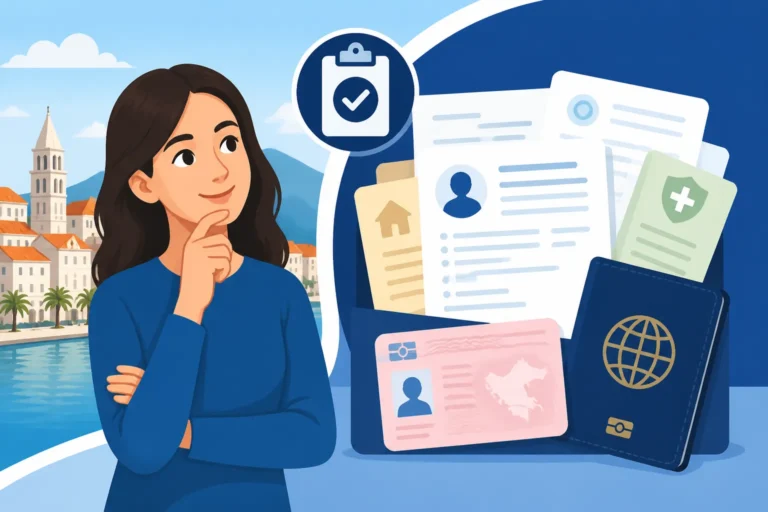
Navigating the MUP website and collecting all the right paperwork can feel like a scavenger hunt with ever-changing rules. Trust me, I’ve been there. Getting your documents in order is often the most time-consuming part, so let’s break down exactly what you’ll need to present.
Valid Passport, Travel Insurance, and Health Coverage
This might sound obvious, but your passport is your golden ticket, and it needs to be valid for at least three months beyond the intended period of your stay in Croatia. Don’t wait until the last minute to check its expiry date! Additionally, you'll need proof of travel insurance or health insurance that covers your entire stay in Croatia. This isn't just a suggestion; it's a non-negotiable requirement. While basic travel insurance might cover you for a short trip, for a digital nomad permit, the MUP expects comprehensive health insurance.
This is where understanding your options is key. You might initially use a standard travel insurance policy, but for long-term residency, you'll eventually need a more robust plan. Many expats opt for international private health insurance providers like Cigna Global, which offers comprehensive coverage specifically designed for those living abroad, giving you peace of mind that you're covered for more than just emergencies. For a truly long-term plan, you'll want something that meets all HZZO (Croatian Health Insurance Fund) requirements, though as a digital nomad, you won't be paying into the HZZO system directly unless you later switch permit types. Make sure your chosen policy clearly states the coverage period and benefits. You can find more specific details on "Health Insurance in Croatia: Mandatory, Supplementary and Private Options Explained" or "Understanding Private Health Insurance Plans in Croatia".
Proof of Accommodation in Croatia
The MUP needs to know where you'll be laying your head at night. You can't just say you'll figure it out when you get there. You'll need to provide evidence of accommodation for your entire intended stay, or at least for a significant portion of it. This could be a notarized rental agreement (pre-signed, often with a landlord who is willing to help), proof of property ownership if you've bought a place (lucky you!), or a statement from a host confirming they are providing you accommodation.
If you’re renting, make sure the rental contract is properly drawn up, includes all necessary details, and is ideally verified by a public notary in Croatia, or at the very least, registered with the tax administration (Porezna Uprava). This registration is actually a legal requirement for landlords, and a properly registered contract provides solid proof of your address. Remember, your future address in Croatia will be your prebivalište (permanent address) or boravište (temporary address), and you’ll need to officially register it with the MUP once you arrive, usually within a few days. For more on this, check out "Registering Your Residence in Croatia: The Complete MUP Guide".
Clean Criminal Record Verification
Croatia, like most countries, requires assurance that you're not bringing any criminal baggage with you. You'll need a criminal background check (often called a police clearance certificate) from your home country, and any other country where you’ve resided for more than six months in the last few years. This document typically needs to be issued within a certain timeframe (e.g., three or six months) before your application.
Here's the kicker: this certificate usually needs to be officially translated into Croatian by a sworn court interpreter (sudski tumač) and, in many cases, apostilled or legally certified. The apostille is an international certification that makes the document legally recognized in Croatia. The process of obtaining this can vary wildly depending on your home country, so start this well in advance. Some countries are faster than others, and dealing with remote governmental agencies from abroad can be a real test of patience.
Proof of Remote Work Status
As mentioned earlier, proving you're actually a digital nomad is critical. This means providing documentation that clearly states your employment status and where your employer (or clients) is located.
For Employed Individuals
If you're working for a foreign company, you'll need a letter from your employer confirming your position, that you can work remotely, your salary, and that the company is not registered in Croatia. An employment contract from your foreign employer is also typically required. Ensure this letter is on company letterhead and signed, and ideally, translated into Croatian by a certified translator.
For Self-Employed or Business Owners
If you're a freelancer or own your own company, you'll need to provide proof of your business registration in a foreign country (e.g., company registration documents, tax registration), contracts with foreign clients, and invoices proving your income comes from outside Croatia. Again, official translations will be your friend here. This helps the MUP clearly see that your income is generated solely from foreign sources.
Navigating the Application Process Itself
Once you've got all your ducks in a row with the documents, it's time to actually submit your application. This can be done in a few different ways, each with its own advantages and potential headaches.
Where to Submit Your Application
You have a few options for submitting your digital nomad permit application, and your choice might depend on where you currently are in the world.
- Croatian Embassy or Consulate Abroad: If you're applying from outside Croatia, this is the most common route. You'll typically schedule an appointment, submit your documents, and undergo an interview. The benefit here is that you get the permit before you arrive, providing a smoother entry.
- MUP (Ministry of Interior) within Croatia: If you're already in Croatia on a tourist visa or visa-free stay, you can apply directly at the local police station (policijska uprava or policijska postaja) responsible for your place of residence. However, be aware that you might need to leave the Schengen Area while your application is being processed if your current visa or visa-free stay is about to expire, only to re-enter once approved (or with a temporary stay confirmation). This is a common point of confusion and anxiety for applicants.
- e-Visits MUP Portal: Croatia has made efforts to modernize its immigration processes, and the e-Visits platform (part of the larger e-Građani system) is designed to allow online submission of applications. This can be a huge time-saver and is generally recommended if you prefer handling things digitally. You upload scanned copies of your documents, and if successful, you'll then need to visit the MUP in person for biometrics and final processing. This route is often the quickest for initial submission.
No matter which route you choose, remember that the initial processing time can vary significantly, sometimes taking several weeks or even a couple of months, so patience is key. Starting the process with a clear understanding of your chosen path, whether through a physical embassy or the digital portal, is crucial.
Application Forms and Associated Fees
You'll need to fill out the "Application for Temporary Stay" (Zahtjev za izdavanje odobrenja za privremeni boravak) form, which is typically available on the MUP website or at embassies/police stations. Fill it out accurately and completely, as any errors can cause delays. Along with your application, there are administrative fees (upravna pristojba) that need to be paid.
These fees typically cover the processing of your application and the issuance of your biometric residence card (boravišna iskaznica). The exact amounts can change, so it's always best to check the latest fees on the official MUP website or with the embassy/consulate. You'll usually receive payment slips (uplatnice) which you then pay at a Croatian bank, post office, or FINA office. Keep all receipts as proof of payment; they'll be needed for your file.
Biometrics and the Residence Card
If your application is approved, the final step involves providing your biometric data (fingerprints and a digital photograph) at the MUP office in Croatia. This is usually done shortly after approval. Once your biometrics are collected, your boravišna iskaznica (residence card) will be ordered. This physical card is your official proof of temporary residence in Croatia and will contain your photo, personal details, and OIB (Personal Identification Number).
The card production usually takes a week or two, and you’ll be notified when it’s ready for pick-up. This is your official ID for your stay in Croatia, so keep it safe! It will be indispensable for everything from opening a bank account to proving your identity. If you're moving your entire life, thinking about how you'll manage your belongings might cross your mind. Companies like Sirelo can assist with international moving services, taking some of the logistical stress off your plate as you prepare for your new life with your new residence card.
Post-Approval: What to Know About Your Stay
Getting the permit is a huge step, but it's not the end of the story. There are still a few crucial things to understand about maintaining your status and living legally in Croatia as a digital nomad.
Understanding Health Insurance Post-Approval
While you needed travel or health insurance for the application, it’s important to understand your health coverage during your actual stay. As a digital nomad in Croatia, you typically won’t be automatically enrolled in the public health insurance system (HZZO) because you’re not contributing to the Croatian social security fund through local employment. This means you must maintain private health insurance for the entire duration of your permit.
This is where a good international health insurance plan, such as those offered by Cigna Global, becomes not just a requirement but a real lifeline. These plans are designed for expats and can offer comprehensive coverage for medical emergencies, doctor visits, specialist care, and even prescription medications. It’s absolutely critical that you have continuous, valid health insurance throughout your stay. Falling ill or having an accident without proper coverage can lead to significant financial distress. Always ensure your policy is up to date and meets Croatia's requirements for foreign residents.
Tax Implications: A Major Benefit for Digital Nomads
One of the most attractive aspects of the Croatian digital nomad permit is the tax situation. Under current Croatian law, digital nomads holding this permit are generally exempt from paying Croatian income tax on the income they earn from their foreign-based work. This is a huge advantage, as it means you typically only pay tax in your home country (or country of tax residency) as per existing double taxation treaties or your local tax laws.
However, this doesn't mean you're entirely off the hook for all things financial in Croatia. You'll still need an OIB (Personal Identification Number), which you should have obtained as part of your permit application. This OIB is your unique Croatian ID for all official and financial matters. While you won't be paying income tax on your digital nomad earnings to Croatia, if you were to, for example, rent out a property you own in Croatia, or generate any income from Croatian sources, that income would be taxable under Croatian law. So, stick to your remote, foreign-sourced income, and you’ll generally be in good shape regarding taxes. You can learn more about this in "Understanding Income Tax in Croatia: The Full Expat Guide" or "How to Get an OIB (Personal Identification Number) in Croatia".
Permit Duration and Reapplication Rules
The Croatian digital nomad permit is issued for a maximum period of one year. It cannot be extended beyond this one-year limit while you are in Croatia on the same permit. This means that after your year is up, you must leave Croatia (and the Schengen Area).
Here's the catch: there's a "cooling-off" period. You generally cannot reapply for another digital nomad permit for six months after the expiry of your previous permit. So, if you're planning to make Croatia your long-term base, you'll need to consider other residency options after your first year, or plan to spend some time outside of Croatia. This rule is in place to prevent the permit from becoming a de facto permanent residence visa. Be mindful of these limitations as you plan your long-term stay in Europe.
Here’s a quick overview of the key requirements:
| Requirement Category | Specific Requirement | Documentation Examples | Key Considerations |
|---|---|---|---|
| Eligibility | Non-EU/EEA Citizen | Passport | Permit is exclusively for non-EU/EEA nationals. |
| Remote Work for Non-Croatian Entity | Employment contract, company registration (foreign), client contracts | Cannot work for Croatian companies or clients. Income must be foreign-sourced. | |
| Sufficient Funds | Bank statements (last 3-6 months) | Approx. €2,300-€2,500 monthly for single applicant (2.5x average gross salary); increases for dependents. Must show consistent income/savings. | |
| Documentation | Valid Passport | Passport | Valid for at least 3 months beyond intended stay. |
| Health Insurance | Insurance policy certificate | Must cover entire period of stay. Comprehensive international private health insurance (e.g., Cigna Global) is highly recommended. | |
| Proof of Accommodation | Notarized rental agreement, property ownership, host statement | Must cover entire intended stay. Registered rental contract is ideal. | |
| Criminal Background Check | Police clearance certificate | From home country and any country of residence >6 months in last 5 years. Must be apostilled/legalized and translated by a sworn interpreter. | |
| Proof of Remote Work Status | Employer letter, foreign business registration, client contracts | Clearly state remote nature, foreign employer/client, and salary/income. Translated by a sworn interpreter. | |
| Application Process | Application Form | Zahtjev za privremeni boravak | Fill accurately; available at MUP/embassy or e-Visits portal. |
| Administrative Fees | Payment slips/receipts | Check current fees with MUP/embassy. Paid at bank/post office/FINA. | |
| Biometrics (after approval) | Physical presence at MUP | Fingerprints and photo for boravišna iskaznica (residence card). | |
| Post-Approval | Maintain Health Insurance | Valid policy | Essential for the entire duration of stay; not covered by HZZO. |
| OIB (Personal Identification Number) | OIB document/card | Obtained during application process; essential for all official matters. | |
| No Croatian Income Tax on Foreign Earnings | (No documentation needed for this point) | A key benefit: generally exempt from Croatian income tax on foreign-sourced digital nomad income. | |
| Permit Duration and Reapplication | (No documentation needed for this point) | Maximum 1 year. Must leave Croatia and observe a 6-month "cooling-off" period before reapplying for the same permit. Consider alternatives like "How to Transfer from a Digital Nomad Permit to Another Residence Type" for longer stays. |
Getting a digital nomad permit in Croatia can be a fantastic experience, but it truly hinges on understanding and diligently meeting all these specific requirements. Don't underestimate the details, and give yourself plenty of time for preparation. Sretno! (Good luck!)
Disclaimer
The information provided in this article is intended for general guidance and informational purposes only, and does not constitute legal, financial, or immigration advice. While we strive to keep the information up-to-date and correct, rules and regulations in Croatia can change frequently. Always consult with official government sources (such as the Ministry of Interior – MUP), a qualified legal professional, or an immigration specialist for advice tailored to your specific situation. Reliance on any information in this article is solely at your own risk.