Can I Switch My Digital Nomad Permit to Permanent Residence in Croatia?
One of the most common questions I hear from fellow expats who've fallen in love with Croatia and initially arrived on a digital nomad permit is, "Can I actually stay here long-term, like, permanently, after my digital nomad visa expires?" It's a completely natural thought! You've settled in, built a life, made friends, and the idea of leaving when your temporary status runs out can be disheartening. This guide will walk you through the realities of the Croatian digital nomad permit and the pathways you'll need to navigate if your dream is to make Croatia your forever home.
Understanding the Digital Nomad Permit's Nature in Croatia
Let's be brutally honest from the get-go: the Croatian digital nomad permit, fantastic as it is, was never designed to be a direct stepping stone to permanent residency. Many of us arrive, enchanted by the Adriatic coast or the charm of Zagreb, thinking it’s an easy "in" for a longer stay. But the administrative reality, as many of us have experienced, often hits differently.
Temporary by Design: Why It's Not a Direct Path to Permanent Residence
The digital nomad permit is officially known as a "temporary stay for digital nomads" ( privremeni boravak digitalnih nomada). The key word here is "temporary." It allows you to reside in Croatia for up to a year, with the possibility of extending it for another year, but crucially, it does not allow you to count that time towards the five years usually required for permanent residence. This is a common point of confusion and frustration for many, and it's understandable to feel a bit blindsided by this distinction after you’ve already invested so much into settling in.
Think of it this way: the Croatian government created this permit to attract skilled remote workers and boost the economy by having people spend money here. It’s a wonderful initiative for those looking for a change of scenery or a temporary base, but it’s fundamentally different from a work permit or family reunification permit, which are tied to more enduring reasons for staying in the country. The intention behind the digital nomad permit is to facilitate a prolonged visit, not to start a clock towards full integration into the social security system as a permanent resident.
This distinction is crucial because it means that even if you spend two full years in Croatia on a digital nomad permit, those two years generally won't count towards the continuous five-year period required for stalni boravak, or permanent residence. It's like pressing a pause button on your long-term residency aspirations, which can be a bitter pill to swallow when you’ve put down roots.
Key Eligibility Criteria and Limitations
When you applied for your digital nomad permit, you likely remember demonstrating proof of your remote work, sufficient funds, and valid health insurance. These criteria highlight its temporary nature. You’re not meant to be employed by a Croatian company, nor are you contributing to the Croatian pension fund or unemployment insurance in the same way a regular employee would.
This lack of integration into the full social security system is one of the main reasons why the time spent on a digital nomad permit doesn't accumulate for permanent residency. You're essentially a long-term visitor with special permission to work remotely, rather than a fully integrated resident for the purpose of long-term settlement. It's a subtle but powerful difference that often catches expats off guard.
Furthermore, while you're enjoying your Croatian life, remember that the digital nomad permit typically doesn't automatically extend to family members in the same way other residence permits might. If you were hoping to bring a spouse or children, you would have had to apply for separate temporary residence permits for them, often under a different legal basis like family reunification, or their own digital nomad status. This again underscores the individual and temporary nature of the digital digital nomad arrangement.
The Road to Permanent Residence in Croatia: Standard Pathways
So, if your digital nomad time doesn't count, what does? This is where understanding the conventional routes to permanent residence becomes absolutely essential. It’s not impossible to stay long-term, but it requires a change of strategy and often, a fresh start on your residency clock.
General Requirements for Permanent Residence (Stalni Boravak)
The most common path to permanent residence in Croatia is through continuous temporary residence for five years. This "continuous" part is key – it means you can't have too many gaps or spend too much time outside Croatia during those five years. The clock generally starts ticking after you’ve obtained a qualifying temporary residence permit. For a deeper dive into this, you'll want to read up on the nuances of Permanent Residence in Croatia: The Complete Pathway (2027).
Beyond the five-year rule, there are other pathways. For instance, if you're married to a Croatian citizen, the rules for family reunification can significantly shorten the time needed. Certain other categories, like being a long-term resident of another EU country, might also offer different routes. However, for most digital nomads looking to switch, the default assumption should be the five-year continuous temporary residence.
The documentation for permanent residency is comprehensive. You'll need proof of funds, accommodation, clean criminal records, and importantly, proof of continuous temporary residence status for the required period. It's a significant administrative undertaking, and it’s why many expats often seek assistance from legal professionals specializing in immigration.
Qualifying Temporary Residence: What Counts and What Doesn't
Here's the crucial part: your digital nomad time generally does not count towards that five-year requirement for permanent residence. This is explicitly stated in Croatian law. The underlying philosophy is that the digital nomad permit is granted for a specific, temporary purpose, without the intent of full integration into the Croatian social security and economic system on a permanent basis.
What does count, then? Typically, any period of temporary residence obtained on the basis of:
- Employment with a Croatian company (a work and residence permit).
- Self-employment (such as an obrt or d.o.o. company registered in Croatia).
- Family reunification (e.g., as a spouse or child of a Croatian citizen or another resident with a qualifying permit).
- Study (though often only half the time spent as a student counts, so 10 years of study might lead to 5 years credited towards permanent residence).
It’s important to understand that if you switch from a digital nomad permit to, say, a work permit, your five-year countdown to permanent residence will essentially begin on the day your work permit is issued. All that time you happily spent as a digital nomad, exploring the islands and sipping coffee in Split or Zagreb, will unfortunately not be factored into your permanent residency application. This can be a frustrating reset, but it's the reality of the system.
Navigating the Switch: Transitioning from Digital Nomad to Another Status
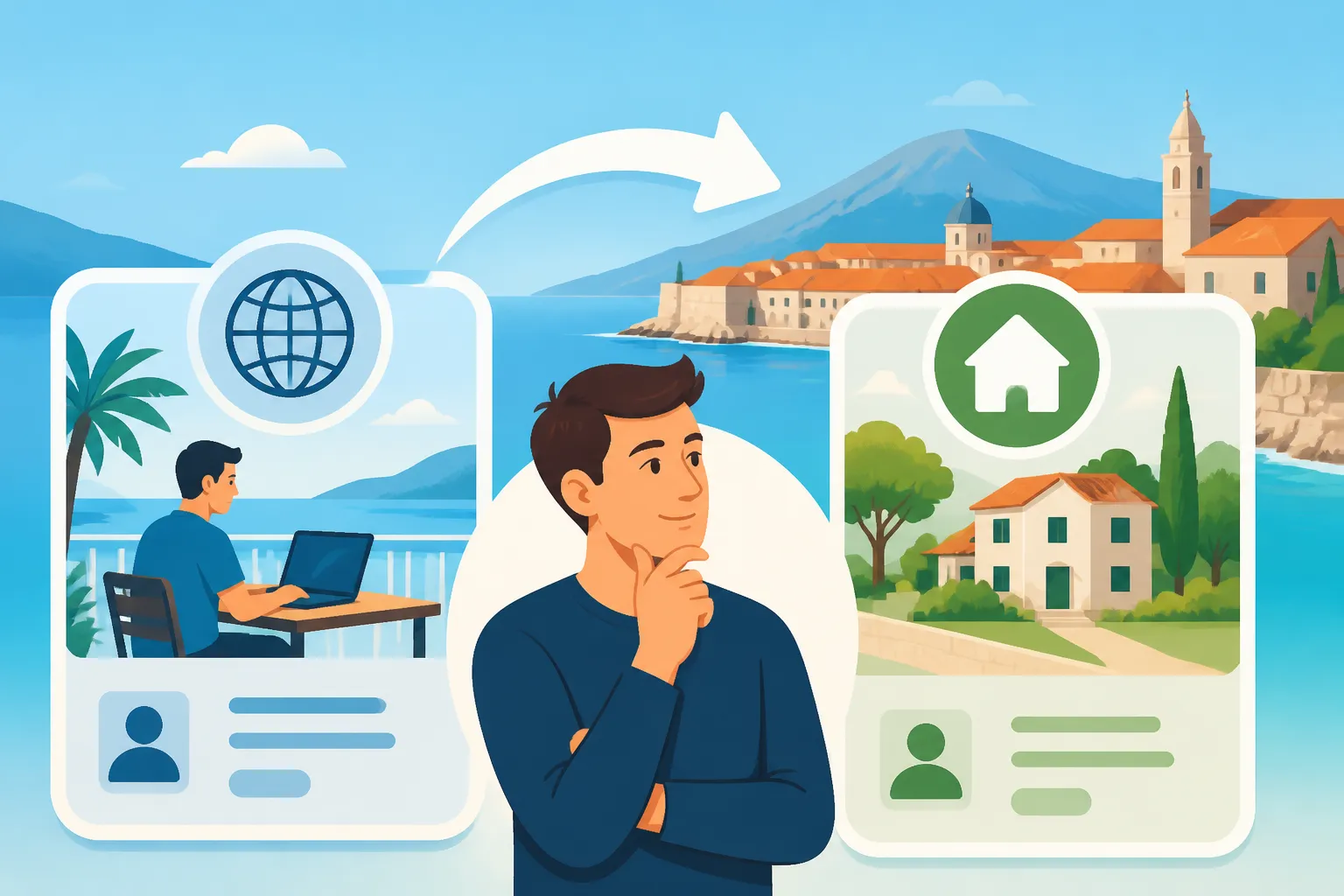
Since your digital nomad time doesn't count, your primary goal for permanent residence will be to transition to a different type of temporary residence permit that does qualify. This is not a simple "switch" in the sense of an upgrade; it's more like applying for a brand-new permit under different criteria.
Identifying a New Basis for Temporary Residence
The first step is to figure out which qualifying temporary residence permit makes the most sense for your personal and professional circumstances. Do you want to work for a Croatian company? Are you ready to start your own business here? Or perhaps you've met a Croatian partner and are considering family reunification?
Option 1: Employment with a Croatian Company. If you find a job with a Croatian employer, they will need to apply for a The Complete Guide to Croatian Work and Residence Permits (2027) for you. This often involves a labor market test to prove no suitable Croatian or EU candidates were available, although certain professions are exempt. This is a common and straightforward route if you secure a job.
Option 2: Self-Employment. Many digital nomads are entrepreneurs at heart. If you want to continue working for yourself, but on a long-term basis within Croatia, you could consider opening a Croatian company, like a paušalni obrt. This is a popular choice for freelancers and consultants, and it allows you to apply for a temporary residence permit based on self-employment. The process involves registering your business, getting an OIB (which you likely already have), and demonstrating sufficient funds and a viable business plan. Check out Self-Employment in Croatia: The Paušalni Obrt Guide for Foreigners for detailed steps.
Option 3: Family Reunification. If you've married a Croatian citizen or a foreign national who already holds a qualifying temporary or permanent residence permit, you can apply for temporary residence based on family reunification. This path can sometimes be faster and have different requirements, especially concerning the duration needed for permanent residency. Details can be found in Family Reunification in Croatia: A Complete Guide for Expats.
The Application Process for a New Temporary Residence Permit
Once you've identified your new basis, you’ll essentially be going through a new application process for temporary residence. This means gathering all the required documents again, which might include:
- Proof of purpose: Employment contract, business registration documents, marriage certificate, etc.
- Proof of funds: Bank statements demonstrating you can support yourself.
- Proof of accommodation: A rental contract or property ownership.
- Health insurance: You'll need valid health insurance. While on a digital nomad permit, you likely had private international insurance like Cigna Global. For a new temporary residence, you'll generally need to be covered by the Croatian public health insurance fund (HZZO) or demonstrate equivalent private coverage that meets Croatian standards. It's vital to confirm the specific requirements with MUP. Find more details on What Health Insurance Do I Need for a Croatian Residence Permit?.
- Clean criminal record check: Both from your home country and potentially from Croatia.
- Valid passport and copies.
- OIB: Your Croatian personal identification number, which you almost certainly obtained when you first arrived. If not, you'll need to How to Get an OIB (Personal Identification Number) in Croatia.
The application is typically submitted at the local police station (MUP) responsible for foreigners, usually in the city where you intend to reside. It's often best to How to Book an Appointment at the MUP for Immigration Matters in advance, as queues can be long. Sometimes, especially if your initial digital nomad permit is about to expire, MUP might advise you to leave the Schengen Area and apply for a new long-stay (Type D) visa from a Croatian embassy or consulate in your home country or country of habitual residence. This is a common and often frustrating requirement, so be prepared for that possibility.
The Five-Year Countdown: Starting Anew
After successfully transitioning to a qualifying temporary residence permit, you'll finally be on the official path to stalni boravak. But remember that important caveat: the clock generally resets.
Resetting the Clock: When Your Time Starts Counting
The moment you receive your new, qualifying temporary residence permit – be it for work, self-employment, or family reunification – that's when your five-year countdown to permanent residence truly begins. Any previous time spent in Croatia on a digital nomad permit will not be included. It's a clean slate.
This can be a tough pill to swallow for many, especially if you've been in Croatia for a year or two as a digital nomad. You might feel like you're losing valuable time. However, viewing it as starting a new chapter, fully integrated into the Croatian system, can help manage expectations. You are now building a foundation that directly leads to long-term stability and permanent residency. This journey requires patience, as administrative processes in Croatia, like in many countries, are rarely quick.
For example, if you moved to Zagreb on a digital nomad permit in January 2024, renewed it for a second year in January 2025, and then successfully transitioned to a work permit in January 2026, your five-year countdown for permanent residence would begin in January 2026, making you eligible to apply in January 2031. Your digital nomad years of 2024 and 2025 would not be counted.
Preparing for the Long Haul: Essential Considerations
Making Croatia your permanent home is a long-term commitment. Beyond the legal aspects of getting your permits in order, there are many practical considerations.
Financial Stability: Ensure your income source for your new temporary permit (be it employment or self-employment) is stable and sufficient. This will be consistently reviewed during any renewals of your temporary permit. You’ll need to demonstrate not just income, but also your ability to pay taxes and contributions in Croatia.
Language and Integration: While not always a strict legal requirement for temporary permits, learning Croatian will significantly ease your integration and quality of life. For permanent residence, there might be a basic language and cultural knowledge test, so starting early is a good idea. Plus, it just makes living here so much richer.
Housing and Logistics: If you're planning to stay for the long haul, you might reconsider your housing situation. What was suitable for a temporary stay might not work for five or more years. Maybe it's time to think about buying property, or finding a more stable rental. When moving for the long term, consider using services like Sirelo to help with logistics and finding reliable movers who understand the nuances of international relocation. They can definitely help smooth out the stresses of a big move or even a local one that feels like a huge undertaking.
Practical Steps and Advice for Your Transition
Making this significant shift requires careful planning and execution. Don’t try to wing it; that’s a recipe for headaches and potentially costly mistakes.
Consult with Experts
The rules and interpretations of Croatian immigration law can sometimes be complex and subject to change. What was true last year might have slight modifications this year. Your best bet for accurate, up-to-date, and personalized advice is to consult:
- Immigration Lawyers: A reputable Croatian immigration lawyer specializing in foreign residency permits can assess your specific situation, advise on the best pathway, and help you prepare and submit your applications. They can also represent you at MUP if needed.
- MUP Officials: While sometimes challenging due to language barriers or busy offices, directly asking MUP (Ministry of Interior) officials is crucial. Always aim to get information in writing or note down the name of the official you spoke with, as different offices or even different employees can sometimes give slightly varying advice. Remember, what’s written in the law is paramount, but interpretation can vary.
Never rely solely on anecdotal advice from online forums, no matter how well-meaning. While expat communities are invaluable for support, legal advice should always come from qualified professionals or official sources.
Document Preparation Checklist
Regardless of which qualifying temporary residence permit you pursue, thorough documentation is key. This isn't just about having the papers; it's about having them correctly translated (by a certified court interpreter in Croatia if not in Croatian or English), apostilled if required, and presented in the correct order. Here’s a generalized table of documents you might need for a new temporary residence permit application, which will then start your countdown to permanent residence:
| Document Category | Specific Documents | Notes |
|---|---|---|
| Personal Identification | Valid passport | Ensure it has sufficient validity (e.g., at least 3 months beyond your intended stay). |
| Passport-sized photos | Recent, biometric-standard photos. | |
| Proof of Purpose | Employment contract (if applicable) | For work permits, often needs MUP approval. |
| Business registration documents (if self-employed) | For obrt or d.o.o., proof of registration with relevant Croatian authorities. | |
| Marriage/Birth Certificate (if family reunification) | Officially translated and apostilled/legalized. | |
| Financial Means | Bank statements | Demonstrating sufficient funds for living expenses. Amounts vary by permit type. |
| Proof of income/salary | Employment contract, invoices, or tax returns. | |
| Accommodation | Rental agreement / Property ownership title | Registered with the Tax Administration. |
| Proof of communal charges payment | Utility bills or pričuva (building reserve fund) payments. | |
| Health Insurance | Proof of HZZO registration or equivalent private health insurance | Must meet Croatian standards. Consider options like Cigna Global for comprehensive international coverage that can be adapted. |
| Background Check | Criminal record certificate from home country and/or Croatia | Officially translated and apostilled/legalized. Must be recent. |
| Administrative | Application form (Obrazac 1a) | Filled out in Croatian. |
| OIB (Personal Identification Number) | Essential for all administrative tasks. | |
| Administrative fees / Upravna Pristojba | Payment slips (biljezi) for the application. | |
| Proof of payment of application fees | Often paid at MUP or a local post office. |
This process of moving from a digital nomad lifestyle to true permanent integration can feel like starting all over again in many ways. It requires a resilient spirit, a good dose of patience, and a willingness to navigate the Croatian bureaucracy. But for those of us who’ve chosen to make Croatia our home, the reward of building a life in this beautiful country is absolutely worth the effort.
Disclaimer
Please note that I am a lifestyle blogger and expat, not a legal professional. The information provided in this article is based on my personal experience, research, and understanding of Croatian laws and regulations, which are subject to change. While I strive for accuracy, this content should be used for informational purposes only and does not constitute legal advice. Always consult with a qualified Croatian immigration lawyer or the official MUP (Ministry of Interior) for the most current and personalized guidance regarding your specific residency situation.