Can I Sponsor My Same-Sex Partner for Residence in Croatia?
Navigating the labyrinthine world of Croatian immigration can feel like a full-time job at the best of times, but for same-sex couples, the process of securing residence for a partner often comes with an added layer of uncertainty and, frankly, frustration. Many wonder if their relationship status is even recognized, or if they'll face additional hurdles simply because they don't fit into a traditional mold. This comprehensive guide aims to shed light on exactly how you can sponsor your same-sex partner for residence in Croatia, breaking down the legal framework and practical steps involved.
Understanding Croatian Law on Same-Sex Partnerships and Residency
Croatia has made significant strides in recognizing same-sex relationships, offering a legal pathway for couples that many expats might not even be aware of. It’s not always straightforward, but the framework is there to support your residence application.
Life Partnership (Životno Partnerstvo) vs. Marriage
First things first, let's talk about the legal landscape. In Croatia, same-sex couples cannot legally marry, but they can enter into a "životno partnerstvo," which translates to "life partnership." This legal status was introduced by the Life Partnership Act (Zakon o životnom partnerstvu osoba istog spola) in 2014, and it grants same-sex partners almost all the same rights and responsibilities as marriage for heterosexual couples. This is a crucial distinction and one that directly impacts immigration.
For all intents and purposes, from property rights and inheritance to healthcare and, critically for us, immigration and family reunification, a registered life partnership is treated on par with marriage. This means that if you are in a registered life partnership, or intend to register one in Croatia, your non-EU/EEA partner is generally afforded the same sponsorship rights as a spouse in a heterosexual marriage. This is a huge relief for many and a testament to Croatia’s progressive stance in this area compared to some other EU nations. It's not a common-law partnership or a civil union in the sense that it carries fewer rights; it's a robust legal framework. You'll find that Understanding Life Partnership (Životno Partnerstvo) for Immigration is key to grasping the full scope of your rights.
The process of registering a life partnership is handled at the local Matica (register office), similar to how marriages are registered. You’ll need valid identification, proof of no prior registered partnerships, and potentially a few other documents, depending on your individual circumstances. Once registered, you receive a certificate which becomes one of the most vital documents for your partner's residence application.
Initial Hurdles and Common Misconceptions for Expats
Even with a progressive legal framework, the reality on the ground can sometimes be a bit different. One of the biggest hurdles expats often face is simply navigating the Croatian bureaucracy, which can be notoriously slow and opaque. Many local officials at police stations (MUP) or even embassies abroad might not be intimately familiar with the nuances of the Life Partnership Act, especially when it comes to international applicants. You might encounter blank stares or even incorrect information, which is, understandably, incredibly frustrating.
It's easy to get discouraged when you're met with resistance or confusion, but it's important to remember that the law is on your side. The issue often lies in a lack of training or experience among individual administrators, rather than malicious intent. This is where patience, persistence, and being well-prepared with all your documentation become absolutely paramount. You may need to politely educate officials or ask to speak with a supervisor if you feel you're not getting accurate information. Don't let initial roadblocks deter you; many have successfully navigated this path before you.
Another common misconception is that simply being in a long-term, committed same-sex relationship is enough. Unfortunately, like with heterosexual couples, Croatian law requires a formal, legal recognition of your partnership to unlock the spousal sponsorship route for non-EU/EEA citizens. Therefore, establishing a životno partnerstvo is usually the critical first step before any residence application can be filed. For EU/EEA citizens, there might be slightly more flexibility in proving a long-term relationship, but for non-EU/EEA, formal registration is generally expected.
The Process for Sponsoring Your Same-Sex Partner for Residence
Once you understand the legal basis, the actual application process for your partner's residence permit starts to look a lot like any other family reunification application, albeit with the životno partnerstvo certificate as your cornerstone.
Applying for Temporary Residence Based on Life Partnership
The primary route for your non-EU/EEA same-sex partner to join you in Croatia is by applying for a temporary residence permit based on family reunification, specifically citing your registered life partnership. This is a type of The Expat Guide to Temporary Residence (Privremeni Boravak) in Croatia. The application can typically be submitted either at a Croatian embassy or consulate in your partner's home country (or a country where they hold legal residence) or, in some cases, directly at the local MUP (Ministry of Interior) office in Croatia, if your partner is already legally present in the country on another basis (e.g., a tourist visa, though this is riskier and not always advised).
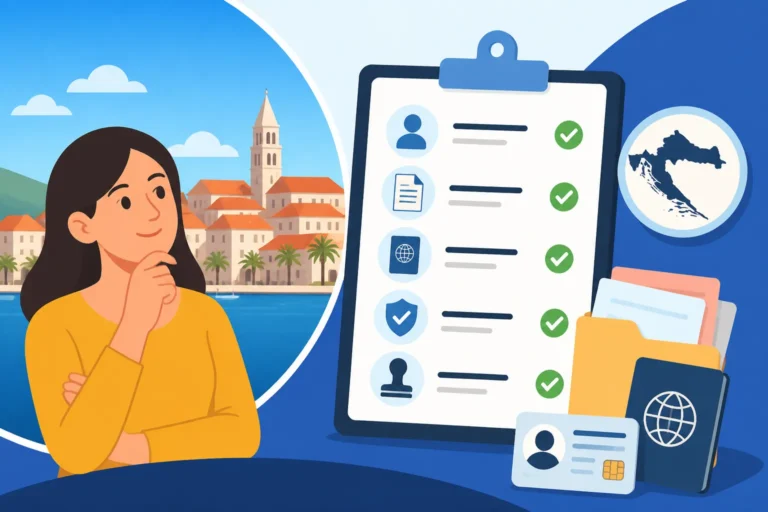
The list of required documents can feel overwhelming, but it's designed to prove both your identity and the authenticity of your relationship, as well as your ability to support your partner. Key documents will include:
- Proof of your registered life partnership: This is your životno partnerstvo certificate.
- Proof of identity: Valid passports for both partners.
- Proof of accommodation: A rental agreement, property ownership certificate, or a statement from the person providing accommodation in Croatia.
- Proof of sufficient funds: This shows you can financially support your partner without them becoming a burden on the Croatian social system. This could be bank statements, salary slips, or proof of other income. What Is the Minimum Income for Family Reunification in Croatia? is a good resource to review.
- Health insurance: Mandatory for all residence permit applicants.
- Criminal background check: Usually required from your partner’s country of origin.
- OIB (Personal Identification Number): Both partners will need an OIB. If your partner doesn’t have one yet, it will often be assigned as part of their residence application. Understanding How to Apply for an OIB (Personal Identification Number) in Croatia is a good preliminary step for many expat tasks.
- Application forms: Duly completed and signed.
Once submitted, the MUP will review your application. This can take several weeks or even months, depending on the MUP office's workload and whether they request additional information. Be prepared for potential interviews, either together or separately, to verify the relationship.
Essential Documentation and Evidentiary Requirements
Let's dive deeper into what these documents entail, because simply having a piece of paper often isn't enough; it's about what that paper proves. When it comes to financial stability, for example, a single bank statement showing a lump sum might raise more questions than it answers. The MUP wants to see consistent income that demonstrates your ability to cover living expenses for two people in Croatia. This usually means a steady job contract, proof of regular salary deposits, or consistent income from a self-employed business. If you're a paušalni obrt owner, your yearly income statements will be crucial.
For accommodation, make sure your rental agreement is legally registered with the tax administration (Porezna Uprava). If you own property, your ownership certificate (vlasnički list) is needed. It’s not just about having a roof over your head; it's about proving legitimate, long-term housing.
Health insurance is non-negotiable. Your partner will need valid travel health insurance for the application period and proof of enrollment in the Croatian public health insurance system (HZZO) or equivalent private insurance once residence is granted. Many expats opt for international private health insurance solutions like Cigna Global for comprehensive coverage and peace of mind, especially during the initial transition period or if they prefer a broader network of doctors. Once your partner has temporary residence, they will likely need to register with HZZO if you are working or residing in Croatia on a basis that allows for HZZO enrollment. For more on this, check out What Health Insurance Do I Need for a Croatian Residence Permit?.
Crucially, any documents not originally issued in Croatian or English must be officially translated by a sworn court interpreter in Croatia. This often means sending documents from your home country to Croatia for translation, or getting them translated at a Croatian embassy abroad. Apostille stamps or legalization may also be required, depending on the issuing country and whether it's part of the Hague Apostille Convention. How to Prepare Documents for a Croatian Residence Application offers a more granular look at this.
Here's a simplified table of key documents:
| Document Type | Purpose | Specifics/Tips |
|---|---|---|
| Life Partnership Cert. | Core proof of relationship | Original or certified copy of your životno partnerstvo registration. Essential for family reunification applications. |
| Valid Passports | Identity and nationality proof | Copies of all relevant pages, including stamps and visas. Must be valid for at least 3 months beyond intended stay. |
| Proof of Accommodation | Demonstrates stable housing | Registered rental contract, property deed (vlasnički list), or notarized statement from host. |
| Proof of Funds | Shows financial self-sufficiency | Bank statements (past 3-6 months), salary slips, employment contract, pension statements. Must meet minimum income thresholds for family reunification. |
| Health Insurance | Essential medical coverage | Travel insurance for application phase, then proof of HZZO registration or private health insurance like Cigna Global once residence is granted. |
| Criminal Background | Security clearance | Issued by competent authority in home country/country of last residence, translated and apostilled/legalized. Must not be older than 6 months. |
| OIB | Personal Identification Number | Required for both partners. If one partner lacks it, it's often obtained during the residence application. |
| Application Forms | Formal request for residence | Carefully fill out all relevant MUP forms (e.g., obrazac 1a for non-EU/EEA). |
| Photos | Passport-style photographs | Typically 35x45mm, clear background, recent. |
| Admin Fees | Application processing costs | Payment receipts for administrative fees (upravne pristojbe) for the application and the residence card itself. |
Navigating Challenges and Important Considerations
Even with all your documents in order, the MUP’s process isn’t always a straight line. Being prepared for potential challenges can save you a lot of stress.
Proving the Authenticity of Your Relationship
This is where many couples, same-sex or heterosexual, can feel a bit exposed. Even with a legally recognized životno partnerstvo, the MUP reserves the right to scrutinize the authenticity of your relationship. This is standard procedure to prevent fraudulent applications. They want to ensure your partnership is genuine and not solely for immigration purposes. While it can feel intrusive, it’s a necessary part of the process.
You'll need to provide compelling evidence that you live together, share your lives, and have a long-term commitment. This can include:
- Joint bank accounts: Statements showing shared finances.
- Shared utility bills: Proof that you both reside at the same address (electricity, internet, water bills in both names).
- Correspondence addressed to both partners: Letters, packages, etc.
- Photos: A collection of photos together over time, showing your life as a couple (travel, holidays, everyday life, with friends/family).
- Travel history: Evidence of joint trips, plane tickets, hotel bookings.
- Letters from friends and family: Testimonials confirming your relationship.
- Lease agreements or property deeds in both names.
The more evidence you can provide, the stronger your case will be. The MUP is looking for a comprehensive picture of a shared life. It's a deeply personal process, and it's okay to feel uncomfortable sharing so many intimate details, but it's part of securing your future together in Croatia.
Long-Term Residence and Citizenship Pathways
Once your partner successfully obtains their initial temporary residence permit based on your life partnership, this opens the door to longer-term immigration goals. Temporary residence permits are typically granted for one year and must be renewed annually. Each renewal requires similar documentation, confirming the continuation of your life partnership and meeting all other conditions.
After five continuous years of temporary residence in Croatia, your partner will generally become eligible to apply for Permanent Residence in Croatia: The Complete Pathway (2027). This is a significant milestone, as permanent residence offers much greater stability and fewer renewal requirements. The five-year period must be continuous, with strict limits on absences from Croatia.
Beyond permanent residence, the pathway to Croatian Citizenship: Routes to Naturalisation and Descent (2027) can also become available. For spouses/partners of Croatian citizens (or those with permanent residence), the naturalization period is often reduced. Typically, several years of permanent residence, combined with demonstrated integration into Croatian society (including basic Croatian language proficiency and cultural knowledge), are required for citizenship by naturalization. Your registered životno partnerstvo will be a key factor in these applications, demonstrating your commitment to living permanently in Croatia as a family unit.
When considering such long-term moves, remember that relocating your entire life, including all your household belongings, requires careful planning. Services like Sirelo can be invaluable in connecting you with reliable international movers who understand the complexities of moving to Croatia, ensuring your possessions arrive safely as you settle into your new home together.
Practical Advice and Support for Same-Sex Expat Couples
Navigating the MUP and Croatian bureaucracy can be overwhelming, but you don’t have to do it alone. There are resources and strategies to help smooth the path.
Seeking Legal and Local Expert Assistance
Given the complexities and potential for misinterpretation of the Life Partnership Act at various administrative levels, engaging a Croatian immigration lawyer or a legal expert specializing in expat affairs is highly recommended. While it’s an added expense, their expertise can be invaluable. A good lawyer will know the latest regulations, understand how to present your case effectively to the MUP, and can intervene on your behalf if you encounter difficulties. They can help prepare your documents, ensure everything is correctly translated and apostilled, and guide you through potential interviews.
This specialized help can circumvent common pitfalls, such as submitting incomplete documentation or misunderstanding specific requirements. They can also represent you, attend MUP appointments with you, and generally act as an advocate in a system that can be quite daunting for non-Croatian speakers. Remember, laws and interpretations can shift, so having someone who lives and breathes this stuff is a huge advantage.
Building a Support Network and Staying Informed
Beyond legal advice, building a robust support network is crucial for emotional well-being and practical tips. Seek out online expat groups in Croatia, particularly those with LGBTQ+ members or those focused on family reunification. These communities can offer a wealth of informal advice, shared experiences, and up-to-date insights into the MUP's current practices. Hearing from others who have successfully navigated similar processes can provide much-needed reassurance and specific local tips that you won't find on official websites.
Stay vigilant and regularly check the official MUP website for any updates to immigration laws or procedures. Croatian administrative processes are dynamic, and requirements can change without much prior notice. If you're an EU citizen, remember that your partner might follow a slightly different, though still often bureaucratic, path to residence based on EU free movement rights. For instance, How to Apply for Family Reunification in Croatia? offers broader insights.
Finally, prepare for your MUP appointments meticulously. Understanding How Do I Book a MUP Appointment for My Residence Application? and arriving with all original documents and their copies will make a significant difference in the efficiency of your visit. After approval, you'll also need to get your biometric residence card, a process explained in How Do I Get a Biometric Residence Card (Boravišna Iskaznica) in Croatia?. It’s a journey, but with the right preparation and support, you and your partner can build a beautiful life together in Croatia.
Disclaimer
The information provided in this guide is for general informational purposes only and does not constitute legal or immigration advice. While every effort has been made to ensure accuracy, laws and procedures can change. It is highly recommended to consult with a qualified Croatian immigration lawyer or the official MUP (Ministry of Interior) for the most current and personalized advice regarding your specific situation.