How Do I Declare Self-Employment Income in Croatia?
Navigating the world of self-employment income as an expat in Croatia can feel like deciphering ancient hieroglyphs, especially when the tax system is already complex and official information is often only in Croatian. Many of us arrive with big dreams of working for ourselves, only to be met with a bureaucratic maze. This guide aims to cut through the confusion and provide a clear, empathetic roadmap for declaring your self-employment income here in Croatia.
Understanding Self-Employment Structures in Croatia for Expats
Croatia offers a few different ways to operate as a self-employed individual or small business owner, and understanding these is the first crucial step in knowing how to declare your income. The choice you make significantly impacts your tax obligations and administrative burden.
The Ubiquitous Paušalni Obrt (Flat-Rate Trade)
If you've spent any time researching self-employment in Croatia, you've undoubtedly stumbled upon the paušalni obrt. This structure is hands down the most popular choice for freelancers, digital nomads, and small business owners, especially those providing services, and for good reason: it simplifies the tax process dramatically.
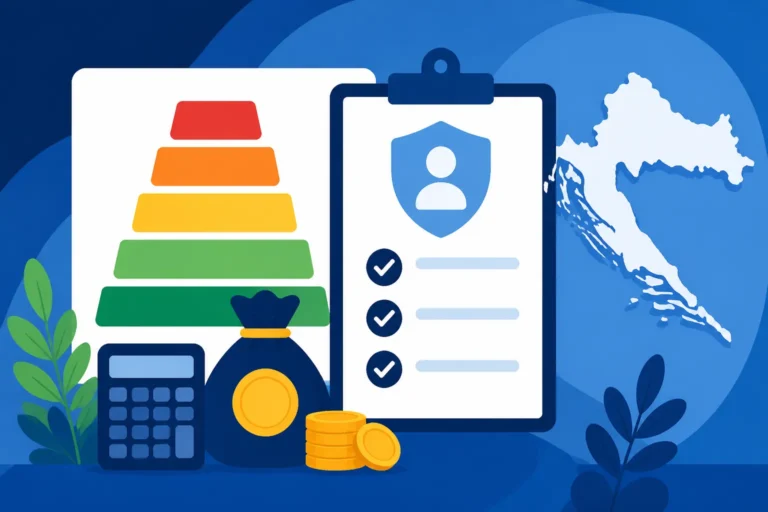
A paušalni obrt operates under a flat-rate taxation system, meaning your income tax isn't calculated as a percentage of your actual profit. Instead, it's based on predefined income brackets. For example, if your annual income falls within a certain bracket (let's say up to €30,000 for illustrative purposes, though these figures can change), you pay a fixed, relatively low amount of income tax, regardless of whether you earned €1 or €29,999 within that bracket. This predictability is a huge relief for many expats who are used to more complex income tax calculations. The beauty of this system is that it bypasses the need for extensive bookkeeping and detailed expense tracking for income tax purposes, making it far less intimidating than traditional accounting. For those of us just starting out or working remotely for foreign clients, it’s often the most straightforward and least costly option, allowing us to focus on our actual work rather than drowning in paperwork. If you're looking to set one up, our guide on How to Register a Paušalni Obrt (Flat-Rate Trade) in Croatia can walk you through the specifics.
The More Complex Obrt and d.o.o. (Limited Liability Company)
While the paušalni obrt is excellent for its simplicity, it's not the only game in town. You might hear about other structures like a regular obrt (craft/trade) or a d.o.o. (društvo s ograničenom odgovornošću), which is Croatia's equivalent of a limited liability company.
A regular obrt is similar to the paušalni obrt in that you operate as a sole trader, but your income tax is calculated on your actual profit (total income minus total expenses). This means you need much more rigorous bookkeeping, tracking every single receipt and invoice. While it offers more flexibility for deducting business expenses and has no income ceiling, it comes with a significantly higher administrative burden and often requires hiring an accountant from day one. Then there's the d.o.o., a full-blown company structure. This is generally overkill for a single freelancer or digital nomad unless you plan to scale rapidly, hire employees, or attract significant investment. Forming a d.o.o. involves more capital, complex legal registration, and a substantial monthly accounting cost. It also brings corporate profit tax and dividend taxation into play, making your tax life far more intricate. Most expats, especially in their initial years, find these options unnecessarily complex and expensive compared to the paušalni obrt. It’s wise to consider a d.o.o. only when your paušalni obrt income consistently exceeds its highest bracket or if you have specific business needs that require a separate legal entity.
The Step-by-Step Process for Declaring Your Paušalni Obrt Income
Alright, let’s get into the nitty-gritty of actually declaring your income. While the paušalni obrt simplifies things, there are still specific forms and deadlines you absolutely need to nail down. Misunderstandings here can lead to headaches, fines, and a lot of lost sleep.
Initial Registration and Getting Your OIB
Before you can even think about declaring income, you need to be properly registered. The foundational piece of this puzzle for any foreigner in Croatia is your OIB (Osobni identifikacijski broj), your personal identification number. Without it, you can't open a bank account, register a business, or do much of anything official. Our guide on How to Get an OIB (Personal Identification Number) in Croatia can help you secure this vital number.
Once you have your OIB and have sorted out your residence permit with the MUP, the next big step is registering your paušalni obrt with the relevant authorities. This involves going to the Ured državne uprave (State Administration Office) or a similar local body to register the trade itself, and then, crucially, registering as a taxpayer with the Porezna Uprava (Tax Administration). The key document here is the Form RPO (Prijava u Registar Poreznih Obveznika), which translates to "Application for Registration in the Register of Taxpayers." This form tells the tax authority that you exist, that you're operating a paušalni obrt, and what your estimated income bracket will be for the year. Filling it out correctly ensures you're placed into the appropriate tax category from the start. This initial registration is your formal entry into the Croatian tax system as a self-employed individual, so take your time and, if necessary, get some professional help.
Understanding Your Quarterly Tax Obligations
The core of paušalni obrt taxation lies in its quarterly payment structure. Unlike traditional employment where taxes are withheld from your salary, you are responsible for calculating and paying your own contributions every three months. This isn't just income tax; it also includes your mandatory social contributions for health and pension. Understanding these is crucial, and our article on Understanding Social Security Contributions (Doprinosi) in Croatia provides more context.
The amount you pay each quarter is a fixed sum, determined by the income bracket you fall into. These brackets are published annually by the government and cover specific ranges of expected annual income. For instance, if your paušalni obrt is registered in the lowest income bracket, you’ll pay a relatively small, fixed amount each quarter, regardless of whether you invoiced a lot or a little within that three-month period. As your income grows, you might move into a higher bracket, and your quarterly payments will increase accordingly. This system means you don't need to perform complex calculations based on your exact monthly earnings; you simply pay the predetermined sum for your bracket. The payments are due by the last day of each quarter for the previous quarter – so by March 31st for Q1 (January-March), June 30th for Q2, September 30th for Q3, and December 31st for Q4. Missed deadlines can lead to penalties, so it's vital to mark these dates on your calendar! You can get a deeper dive into the actual costs in our guide How Much Tax Does a Paušalni Obrt Pay in Croatia in 2026?.
The Annual PO-SD Form: Your Year-End Declaration
Even though the paušalni obrt is a flat-rate system, you still have an annual declaration obligation. This comes in the form of the PO-SD form, which summarizes your gross income for the entire previous calendar year. This form is absolutely critical, as it confirms your actual income for the year and helps the tax authorities verify that you remained within your declared income bracket.
The PO-SD form needs to be submitted to the Porezna Uprava by January 15th of the current year for the previous tax year. For example, income earned in 2023 must be declared by January 15th, 2024. On this form, you'll simply list your total gross income received for the year, alongside a few other details about your obrt. It's not a complex form, but accuracy is key. You're essentially stating, "This is how much I earned, and yes, it falls within the bracket I declared." If your income went over the limit for your initial bracket but still within the paušalni limits, you should have adjusted your quarterly payments during the year, but the PO-SD is where you formally declare the total. Submitting it can be done in person at your local Porezna Uprava office, but increasingly, expats are opting for the digital route via the ePorezna portal. You can find more detailed information on annual filings in our comprehensive article on How to File Your Annual Income Tax Return in Croatia.
Navigating Payments and Administrative Tools
Once you understand what you need to pay and declare, the next hurdle is figuring out how to actually do it. Croatia's administrative systems have been modernizing, but sometimes the "how-to" can still be a bit of a mystery, especially for newcomers.
Making Your Payments: Bank Transfers and Reference Numbers
Paying your quarterly contributions is typically done via bank transfer. You'll need to know the specific bank account numbers (IBANs) for the income tax and social contributions, which are published by the Porezna Uprava. These usually correspond to your OIB and specific payment type.
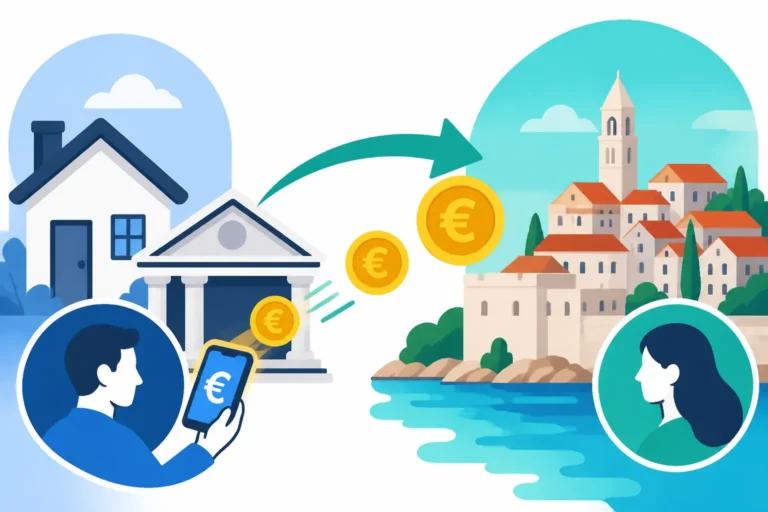
This is where things can get a little tricky, and where a good local bank or an expat-friendly service becomes invaluable. Each payment requires a specific poziv na broj, a reference number that tells the authorities exactly what the payment is for (e.g., Q1 income tax, Q2 health contributions). If you get these wrong, your payment might not be correctly attributed, leading to potential issues down the line. Many Croatian banks, like Zagrebačka Banka or PBZ, offer online banking services that can make this easier, but you'll still need to input those correct numbers. For receiving income from foreign clients, many expats find services like Wise invaluable for converting currencies at good rates and easily transferring funds to their Croatian bank account. It simplifies the process immensely, especially when dealing with multiple international clients. Our guide on How to Transfer Money Internationally from a Croatian Account might offer some useful insights here.
The ePorezna Portal: Your Digital Gateway
The Croatian government has been pushing for digital transformation, and the ePorezna portal is a prime example of this effort. This online platform is your digital interface with the Porezna Uprava and is becoming an indispensable tool for managing your tax affairs.
To access ePorezna, you'll typically need to register for the e-Građani system, which is Croatia's electronic identity platform. This usually involves a visit to a FINA office to verify your identity and get your credentials. Once set up, ePorezna allows you to submit your PO-SD form digitally, check your payment status, review your tax obligations, and even apply for certain tax certificates. It can be a bit daunting at first, especially with the language barrier, but persevering with it is highly recommended. It saves countless trips to the Porezna Uprava office and gives you a clear overview of your tax situation. Using ePorezna can transform what used to be a paper-heavy, in-person ordeal into a manageable online task. Dive deeper into this tool with our article on Understanding the ePorezna Online Tax Portal in Croatia.
Here's a quick overview of the key annual milestones for a paušalni obrt owner:
| Task | Deadline | Description |
|---|---|---|
| Quarterly Income Tax & Contributions | March 31, June 30, Sep 30, Dec 31 | Payment of fixed lump-sum income tax and social contributions for the previous quarter. |
| Annual PO-SD Form Submission | January 15 (for previous year's income) | Submission of the annual report summarizing total gross income received by your paušalni obrt in the previous calendar year to the Porezna Uprava. |
| Income/Expense Book (Knjiga IRa) | Throughout the year | While not submitted, you must maintain a simple book of incoming payments. |
Common Pitfalls and Expert Tips for Expats
Even with all the information in the world, the practical reality of being an expat dealing with a new tax system can throw curveballs. Let’s talk about some common issues and how to navigate them.
Keeping Meticulous Records
While the paušalni obrt is lauded for its simplified bookkeeping, don't misunderstand this as a license to ignore record-keeping entirely. You are still legally obligated to maintain a simple book of incoming payments, often called Knjiga prometa or Knjiga IRa. This is essentially a chronological log of all the invoices you've issued and the payments you've received.
Even if you don't need detailed expense receipts for income tax purposes, it's a good practice to keep them for VAT purposes (if you ever become a VAT payer) or simply for your own financial overview. Furthermore, if the Porezna Uprava ever audits you, they will ask for this record. Many of us expats are used to more rigorous accounting from our home countries, so falling into the trap of doing too little here can be a mistake. Maintain digital copies of all invoices you issue and receive, bank statements, and any official correspondence. This habit will save you a world of pain if a question ever arises, and it's simply good business practice, regardless of the tax system.
The Language Barrier and Seeking Professional Help
Let's be real: Croatian bureaucracy is challenging enough in Croatian. Trying to navigate tax laws and forms in a language you're not fluent in is a recipe for frustration and potential errors. This is where professional help becomes not just a luxury, but often a necessity for long-term peace of mind.
Hiring a knjigovođa (accountant/bookkeeper) who specializes in obrt structures and ideally has experience with expats can be a game-changer. They will ensure your RPO form is correct, your quarterly payments are accurate and timely, and your PO-SD is filed without a hitch. While it's an added expense, the cost of an accountant for a paušalni obrt is usually modest compared to the penalties you might incur for mistakes, not to mention the value of your time and sanity. A good accountant can also advise you on nuances, like when it might be beneficial to switch income brackets or if you're approaching the VAT threshold. For comprehensive guidance on managing your tax affairs as an expat, specialized services like Taxes for Expats can provide tailored advice that considers your unique international situation, ensuring you're compliant both in Croatia and in your home country. Don't be too proud to ask for help; it's an investment in your successful life here.
Double Taxation Agreements
For many expats, especially those maintaining ties or income sources in their home countries, the specter of double taxation looms large. Croatia has signed double taxation agreements (DTAs) with many countries around the world. These agreements are designed to prevent you from paying income tax twice on the same income – once in Croatia and once in your home country.
Understanding if a DTA exists between Croatia and your country of origin, and how it applies to your specific type of self-employment income, is absolutely vital. For example, if you are a US citizen, you still have to file taxes with the IRS, but the DTA and foreign earned income exclusion can significantly reduce your tax burden. For EU citizens, the rules are different again. Often, these agreements specify which country has the primary right to tax certain types of income and how relief from double taxation is provided (e.g., through an exemption or a tax credit). It's a complex area, and while a Croatian knjigovođa can handle your Croatian tax obligations, for international implications, you might need an international tax specialist or a service like Taxes for Expats. They can help you navigate the intricacies of reporting your Croatian self-employment income back home and ensure you're not overpaying. Our pillar article, The Complete Guide to Taxes in Croatia for Expats (2027), provides a broader overview of the tax landscape.
Disclaimer
The information provided in this guide is intended for general informational purposes only and does not constitute legal, tax, or professional advice. While we strive to keep the information accurate and up-to-date, tax laws and regulations in Croatia can change frequently and may be subject to individual interpretation. We strongly recommend consulting with a qualified Croatian accountant, tax advisor, or legal professional for advice tailored to your specific circumstances. We cannot be held responsible for any errors or omissions, or for any actions taken based on the information provided herein.