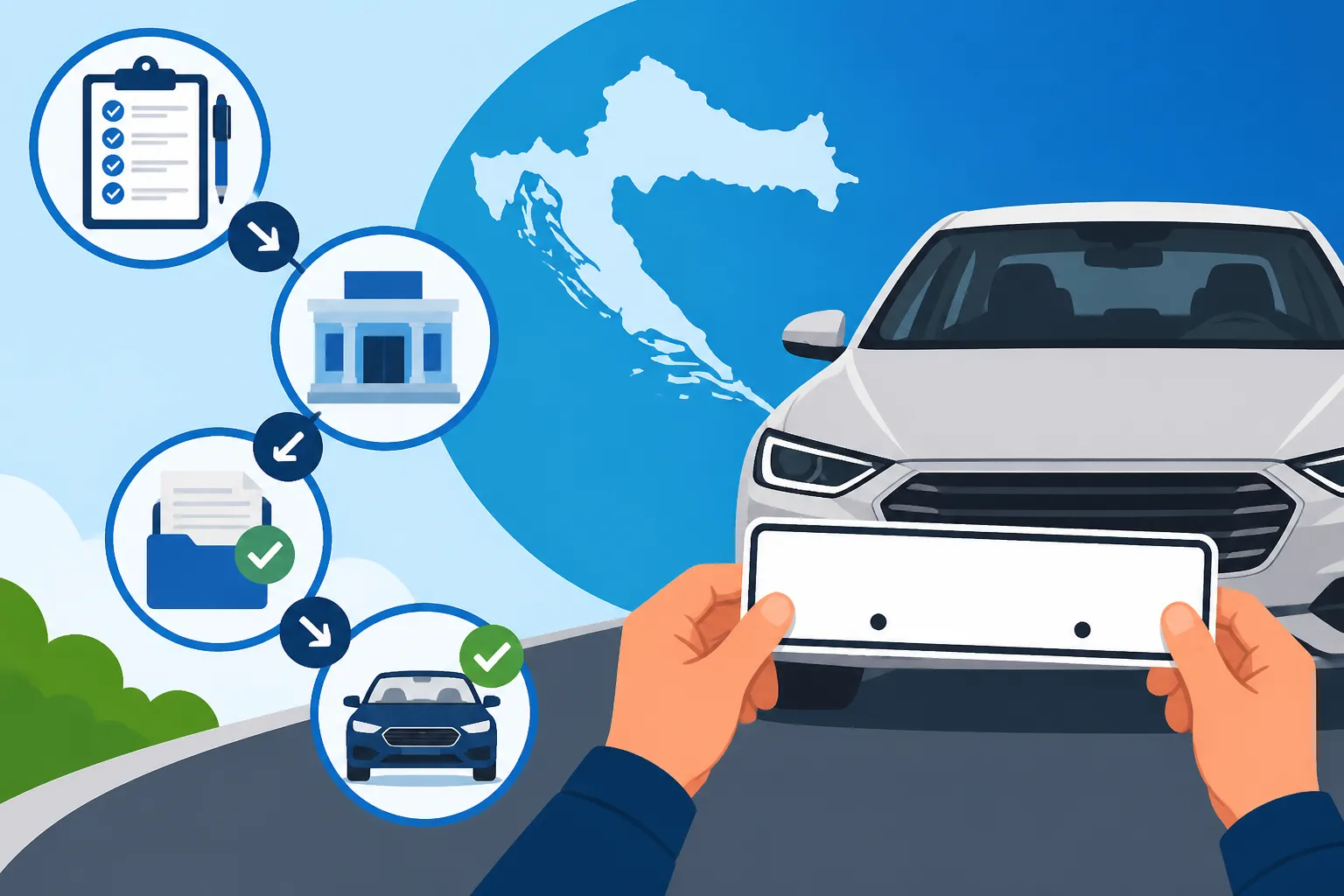
What Is the Process for Getting Croatian Plates on My Car?
Ah, the beloved Croatian license plates! If you’ve moved to Croatia and brought your car with you, or perhaps you’ve bought one locally, the sight of those crisp white plates with the red and blue checkerboard is a marker of true integration. But getting them onto your vehicle, especially if you’ve imported a car, can feel like navigating a maze blindfolded. The sheer volume of paperwork, the multiple agencies involved, and the inevitable language barrier can turn what seems like a simple task into a weeks-long saga. This guide is here to untangle that process, offering a realistic, step-by-step walkthrough of how to get your Croatian plates and finally drive legally and worry-free.
The Initial Reality Check: Is Importing Your Car to Croatia Worth It?
Before you even start gathering documents, it’s worth taking a deep breath and considering if bringing your car to Croatia is the best option for you. Many expats, myself included, have learned this lesson the hard way. The romantic notion of driving your familiar vehicle on picturesque Croatian roads can quickly collide with the harsh realities of import taxes, bureaucratic delays, and the sheer cost involved. It’s not just about getting the plates; it's about the entire journey your car takes to become a legal Croatian resident.
EU vs. Non-EU Vehicles: Different Hurdles
The first, and perhaps most significant, factor is whether your car is coming from an EU member state or a non-EU country. This distinction fundamentally changes the process and, crucially, the cost.
If your car is from another EU country, you're in a somewhat easier position. You won't face customs duties, and the VAT (Value Added Tax) situation is generally simpler, especially if you've owned the car for more than six months and driven it over 6,000 kilometers. However, you'll still need to go through a technical inspection, pay the homologation fees (to ensure it meets Croatian and EU standards), and then all the regular registration taxes and fees. Even for EU vehicles, the process isn't just a quick swap of plates; there’s a lot of box-ticking and payment-making to be done. The homologation part is often the trickiest, especially if your car has specific features or modifications that aren't common here.
For non-EU vehicles, brace yourself. This is where things get considerably more complex and expensive. You’re looking at customs duties, which can be substantial, and Croatian VAT (PDV) on the declared value of the car, which is currently 25%. Even if you’ve owned the car for years, you’ll likely pay these, unless you qualify for an exemption, such as importing it as part of your personal belongings when moving residence, but even those have strict conditions (like having owned and used the car for at least 12 months in your previous country of residence and moving your permanent residence to Croatia). Beyond the financial hit, the administrative steps for non-EU cars are far more involved, requiring more certifications and potentially longer waiting periods as each document is scrutinised by various agencies. This is where many expats throw in the towel and decide to sell their car back home and buy one in Croatia.
Age and Value Considerations: When to Reconsider
Another vital aspect is the age and current market value of your vehicle. Croatia has a system of special environmental taxes ( Posebni porez na motorna vozila ) that depend heavily on a car’s CO2 emissions and engine power, but also its age. Older, less fuel-efficient vehicles often incur significantly higher registration and annual road taxes. Sometimes, the combined cost of importing, homologating, and registering an older, beloved car can exceed its actual market value in Croatia.
I remember a friend who brought his perfectly good 10-year-old diesel car from the UK, thinking it would be fine. After calculating the homologation costs, the special taxes, and the regular registration fees, he realized he could have bought a younger, more fuel-efficient car in Croatia for the same money, without any of the headaches. It was a brutal wake-up call. So, before you commit, do your homework on the potential costs for your specific vehicle model and year. Check online calculators, or better yet, get a quote from a local agency that specializes in vehicle registration. You might be surprised at how quickly the numbers add up.
The Gauntlet of Paperwork: Essential Documents You'll Need
Let's be honest, Croatia loves its paperwork. And when it comes to vehicle registration, it's no different. You'll feel like you're collecting stamps for a treasure hunt, only the treasure is a license plate. Having everything in order from the start will save you countless trips and heartaches. This is a process where being meticulous pays off immensely.
Personal Identification and Residency Proof
First and foremost, you need to prove who you are and that you’re legally residing in Croatia. Without these foundational documents, nothing else can proceed.
You'll definitely need your valid passport or national ID card if you're an EU citizen. This sounds obvious, but make sure it’s current and not expiring soon. For non-EU citizens, your passport and your valid Croatian residence permit ( boravišna iskaznica ) are essential. This permit demonstrates that you have a legal basis to live here long-term, which is a prerequisite for registering a vehicle in your name.
Crucially, you absolutely must have your OIB, your Croatian personal identification number. This is your everything in Croatia, connecting you to taxes, healthcare, and yes, vehicle ownership. If you don't have one yet, stop everything and apply for it first. You can't even think about registering a car without it. While you're at it, you'll also need proof of your registered address in Croatia ( uvjerenje o prebivalištu or a copy of your residence card with address information). This is generally handled by the MUP when you register your residence in Croatia, but make sure you have a physical document confirming it.
Vehicle Ownership and Technical Documentation
Now, for the car-specific documents. This is where the technical jargon and varying national formats can get truly bewildering.
You’ll need the original vehicle registration certificate from your home country. This is often a multi-part document (e.g., V5C in the UK, Fahrzeugbrief and Fahrzeugschein in Germany). Ensure you have all parts. This proves you are the legal owner of the vehicle. If you’ve bought the car from someone else, you'll need the original bill of sale or purchase agreement. It must clearly state the vehicle details, purchase price, and the full names and OIBs (or equivalent IDs) of both buyer and seller.
Technical specifications are paramount. You’ll need the Certificate of Conformity (CoC) if your vehicle has one. This document, usually provided by the manufacturer, certifies that the vehicle meets EU environmental and safety standards. If you don't have a CoC (which is common for older vehicles or non-EU imports), you'll need to obtain a separate homologation certificate in Croatia. This involves a specialized technical inspection (more on that below) where the vehicle's features are checked against Croatian standards. They'll scrutinize everything from emissions to lights, tires, and safety features.
Any other technical documentation, such as service history, emission certificates, or previous inspection reports, should also be brought along. While not always strictly required, having a comprehensive paper trail can sometimes smooth over questions during the homologation process. Remember, every document needs to be either in Croatian or officially translated by a sworn court interpreter in Croatia. Don’t try to skimp on translations; they will send you back.
Here's a quick overview of essential documents:
| Category | Required Documents | Notes |
|---|---|---|
| Personal ID | Valid Passport / EU National ID Card | For non-EU citizens, also your Croatian Residence Permit. |
| Croatian Identifiers | OIB (Personal Identification Number) | Absolutely essential. Get this first if you don't have it. |
| Residency Proof | Proof of Registered Address (e.g., MUP certificate) | Confirms your official address in Croatia. |
| Vehicle Ownership | Original Vehicle Registration Certificate (all parts) | From your home country. |
| Purchase Proof | Original Bill of Sale / Purchase Agreement | If you bought the car, proving ownership transfer. |
| Technical Specs | Certificate of Conformity (CoC) OR Homologation Certificate (Croatia) | CoC (if available) simplifies things. Otherwise, a local homologation inspection is mandatory. |
| Translation Requirement | Official Croatian translations of all foreign documents | By a sworn court interpreter. |
Step-by-Step Through the Bureaucratic Maze
Now, with your stack of documents (and perhaps a strong coffee), it’s time to tackle the actual process. This isn't a single stop; it's a multi-stage journey involving several different institutions, each with its own set of rules and fees.
The All-Important Technical Inspection (Tehnički Pregled)
Your first major hurdle is the technical inspection, known as tehnički pregled. This isn't just an annual check-up; for imported vehicles, it's a comprehensive examination to ensure your car meets Croatian and EU standards. You'll need to find an authorized technical inspection station ( Stanica za tehnički pregled vozila ). You can spot them by their prominent "CVH" (Centar za vozila Hrvatske) signage.
Here, your car will undergo a thorough inspection. They'll check everything: brakes, lights, tires, emissions, chassis number, engine number, and all safety features. If your car is from a non-EU country or lacks a Certificate of Conformity, this inspection will include the homologation process. This is where they verify that every aspect of your vehicle complies with Croatian regulations. Be prepared for them to find something, even minor, that needs adjustment – perhaps a slight difference in headlight beam pattern or a specific type of tire. It’s not uncommon. Once the car passes, you'll receive a certificate of roadworthiness and, if applicable, the homologation certificate. This document is golden, so guard it carefully! Understanding Vehicle Technical Inspection (Tehnički Pregled) in Croatia is crucial before you go.
This stage can be tedious, and speaking some Croatian or having a local friend help can significantly ease the communication. You'll be spending a fair bit of time there, so make sure your phone has a good data plan, perhaps with an Airalo eSIM, to keep you occupied or to translate on the fly.
Navigating Taxes, Customs, and Fees
This is often the most financially impactful part of the process, especially for non-EU imports. After you have your technical inspection and homologation documents, you'll need to report to the Croatian Tax Administration ( Porezna Uprava ) and potentially customs.
For non-EU vehicles, this is where you pay customs duties and the hefty 25% Croatian VAT (PDV). The calculation will be based on the vehicle's purchase price or an assessed market value, whichever is higher. Be prepared with proof of purchase and any valuation documents.
For all imported vehicles (EU and non-EU), you’ll face the special environmental tax (Posebni porez na motorna vozila). This tax is calculated based on the car's CO2 emissions and, to a lesser extent, engine power and age. Newer, more environmentally friendly cars pay less, while older, high-emission vehicles can incur a substantial fee. The Croatian Tax Administration will issue you a payment slip (uplatnica), which you then take to a bank or post office to pay. Don’t lose this receipt!
Beyond these, there are various administrative fees:
- Administrative Fees: For the registration process itself.
- Road Tax ( Cestarina ): An annual fee based on engine power.
- Ecological Surcharge: Often integrated into other fees.
- Plates Fee: For the manufacturing of your new Croatian license plates.
The exact amounts can vary widely, so it's always best to get a precise calculation once your vehicle's specifications have been assessed during homologation. This is definitely a stage where you might feel like you're just bleeding money, but it's unavoidable.
Securing Your Croatian Car Insurance
You cannot register a vehicle in Croatia without valid third-party liability insurance. This is mandatory. You’ll need to approach one of the many insurance providers in Croatia. Popular choices include Croatia Osiguranje, Euroherc, Wiener Osiguranje, and Generali.
When you go to get insurance, you'll need your vehicle's technical documentation (especially the homologation certificate), your personal ID, and your OIB. The insurance premium will depend on several factors, including your vehicle's type, engine size, your age, and your driving history (though proving foreign driving history to get discounts can be tricky). If you're coming from a country with a no-claims bonus system, try to get a certificate from your previous insurer in English and Croatian if possible; it might help reduce your premium, though it’s not guaranteed to be accepted.
Beyond the mandatory third-party insurance, you might also consider kasko (comprehensive) insurance, which covers damage to your own vehicle, theft, fire, and other perils. This is highly recommended, especially given the various driving conditions and occasional parking challenges in Croatian cities.
Final Registration at the MUP and Plate Issuance
With all your documents in hand – the passed technical inspection, homologation certificate, tax payment receipts, and insurance policy – you are finally ready for the ultimate step: registering your car at the local police department (MUP – Ministarstvo unutarnjih poslova ) that handles vehicle registration.
Head to the MUP vehicle registration office, typically found within larger MUP branches or a dedicated department. This is where you submit everything. A MUP official will review all your documents. They’ll check your identity, your residency status, the vehicle’s legality, and all the payments you’ve made. If everything is in order (and you’ve been thorough, it should be!), they will process your application.
Once approved, you will pay the final administrative fee for the issuance of the traffic license (prometna dozvola) and the actual license plates. These days, the process is quite streamlined once you reach this stage. You’ll typically receive your new Croatian license plates and your traffic license on the spot or within a very short timeframe.
Attaching the plates is usually your job, but it's straightforward. Congratulations, you are now officially driving on Croatian plates! This also applies if you’re looking to purchase a used car here. The process for how to buy a used car in Croatia as a foreigner largely follows these same steps, just without the international import complexities.
Common Pitfalls and Pro Tips for a Smoother Ride
Having been through this (and similar administrative nightmares) more times than I care to count, I’ve seen and experienced the common frustrations. It’s never quite as simple as it sounds on paper.
Language Barriers and Finding Assistance
One of the biggest hurdles, especially outside of major tourist hubs like Zagreb or Split, is the language barrier. While younger officials often speak English, many don't, especially in smaller towns or specific departments. Trying to explain complex technical details about your car or decipher intricate tax forms in Croatian can be incredibly frustrating. This is where your empathy for fellow expats comes into full swing!
Pro Tip 1: Bring a Croatian Speaker. If your Croatian isn't fluent, bring a Croatian-speaking friend, colleague, or hire a local assistant who can translate for you. This is not just about convenience; it can prevent misunderstandings that lead to delays or extra costs.
Pro Tip 2: Use Translation Apps (and local help). While deep conversations might need a human, having Google Translate or a similar app ready on your phone can help with basic questions or document interpretation. Just make sure you have reliable mobile data. I've found an Airalo eSIM invaluable for staying connected without racking up huge roaming charges when dealing with such multi-location tasks.
Pro Tip 3: Consider an Agency. Many Croatian cities have agencies that specialize in vehicle registration and import. For a fee, they will handle most, if not all, of the paperwork, dealings with the Porezna Uprava, and even accompany you to the tehnički pregled. This can be a worthwhile investment to save yourself immense stress, time, and potential mistakes. They know the ins and outs, the unwritten rules, and who to talk to.
Unexpected Costs and Delays
The costs can add up faster than you expect, and waiting periods can stretch. The initial quotes for taxes might not always include every single administrative fee, or the homologation process might uncover an unexpected "non-conformity" that requires a small repair or modification.
Pro Tip 1: Build a Buffer. Always budget more than you initially calculate for vehicle import and registration. Add at least a 20-30% buffer for unexpected taxes, minor repairs, additional translations, or agency fees. It's better to have money left over than to be caught short.
Pro Tip 2: Patience is a Virtue. The Croatian administrative machine doesn't always run at lightning speed. Documents might take longer to process than anticipated, or appointments at the MUP might have waiting lists. Don't plan to have your car registered and ready to drive within a few days. Give yourself weeks, especially for non-EU imports. During this waiting period, if you need to move household goods or furniture, consider using a service like Sirelo to help manage the logistics; they are quite familiar with international moves to Croatia and can provide valuable insights for other aspects of your relocation while you're tackling car registration.
Pro Tip 3: Keep Copies of Everything. Seriously, scan and save every single document and receipt. If something gets lost, or there's a question about a payment, having your copies will be a lifesaver. This applies not only to car registration but generally to how the Croatian Health Insurance Fund (HZZO) works, understanding Dopunsko Zdravstveno Osiguranje (Supplementary Insurance) in Croatia, and even how to get your OIB and why it matters for healthcare access. Bureaucracy loves proof!
By preparing thoroughly, understanding the sequential steps, and arming yourself with patience and a bit of local assistance, you will eventually get those Croatian plates on your car. It might feel like a triumph worthy of a medal, but it’s a necessary step to truly settling into your new Croatian life.
Disclaimer
Please note that while this guide aims to provide accurate and up-to-date information, regulations in Croatia can change. It is always recommended to verify the latest requirements with official sources such as the Croatian Ministry of Internal Affairs (MUP), the Croatian Tax Administration (Porezna Uprava), and the Centre for Vehicles of Croatia (CVH) or consult with a local expert specializing in vehicle registration. This article is for informational purposes only and does not constitute legal or financial advice.