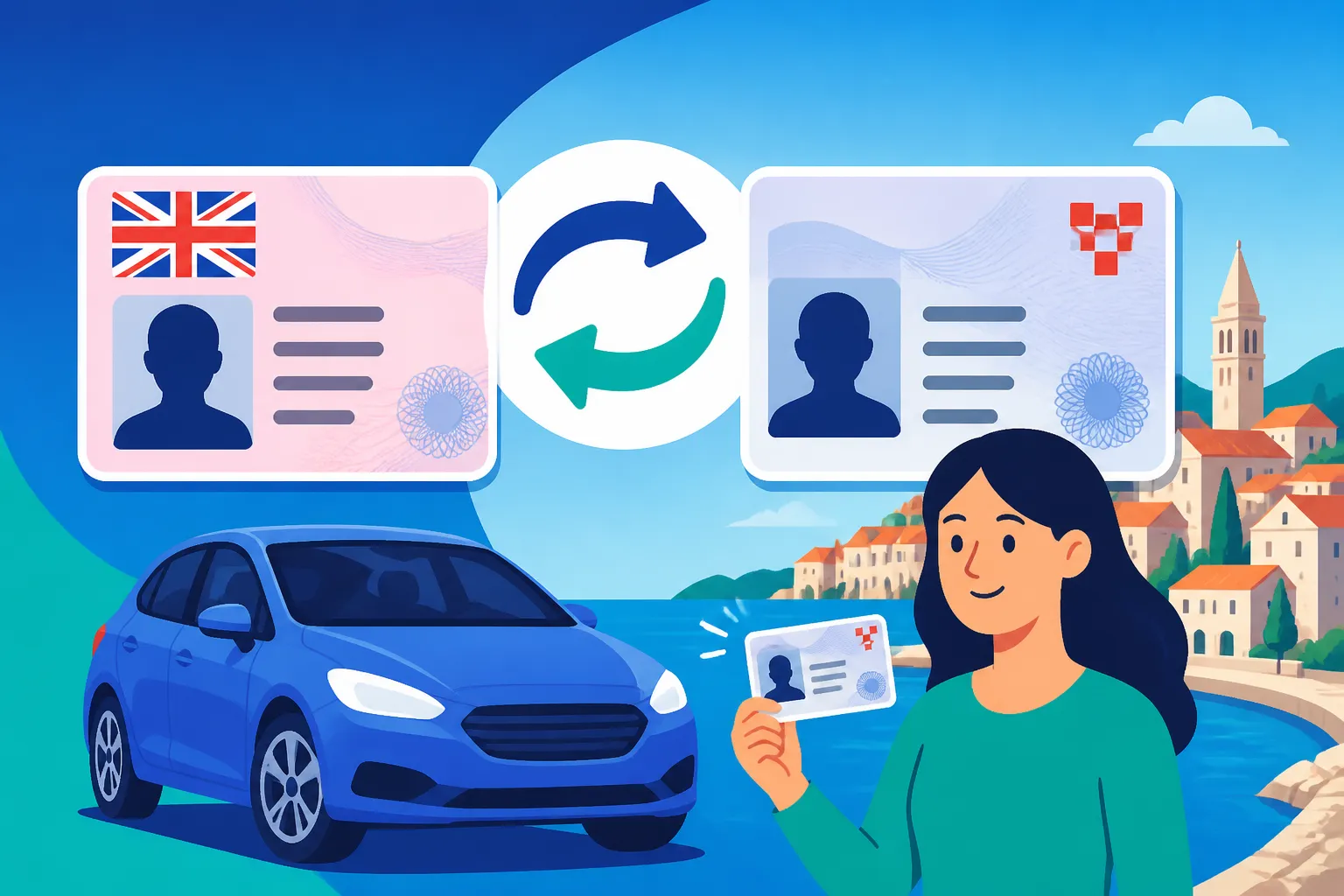
How Do I Exchange My UK Driving Licence for a Croatian One?
Oh, the infamous UK driving licence exchange! If you've recently moved to Croatia from the UK, especially post-Brexit, you're likely staring down a rather perplexing pile of paperwork, wondering how on earth to get your driving privileges properly recognised. This guide is here to walk you through the often-baffling process of exchanging your beloved UK driving licence for a shiny new Croatian one, saving you headaches and unexpected detours.
The Post-Brexit Reality for UK Driving Licences in Croatia
Let's be honest, post-Brexit life for us Brits in Europe has come with its fair share of administrative "surprises." What used to be a straightforward affair of simply using your EU-recognised licence has now morphed into a bureaucratic hurdle, especially when it comes to something as fundamental as driving.
Why Exchange is Now Mandatory
Before Brexit, your UK driving licence, like any other EU licence, was automatically recognised across the entire European Union and the European Economic Area. This meant you could happily drive around Croatia on your UK licence until it expired, at which point you’d simply exchange it for a Croatian one, often with minimal fuss. However, with the UK's departure from the EU, that reciprocal agreement dissolved. The UK is now considered a "third country" when it comes to driving licences in Croatia, just like the United States, Canada, or Australia. This means the rules changed overnight for anyone establishing residence here.
The Croatian government, through its Ministry of Interior (MUP), now mandates that UK citizens who become residents in Croatia must exchange their UK driving licence for a Croatian one within a specific timeframe. Failing to do so can lead to some pretty hefty fines if you're caught driving without a valid Croatian licence, and could even complicate your insurance claims should you be involved in an accident. Trust me, you do not want to be in that situation here. It's not just about avoiding a ticket; it's about ensuring you're legally compliant and protected. The implications of this are real, and the MUP takes it seriously, as Croatia has to adhere to EU standards for non-EU licences.
Initial Grace Period and Current Deadlines
When the UK officially left the EU, there was a period of understandable confusion, and some countries offered grace periods. For Croatia, the general rule that applied to all third-country licences came into effect: you usually have one year from the date you registered your temporary residence ( privremeni boravak) in Croatia to exchange your licence. This isn't a hard and fast rule set in stone just for UK citizens, but a standing regulation for all non-EU licence holders. If you arrived and registered your residence on, say, March 1st, 2023, you would typically have until March 1st, 2024, to complete the exchange.
However, and this is where it gets tricky, the MUP can be quite particular. While the one-year grace period is commonly cited, it's always safest to start the process as soon as you've secured your temporary residence permit and your OIB. Don't wait until the last minute, because Croatian bureaucracy rarely moves at the speed you expect. The term "resident" in this context is crucial. It means you have legally established your abode in Croatia and have obtained the necessary permits, such as a residence card, proving your status. If you're merely visiting, your UK licence (along with an International Driving Permit for longer stays or non-standard visits) might suffice for a shorter period, but for genuine residency, the exchange is non-negotiable.
Eligibility and Documentation: What You Absolutely Need
Gathering the right paperwork in Croatia often feels like a treasure hunt with ever-changing clues. Exchanging your UK driving licence is no different, so let's break down exactly what you'll need before you even think about stepping into a MUP office.
Core Eligibility Criteria for UK Expats
First and foremost, to even consider exchanging your UK licence, you must be a legally registered resident of Croatia. This means you've successfully navigated the process of securing your temporary residence permit ( privremeni boravak). If you're still in the throes of that, you might want to check out our guide on Registering Your Residence in Croatia: The Complete MUP Guide for a deeper dive. Without a valid residence permit, the MUP won't even look at your driving licence application. You’ll also need to meet standard driving age requirements for the categories you wish to have on your Croatian licence.
Additionally, your UK licence must be valid, not expired, suspended, or revoked. The MUP will verify its authenticity directly with the DVLA, so any funny business will be quickly flagged. While not explicitly stated as an eligibility criterion, having an understanding of basic Croatian will immensely help you navigate the process. If you don't speak the language, consider bringing a Croatian-speaking friend or interpreter to your MUP appointment.
Gathering Your Paperwork: The Official Checklist
This is where the rubber meets the road. Being meticulous about your documents will save you multiple trips and a lot of frustration. Here’s a comprehensive list of what you'll typically need:
- Your Original UK Driving Licence: This is the star of the show. Make sure it's in good condition and clearly legible.
- Valid Croatian Residence Card (Boravišna Iskaznica): Your proof of legal residency in Croatia.
- Your Passport or National ID Card: For identification purposes.
- OIB (Personal Identification Number): This little number is your key to pretty much everything in Croatia, including this process. If you don't have one yet, you absolutely need to get it. Our article on How to Get an OIB (Personal Identification Number) in Croatia will guide you through that essential first step.
- Medical Certificate (Liječničko Uvjerenje): This is a specific medical certificate issued by an authorised medical institution in Croatia, confirming you are physically and mentally fit to drive. We'll delve into this more below.
- One Passport-Sized Photo (3×3.5 cm or similar, check MUP requirements): Even in the digital age, a physical photo is usually required. Make sure it's recent and meets standard passport photo specifications.
- Proof of Payment of Administrative Fees: These are typically paid via biljezi (duty stamps) or bank transfer, depending on the MUP office.
- Completed Application Form: You'll usually get this at the MUP office, but some forms might be available online for pre-filling.
When preparing these, make sure you have both original documents and photocopies. Sometimes they ask for originals to view and then keep the copies. Do NOT, I repeat, do NOT show up with only copies or missing a single document. They will send you away.
The Dreaded Medical Examination
Ah, the Croatian medical examination for driving. Many expats describe it as surprisingly thorough, especially if you're used to the UK's self-certification system for standard licences. You can't just go to any doctor for this; you need a specific type of medical professional authorised to issue these certificates for driving licences. These are often found in dom zdravlja (health centres) or specialised private polyclinics.
The examination typically involves:
- An eye test: More than just reading a chart, they'll check your peripheral vision and colour perception.
- General physical exam: Blood pressure, heart rate, and an assessment of your overall health.
- Mental health assessment: A brief consultation to ascertain your mental fitness to drive.
- Blood work/urine tests: Sometimes requested if there are specific concerns.
The process often feels a bit like a production line. You’ll move from one small room to another, getting poked and prodded, often with minimal English spoken. Expect the whole thing to take a couple of hours and cost anywhere from €30 to €70, depending on the institution. It's an out-of-pocket expense, as this isn't typically covered by HZZO (public health insurance). It can be a little daunting, so prepare yourself for a very functional, no-frills experience. Just remember, it's a necessary step to get you back on the road legitimately.
| Document Type | Description | Notes |
|---|---|---|
| UK Driving Licence | Original plastic card licence. | Must be valid and not expired. |
| Croatian Residence Card | Your Boravišna Iskaznica (temporary or permanent residence permit). | Proof of legal residency is paramount. |
| Passport/ID Card | Valid identification document. | Original required for verification. |
| OIB | Your Croatian Personal Identification Number. | Essential for all official transactions. |
| Medical Certificate | Liječničko Uvjerenje from an authorised Croatian medical institution. | Specific for driving licence exchange. Expect to pay a fee (€30-€70) and undergo a thorough examination. |
| Passport Photo | One recent photo, typically 3×3.5 cm or similar. | Check current MUP requirements for size and background colour. |
| Proof of Fee Payment | Administrative stamps (biljezi) or bank transfer receipt. | Fees will be specified at the MUP. |
| Completed Application Form | Form for driving licence exchange. | Usually obtained at the MUP office, but good to check if it's available online to fill out beforehand. |
| Photocopies of Documents | Copies of all original documents. | Always bring copies in addition to originals; they may keep the copies. |
Navigating the Exchange Process at the MUP
Once you've got your medical certificate in hand and your pile of paperwork neatly organised, it’s time for the main event: the MUP. This is often the part that sends shivers down the spine of even the most seasoned expat, but with a bit of preparation and patience, you'll get through it.
Step-by-Step Application at the Police Station (MUP)
Your destination will be the Traffic Police ( Prometna policija) department within your local MUP. In larger cities like Zagreb or Split, this might be a dedicated building or a specific floor. It's usually not the same department where you handle your residence permit. A quick online search for "MUP [your city] prometna policija" or asking a local friend for directions is advisable.
- Arrive Prepared: Go early, especially if it’s a walk-in service. Bring a book, your phone, or an e-reader because waiting is almost a certainty. Ensure your phone is topped up with data, perhaps using an Airalo eSIM, so you can look up last-minute details or pass the time.
- Take a Number: Upon entering, look for the little ticket machine. Select the service for "vozačke dozvole" (driving licences) and grab a number.
- Wait for Your Turn: This is the part that tests your patience. When your number is called, approach the designated window.
- Submit Documents and Pay Fees: Hand over all your meticulously prepared documents. The officer will review them, verify your identity, and explain the fees. You’ll usually be directed to pay these fees at a specific counter, often using biljezi (duty stamps) which you can purchase at the MUP itself or at a post office/kiosk beforehand if you know the exact amount. The current fee for a standard driving licence is around €35.
- Biometrics and Signature: You'll likely have your photo taken digitally on the spot (in addition to the physical one you brought, just to keep things interesting!) and provide an electronic signature.
- Receive a Temporary Document: If all your documents are in order, you'll be given a temporary driving certificate (potvrda o podnesenom zahtjevu) that allows you to drive legally while your new Croatian licence is being processed. This is typically valid for 30 or 60 days.
- Wait for Collection: The officer will tell you when your new licence should be ready for collection. This can range from a few days to a few weeks. You'll simply return to the MUP, take a number for "preuzimanje" (collection), and pick it up.
The whole process can feel like a gauntlet, but remember, the MUP officials are just doing their job, often with heavy workloads. A polite smile and all your documents in order will go a long way.
Understanding the Costs and Fees Involved
Beyond the psychological cost of navigating Croatian bureaucracy, there are actual monetary costs involved in exchanging your UK driving licence. It’s good to budget for these so you’re not caught off guard.
- Medical Examination: As mentioned, this is the biggest individual cost, usually ranging from €30 to €70.
- Administrative Fees for Driving Licence: The fee for issuing a standard driving licence is currently around €35. If you opt for an expedited service (which is often only available for specific situations or at higher cost, and generally not for first-time exchanges), it can be higher.
- Passport Photos: If you need new ones, these might cost around €5-€10.
- Photocopies: A few cents per page if you don't do them yourself.
So, in total, you're looking at a rough estimate of €70-€120 for the entire process. This doesn't include any potential translation costs, which might be required for certain documents depending on your specific situation, although usually not for the licence itself. Compared to other administrative costs you might encounter in Croatia, such as for vehicle registration which we detail in How to Register a Vehicle and Get Croatian Plates, this isn't too bad, but it's still an expense to factor in.
What Happens to Your UK Licence?
This is a common question, and the answer can be a bit bittersweet for some. When you exchange your UK driving licence for a Croatian one, the MUP will typically confiscate your UK licence. It won't be given back to you. Instead, the MUP is legally obliged to send it back to the issuing authority, which in this case is the DVLA in the UK.
This means you won't hold both licences simultaneously. Your new Croatian licence will be your sole, legal driving document in Croatia and throughout the EU/EEA. If you ever return to the UK to reside there, you would then need to go through the process of exchanging your Croatian licence back for a UK one. For many expats, this is a moment of mild sadness, a final tangible link to their previous life perhaps. But rest assured, your driving history and categories are transferred to your new Croatian licence, so you won't be starting from scratch!
Common Pitfalls, Tips, and Staying Connected
Exchanging a driving licence in a foreign country can be fraught with unexpected challenges. After years of living here, I've picked up a few tips and tricks to help you navigate these waters with slightly less stress.
Overcoming Language Barriers and Bureaucracy
One of the biggest hurdles, let's be honest, is the language. While staff in major city MUPs might speak some English, it's far from guaranteed, especially in smaller towns. This is where your patience will be severely tested.
- Bring a Croatian Speaker: If you don't speak Croatian, this is almost essential. Even a friend who can help translate key phrases can make a world of difference in understanding instructions or clarifying requirements. They might prevent you from missing a crucial detail.
- Be Patient and Polite: Croatian bureaucracy operates at its own pace. Getting frustrated or angry will only make things harder for you. A calm, polite demeanour, even when things are moving slowly, is always the best approach.
- Double-Check Everything: Before you leave home, literally go through your checklist twice. Then check it again. The MUP loves a good "missing document" excuse to send you away. Having all documents perfectly prepared is your superpower here.
- Don't Assume: Never assume a rule or process will be the same as in your home country. Croatia has its own unique way of doing things, and it’s best to approach every administrative task with an open mind and a willingness to learn their system. If you've been grappling with similar challenges for things like The Expat Guide to Setting Up Utilities in Croatia, you know exactly what I mean.
Staying Mobile During the Waiting Period
You've submitted your documents, paid your fees, and have a temporary certificate in hand. Great! But what does that mean for your daily commute?
- Driving with the Temporary Certificate: The potvrda o podnesenom zahtjevu you receive from the MUP is your legal proof that you're in the process of getting a Croatian licence. You can absolutely drive with this document. Keep it with you at all times when driving, along with your residence card and OIB.
- Validity: These temporary certificates usually have a validity period of 30 or 60 days. Pay close attention to the expiration date. If your new licence isn't ready before it expires, you'll need to go back to the MUP to get an extension.
- Planning Travel: If you plan to travel outside Croatia (especially outside the Schengen area) during the waiting period, be aware that a temporary Croatian certificate might not be recognised internationally as a valid driving document. It's best to collect your permanent licence before any international trips. This is a good time to ensure you have reliable connectivity for checking updates or navigating unfamiliar areas, perhaps with an Airalo eSIM, which can be invaluable for seamless communication whether you're at home or travelling short distances.
Post-Exchange Considerations
Congratulations, you have your Croatian driving licence! But your journey doesn't quite end there.
- Update Car Insurance: If you own a car in Croatia, you must inform your car insurance provider that you now hold a Croatian driving licence. This is a crucial detail for them, and failing to update it could invalidate your policy in the event of a claim.
- Driving Abroad: Your Croatian driving licence is a full EU driving licence. This means it's valid for driving throughout the entire European Union and EEA without any special permits. For countries outside the EU, you might still need an International Driving Permit (IDP) in conjunction with your Croatian licence, so always check the specific requirements for your destination.
- General Relocation Stress: Let’s face it, moving to a new country like Croatia involves a million moving parts, from finding a place to live to setting up your finances. Exchanging your driving licence is just one piece of the puzzle. If you're feeling overwhelmed by the sheer volume of tasks, remember there are services like Sirelo that can help you find reputable movers and compare quotes, taking some of the logistical burden off your shoulders during this intense period of settling in.
Getting your Croatian driving licence sorted is a significant milestone in becoming truly settled here. It's a rite of passage for many expats, and while it might test your resolve, the freedom it brings is absolutely worth it.
Disclaimer
Please note that while every effort has been made to provide accurate and up-to-date information, rules and regulations in Croatia, especially concerning immigration and administrative procedures, can change. This guide is intended for informational purposes only and does not constitute legal advice. We strongly recommend consulting the official MUP website (mup.gov.hr) or seeking professional legal assistance for your specific situation, particularly for the most current requirements and fees.