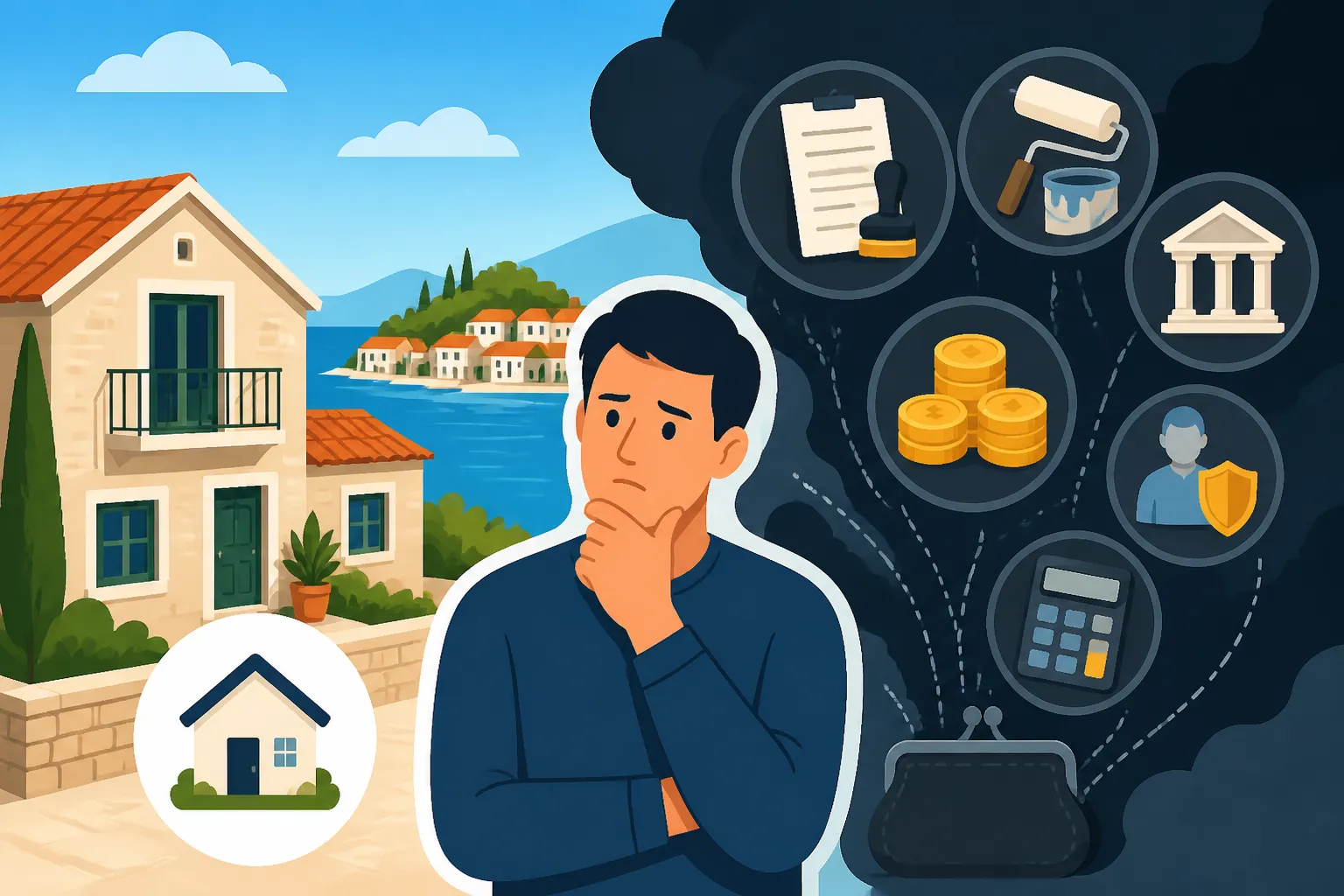
What Are the Hidden Costs of Buying Property in Croatia?
Oh, my dear friend, you’ve decided to take the plunge and buy property in Croatia! That’s wonderful news, truly, a fantastic step towards embracing the good life here. But let’s be honest, dreaming of your charming stone house or modern apartment by the sea often overshadows the nitty-gritty financial details. The price tag on the listing is just the beginning, and if you’re not prepared, the "hidden" costs can feel less like minor surprises and more like unexpected tidal waves. This guide is here to shed light on those oft-overlooked expenses, helping you navigate the Croatian property market with your eyes wide open and your wallet (mostly) intact.
Initial Purchase Costs Beyond the Price Tag
When you find that perfect nekretnina (real estate), your heart might flutter, but your brain needs to stay grounded. The advertised price is just the tip of the iceberg. There are several significant expenses that come into play the moment you decide to make an offer, and ignoring them can lead to some serious financial headaches down the line. It's not just about what the seller wants; it's about what the Croatian system requires.
Real Estate Transfer Tax (Porez na Promet Nekretnina)
Alright, let's start with the big one, the Porez na Promet Nekretnina. This is essentially a property transfer tax, and it's a non-negotiable part of buying property in Croatia. Currently, it stands at 3% of the property's purchase price. Now, that might sound straightforward enough, but here's where it can get tricky: this 3% is calculated on the market value of the property, which is determined by the tax authorities (Porezna Uprava). While it's usually based on the price stated in your purchase agreement, the tax office has the right to assess the property themselves. If their valuation is higher than what you declared, they'll tax you on their higher figure, and you'll be on the hook for the difference.
Imagine you've agreed to buy a stunning apartment in Split for €300,000. You've budgeted for €9,000 in transfer tax. But then, a few months later, the tax office sends you a letter (in Croatian, of course, adding to the stress) stating they believe the market value is €320,000. Suddenly, your tax bill jumps to €9,600. It's not a massive increase, but it's an unexpected one that cuts into your contingency fund. This tax typically needs to be paid within 15 days of receiving the decision, so you need to have these funds readily available. It’s a vital piece of the puzzle when you’re figuring out your overall budget. We have a detailed guide on Understanding the Real Estate Transfer Tax (Porez na Promet Nekretnina) that delves deeper into this.
Notary and Legal Fees
This is another area where costs can sneak up on you. In Croatia, a public notary (javni bilježnik) plays a crucial role in validating property transactions. It's not just a formality; it's a legal requirement. The preliminary contract (predugovor) and the final purchase agreement (kupoprodajni ugovor) must be certified by a notary. The fees for this are generally based on the value of the transaction, and they are legally prescribed. They can range from a few hundred to over a thousand euros, depending on the complexity and value.
Beyond the notary, you'll almost certainly want, and frankly need, legal representation. While it's technically possible to navigate the purchase process without a lawyer, it's akin to sailing the Adriatic in a rowboat without a compass – you're brave, but potentially foolish. A good lawyer will perform due diligence, check the property’s legal status, ensure there are no encumbrances or outstanding claims, and guide you through the entire process, including registering your ownership. Legal fees can vary significantly. Some lawyers charge a flat fee, while others charge a percentage of the purchase price, often between 0.5% and 1.5%. For a €300,000 property, that could easily be €1,500 to €4,500. This might seem like a lot, but trust me, a good lawyer can save you from far more expensive problems down the line. Don't skimp here; it's your peace of mind and your investment on the line. You can find more comprehensive information about these expenses in our guide to Understanding Notary Fees and Property Purchase Costs in Croatia.
Real Estate Agent Commission
Many expats choose to work with a real estate agent, especially when buying property in a foreign country. While they can be incredibly helpful in navigating the market, translating documents, and connecting you with lawyers and notaries, their services come with a fee. In Croatia, the standard real estate agent commission is typically between 2% and 3% (plus VAT) of the purchase price, often paid by both the buyer and the seller, meaning each party pays 2% to 3%.
So, if you're buying that €300,000 apartment, you could be looking at an agent fee of €6,000 to €9,000 (plus VAT). This means the total commission for the sale could be as high as 6% of the purchase price (3% from the buyer, 3% from the seller). It's always worth clarifying these terms upfront. Make sure you understand exactly what services are included and what percentage or flat fee you'll be paying. Some agencies might offer slightly lower rates if they represent both parties, but this needs to be explicitly agreed upon. It’s a significant cost that must be factored in.
Property Valuation Costs
Sometimes, especially if you're taking out a mortgage from a Croatian bank, a professional property valuation (procjena nekretnine) will be required. The bank needs to ensure the property's value justifies the loan amount. Even if you're not getting a mortgage, you might opt for an independent valuation for your own peace of mind, to ensure you're not overpaying.
The cost for a property valuation can vary, usually ranging from €200 to €500, depending on the size, location, and complexity of the property. This isn't a huge amount compared to other fees, but it's another one of those smaller expenditures that collectively add up. It’s a professional service that provides an objective assessment, which can be invaluable, particularly for older properties or those with unique features.
Translation and Certification Fees
Unless you're fluent in Croatian, you're going to need certified translations of various documents, particularly your personal identification, any powers of attorney, and potentially the purchase agreement itself. While your lawyer will handle much of the legal jargon, some official documents presented to the notary or government offices will need to be in Croatian and certified by a sworn court interpreter.
The cost for translation services can quickly add up, typically charged per page or per word. Expect to pay anywhere from €20 to €50 per page for certified translations. This might not sound like much, but if you have a handful of official documents, it can easily run into a few hundred euros. For instance, getting your birth certificate, marriage certificate, and passport translated and certified for various stages of the property purchase or even for obtaining your OIB (Personal Identification Number) can quickly consume a portion of your budget.
Ongoing Ownership Expenses You Might Forget
Congratulations, you’ve bought your property! The initial hurdles are cleared. But hold on, the financial journey doesn't end there. Owning property in Croatia comes with its own set of ongoing responsibilities and costs that, if not anticipated, can really eat into your budget and enjoyment of your new home.
Annual Property-Related Taxes and Fees
Unlike some countries with high annual property taxes, Croatia's system is a bit different and, frankly, less straightforward. There isn't one single "annual property tax" as you might know it. Instead, you'll encounter a few different municipal charges that essentially serve the same purpose:
- Komunalna Naknada (Communal Fee): This is a municipal fee charged for the use of communal infrastructure (roads, lighting, green areas, etc.). It's calculated based on the size of your property, its location (zone), and the type of property.
- Vodna Naknada (Water Contribution): A contribution for water management, again based on property size and location.
- Pričuva (Building Reserve Fund): If you own an apartment in a building with multiple units, you'll be contributing to a pričuva. This is a mandatory monthly payment that goes towards the maintenance and repairs of common parts of the building (roof, facade, stairwells, etc.). The amount is determined by the building's management and typically ranges from €0.50 to €1.00 per square meter per month. For a 70 sqm apartment, that’s €35-€70 a month, which really adds up over a year.
These fees aren't exorbitant, but they are recurring. For a typical apartment, you might be looking at a few hundred euros a year in total for komunalna naknada and vodna naknada, plus your pričuva. If you own a holiday home, you'll also pay Porez na Kuću za Odmor, a specific tax for vacation homes. We cover these in more detail in The Complete Guide to Property and Real Estate Taxes in Croatia (2027).
Utility Connection and Maintenance
Once you own the place, you'll need to get all the utilities connected and transferred into your name. This includes electricity (HEP), water, gas (if available), internet, and waste removal. While the actual usage costs are variable, there can be connection fees or transfer fees, especially if you're changing providers or reactivating dormant connections.
Getting reliable internet is often a priority, and depending on your location, you might have options like Hrvatski Telekom, A1, or Telemach. During these initial setup phases, staying connected can be a challenge. That’s why many expats, myself included, rely on eSIM services from providers like Airalo to ensure they have mobile data while the home internet gets sorted. These minor costs, when multiplied across all utilities, can easily amount to a few hundred euros in initial setup fees, plus the ongoing monthly bills. Don’t forget about the waste collection fees too, which are usually a monthly charge. Our guide to The Expat Guide to Setting Up Utilities in Croatia provides a good overview.
Insurance (Home, Earthquake, Flood)
Protecting your investment is paramount, and insurance in Croatia is something you absolutely need to consider. While not always legally mandatory (especially for individual houses), comprehensive home insurance (osiguranje imovine) is highly recommended. Given Croatia's seismic activity, earthquake insurance is a smart, if sometimes overlooked, addition. If your property is near the coast or a river, flood insurance might also be prudent.
The cost of insurance varies widely based on the property's value, location, age, and coverage. Expect to pay anywhere from €150 to €500 or more per year for decent coverage. This isn't a "hidden" cost in the sense of bureaucracy, but it's an often-forgotten line item in the annual budget. Many new homeowners focus on the purchase price and forget about protecting their asset after they've bought it.
Maintenance and Renovation (Especially Older Properties)
This is perhaps the "most hidden" cost, particularly if you're enchanted by an older, charming Croatian stone house. While these properties offer immense character, they often come with a hidden list of necessary repairs and renovations. From leaky roofs and outdated electrical systems to crumbling facades and inefficient heating, older homes can be money pits if you're not careful. Even a newer apartment might require some initial work to match your style or fix minor issues.
Budgeting for maintenance is crucial. Even for a well-maintained property, you should set aside at least 1% of the property's value annually for ongoing upkeep and unexpected repairs. For a €300,000 property, that’s €3,000 a year! If you're planning a significant renovation, these costs can spiral into tens of thousands of euros. Securing local, reliable contractors, managing projects (especially if you're not on-site), and dealing with potential material delays or language barriers can all add to the stress and the bill. Always get multiple quotes and check references.
Capital Gains Tax (If Selling in Less Than 3 Years)
This isn't an immediate cost, but it's a potential hidden cost if your long-term plans change. If you decide to sell your property in Croatia within three years of purchasing it, you may be subject to capital gains tax (porez na dobit od otuđenja nekretnina). This tax is 20% on the profit you make from the sale.
For example, if you bought a property for €300,000 and sell it for €350,000 two years later, your capital gain is €50,000. You would then pay 20% of that €50,000, which is €10,000, in capital gains tax. There are some exceptions, such as if you used the property as your primary residence and were registered there, but generally, if it’s a quick turnaround for investment, be prepared for this tax. This is a vital consideration for anyone who views their property as a short-term investment rather than a long-term home.
Unexpected Bureaucracy and Administrative Fees
Ah, bureaucracy. It's a hallmark of many administrative systems, and Croatia is no exception. While the process has become more streamlined in recent years, there are still various administrative hurdles and associated fees that can catch you off guard, especially as a foreigner. These often involve various forms, registrations, and official documents, each with its own small fee and potential for delays.
OIB Acquisition
Before you can even dream of owning property, you absolutely must have an OIB (Osobni identifikacijski broj) – your personal identification number. Without it, you cannot legally own property, open a bank account, or conduct almost any official business in Croatia. While the OIB itself doesn't have a direct "fee," the process of obtaining it can involve minor costs for document copies, translations, or if you hire someone to assist you.
The real "cost" here can be in time and frustration. You'll need to visit the local tax office (Porezna Uprava) with your passport and potentially other documents. Ensure everything is correctly translated and apostilled if coming from outside the EU. Any errors or missing documents mean repeat visits, which cost you time and potentially money for travel or additional administrative help. It's the absolute first step in your property journey, and you can’t bypass it. Our detailed guide, How to Get Your OIB and Why It Matters for Healthcare Access, explains the process fully.
Land Registry and Cadastre Checks
Before you sign anything, your lawyer will conduct thorough checks of the Zemljišne Knjige (Land Registry) and the Katastar (Cadastre). These are two separate but interconnected registers that confirm property ownership, boundaries, and any encumbrances (mortgages, easements, liens) on the property. While the lawyer's fee covers their time for this, there are usually minor administrative fees for obtaining official extracts (izvadak iz zemljišne knjige and posjedovni list).
These fees are typically small, perhaps €10-€20 per document, but they are essential for ensuring the property has a clean title and that you are indeed buying what you think you are buying. It's a critical step that prevents future legal disputes. Don't ever skip or rush this stage; it’s your best defense against inheriting someone else's problems. For more details on this crucial step, check out Understanding the Zemljišne Knjige (Land Registry) in Croatia.
Energy Performance Certificate (Energetski Certifikat)
In Croatia, it is legally mandatory for properties being sold or rented to have an Energy Performance Certificate (Energetski Certifikat). This certificate assesses the property's energy efficiency and assigns it a rating (from A+ to G). While it's the seller's responsibility to provide this, sometimes older properties might not have one, or the existing one might be outdated.
If for some reason the seller doesn't have one, or if you want an updated assessment, you might end up paying for it yourself. The cost for obtaining an Energetski Certifikat typically ranges from €150 to €400, depending on the size and complexity of the property. It’s an important document that gives you insight into potential future utility costs and helps you understand the property's environmental footprint. Learn more about this in Understanding the Energy Performance Certificate (Energetski Certifikat).
Bank Fees and International Transfers
If you're transferring a substantial amount of money from your home country to Croatia for the purchase, be prepared for bank fees on both ends. International wire transfers, especially large sums, can incur charges from your sending bank, intermediary banks, and the receiving Croatian bank. These can range from a few euros to several hundred euros per transaction, depending on the amount and the banks involved.
Furthermore, once you’ve opened a Croatian bank account (a necessity for property ownership and paying bills), you’ll face monthly account maintenance fees, which are generally reasonable but still an ongoing cost. It's crucial to research and understand the fee structure of both your foreign bank and your chosen Croatian bank. While some foreign services like Revolut or Wise offer competitive exchange rates and lower fees for transfers, a significant property purchase will almost certainly involve traditional bank wires. We have a helpful resource on How to Open a Bank Account at a Croatian Bank as a Foreigner to get you started.
Obtaining Necessary Permits (If Building/Renovating)
If your dream property is a plot of land where you plan to build, or an older home ripe for a major overhaul, you’ll quickly encounter the world of building permits (građevinska dozvola) and other necessary approvals. This process can be notoriously slow and complex in Croatia, involving architects, engineers, and multiple visits to local government offices (jedinica lokalne samouprave).
The costs associated here are numerous:
- Architectural design fees: Can be a significant percentage of the total construction cost.
- Geodetic survey fees: For precise land measurements and mapping.
- Permit application fees: Various administrative fees for submitting your plans.
- Utility connection fees: New connections for electricity, water, sewage, etc., are far more expensive than simply transferring existing ones.
- Supervision fees: For engineers overseeing the construction work.
These can easily add tens of thousands of euros to your project. Even for minor renovations that impact the structural integrity or exterior appearance, you might need a lokacijska dozvola (location permit) or građevinska dozvola. Always consult with a local architect or construction expert before buying land or a fixer-upper, to get a realistic estimate of these costs and the time involved. The good news is, once you’ve settled in and found your rhythm, you might even consider bringing your entire household goods over. International moving services like Sirelo can certainly make that transition smoother, handling the logistics so you can focus on enjoying your new Croatian home.
Summary of Potential Hidden Costs
To give you a clearer picture, here’s a quick overview of what you might encounter:
| Cost Category | Description | Estimated Range (as % of property value or flat fee) | When Paid |
|---|---|---|---|
| Initial Purchase Costs | |||
| Real Estate Transfer Tax | Mandatory tax on property sale (market value) | 3% | Post-purchase |
| Notary Fees | Certification of contracts | ~€300 – €1,500 (based on value) | At contract signing |
| Legal Fees | Due diligence, contract drafting, registration | 0.5% – 1.5% | During purchase |
| Real Estate Agent Commission | Fee for agent's services | 2% – 3% (+ VAT) for buyer | At contract signing |
| Property Valuation | Professional assessment of property value (often bank-required) | €200 – €500 | Pre-purchase |
| Translation/Certification Fees | Certified translations of personal/legal documents | €20 – €50 per page | As needed |
| Ongoing Ownership Expenses | |||
| Komunalna & Vodna Naknada | Annual municipal fees for infrastructure | Few hundred euros/year | Annually |
| Pričuva (Building Reserve Fund) | Monthly contribution for shared building maintenance (apartments) | €0.50 – €1.00/sqm/month | Monthly |
| Utility Connection/Transfer Fees | Initial setup/transfer of electricity, water, internet | €50 – €300 (one-off) | Post-purchase |
| Home Insurance | Property, earthquake, flood insurance | €150 – €500+ /year | Annually |
| Maintenance/Renovation | Ongoing upkeep, repairs, improvements (variable) | Min. 1% of property value/year (for upkeep) | As needed |
| Capital Gains Tax | Tax on profit if selling within 3 years (with exceptions) | 20% of profit | Upon sale |
| Bureaucracy/Admin Fees | |||
| OIB Acquisition | Personal identification number (no direct fee, but associated admin costs) | Minor admin costs | Pre-purchase |
| Land Registry/Cadastre Extracts | Official documents confirming ownership, boundaries, encumbrances | €10 – €20 per document | During due diligence |
| Energy Performance Certificate | Assessment of property's energy efficiency (seller usually provides) | €150 – €400 (if you pay) | Pre-purchase |
| Bank Fees (Intl. Transfers, Account) | Charges for large transfers, monthly account maintenance | Varies, €50 – €500+ per transfer; €5-€15/month account fee | Ongoing |
| Building/Renovation Permits | Fees for permits, architectural plans, surveys (if applicable) | Thousands to tens of thousands (highly variable based on project) | Pre-construction |
Disclaimer
Please note: The information provided in this guide is intended for general informational purposes only and does not constitute legal, financial, or real estate advice. While we strive to keep the information up-to-date and accurate, laws, regulations, and fees in Croatia can change frequently. It is highly recommended to consult with a qualified Croatian lawyer, real estate agent, and tax advisor for personalized advice regarding your specific situation before making any property purchase decisions.