Driving in Croatia: Licences, Registration and Rules for Expats (2027)
Moving to a new country like Croatia is an exhilarating adventure, filled with stunning scenery and new experiences. But let’s be honest, the practicalities, especially something as seemingly straightforward as driving, can quickly turn into a bureaucratic maze that leaves even the most seasoned expat pulling their hair out. From figuring out if your current licence is even valid, to navigating the labyrinthine process of vehicle registration and understanding local road rules, it’s a lot to take in. This guide is here to untangle that knot, offering you a realistic, step-by-step roadmap to confidently hitting the roads in Croatia.
Understanding Croatian Driving Culture and Road Etiquette
Croatia's roads offer breathtaking views, from the winding coastal routes of the Adriatic to the pastoral landscapes of the interior. But it's not just about the scenery; it's about understanding the unique rhythm of Croatian driving. It's often a blend of relaxed Mediterranean pace and surprising assertiveness, which can be a little jarring if you're not used to it.
Navigating Local Driving Habits
You’ll quickly notice that Croatian drivers, while generally courteous, can sometimes be a bit… expressive with their horns. A quick honk isn't always aggressive; it can be a warning, a greeting, or just an impatient nudge. Don't take it personally. On narrower roads, especially in older towns or rural areas, be prepared for close passes and the occasional unexpected maneuver. Patience is truly a virtue here. Drivers tend to stay quite close to the car in front, so maintaining a safe following distance is even more crucial for expats who might not anticipate sudden braking. In cities like Zagreb or Split, traffic can be heavy, especially during rush hour, and finding parking can be a sport in itself. Just breathe, take your time, and remember that everyone eventually gets where they're going. You'll also see that flashing headlights can mean two things: either "I'm coming through, get out of my way!" or "You can go, I'm waiting." It really depends on the context and the driver, which can be confusing initially.
Essential Road Signs and Markings
Croatian road signs largely conform to the European standard, which is a relief. You'll recognize most of them, particularly the international symbols for speed limits, no entry, parking restrictions, and directions. However, there are a few nuances to be aware of. Pay close attention to signs indicating the right of way, as these are very strictly observed, especially at intersections without traffic lights. The "yield" triangle (obrnuti trokut) and "stop" sign (stop) are self-explanatory, but sometimes the main road will have a yellow diamond sign indicating priority, and those entering from side roads must yield. Road markings, especially in older areas, might be faded or less clearly visible than you're used to, particularly when it’s raining. Keep an eye out for pedestrian crossings (zebra crossings), as pedestrians generally have the right of way, and drivers are expected to stop. You'll also frequently encounter signs for "magistrala" (main road, often coastal) and "autocesta" (highway). It’s a good idea to familiarize yourself with these terms.
Driving Licences for Expats in Croatia
This is often where the real headache begins for many expats. The rules for driving licences depend heavily on your nationality and how long you intend to stay in Croatia. It’s not a one-size-fits-all scenario, and the process at the MUP (Ministarstvo Unutarnjih Poslova – Ministry of Interior) can sometimes test your patience.
EU/EEA Citizens: Recognition and Exchange
If you're a citizen of an EU or EEA member state (that’s Austria, Belgium, Bulgaria, Cyprus, Czech Republic, Denmark, Estonia, Finland, France, Germany, Greece, Hungary, Iceland, Ireland, Italy, Latvia, Liechtenstein, Lithuania, Luxembourg, Malta, Netherlands, Norway, Poland, Portugal, Romania, Slovakia, Slovenia, Spain, Sweden), you're in a relatively straightforward position. Your national driving licence is fully recognized in Croatia. You can use it without needing an International Driving Permit (IDP) as long as it's valid.
However, once you establish temporary or permanent residency in Croatia, you are generally encouraged to exchange your licence for a Croatian one. It's not strictly mandatory unless your licence expires, is lost, stolen, or damaged. Many expats find it more practical to exchange it simply because having a Croatian licence can simplify administrative processes, especially if you get stopped by the police or need to deal with insurance claims. The process for exchange is usually simpler than for non-EU citizens; you'll typically need your original licence, proof of residency, your OIB, a medical certificate (from a specific type of doctor, usually a "liječnik medicine rada"), and photos. You might also be required to provide a translation of your licence if it’s not in Croatian or English. Remember, the MUP is the place to go, and it's always wise to check their current requirements, as they can sometimes shift without much warning. For a deeper dive into establishing your stay, check out our guide on Registering Your Residence in Croatia: The Complete MUP Guide.
Non-EU/EEA Citizens: The Exchange Process and Requirements
Now, for those of us from outside the EU/EEA, things get a bit more complex, and often a lot more frustrating. If you hold a driving licence from a non-EU/EEA country, you can typically use your foreign licence along with an International Driving Permit (IDP) for up to one year from the date you gain temporary residence in Croatia. This is a crucial distinction: it’s one year from residency, not from entry into the country if you came as a tourist first. After that one-year period, you must exchange your foreign licence for a Croatian one. Failure to do so means you’ll no longer be legally permitted to drive, and you could face fines, or worse, have your vehicle impounded.
The exchange process for non-EU citizens is more involved. Croatia has bilateral agreements with some countries (e.g., Bosnia and Herzegovina, Serbia, Montenegro, North Macedonia, Albania, Kosovo, Turkey, Ukraine, Japan, South Korea, China, Australia, and New Zealand) that simplify the exchange, meaning you usually won't need to retake a driving test. However, if your country does not have such an agreement, you will likely be required to undergo a full driving test in Croatia, including both a theoretical and practical component. This can be a significant hurdle, especially if your Croatian language skills aren't up to par. The MUP will require a comprehensive set of documents: your original foreign licence, a certified translation of it into Croatian (often done by a sworn court interpreter), your OIB, proof of residency, a medical certificate (again, from a specialized occupational health doctor), and recent passport-sized photos. They will also collect your original foreign licence. It’s a good idea to prepare all these documents meticulously to avoid repeat visits. For more details on this process, refer to How to Exchange Your Foreign Driving Licence in Croatia.
Getting a Croatian Driving Licence from Scratch
If you don't have a valid foreign licence to exchange, or if you prefer to start fresh, you'll need to go through the full Croatian driving school process. This involves enrolling in an autoškola (driving school), completing a certain number of hours of theoretical instruction, and then practical driving lessons. The curriculum is comprehensive, covering everything from road rules and first aid to vehicle mechanics. After completing the courses, you’ll take a theoretical exam (written or computer-based) and then a practical driving exam with an examiner. The entire process is conducted in Croatian, which presents a considerable challenge for non-Croatian speakers. You might be able to find an autoškola that offers some assistance in English, but the official exams will be in Croatian. This route can be time-consuming and costly, but it does ensure you’re fully versed in Croatian driving laws and customs. It’s a big commitment but a necessary one for many.
Registering Your Vehicle in Croatia
Whether you’re bringing your beloved car from home or buying one locally, getting it properly registered in Croatia is another administrative adventure. This part involves a few different institutions and some very specific steps.
Importing Your Foreign-Plated Vehicle
Bringing your car into Croatia from abroad is a process that requires careful planning and a healthy dose of patience. The moment you become a resident, your foreign-plated vehicle generally has a grace period of up to 30 days to be re-registered with Croatian plates. This is often a huge surprise for expats who think they can drive around indefinitely on their foreign plates. Crucially, the day you establish residency is the clock start, not when you physically bring the car.
The process involves several key steps:
- Customs and VAT/Special Tax (PPMV): If you're moving from a non-EU country, you'll need to pay customs duties and VAT unless you qualify for an exemption as part of household goods being imported due to relocation. From an EU country, you generally won't pay customs, but you might be liable for the PPMV (Poseban porez na motorna vozila – Special Motor Vehicle Tax), which is based on the vehicle's age, CO2 emissions, and engine power. This tax can be substantial.
- Homologation: Your vehicle needs to be certified that it meets Croatian (and EU) technical standards. This is done at a CVH (Centar za vozila Hrvatske) station. They will inspect your vehicle, verify its specifications, and issue a certificate of conformity. This can sometimes involve getting modifications if your car doesn't meet specific standards.
- Technical Inspection (Tehnički Pregled): Once homologated, your car must pass its annual technical inspection. This is a thorough check of the vehicle's roadworthiness.
- Insurance: You'll need to obtain mandatory third-party liability insurance from a Croatian insurer.
- Registration: Finally, with all the above documents in hand, you can head to the MUP (or often a CVH station can complete this step) to get your Croatian plates and registration document (prometnna dozvola).
The entire process can be costly and time-consuming, often taking several weeks or even months depending on your vehicle and documentation. Many expats find it’s sometimes more economical to sell their old car and buy one in Croatia. If you’re considering bringing your car, make sure to get accurate quotes for all taxes and fees beforehand. For general advice on moving logistics, companies like Sirelo can be useful resources, though they don't directly handle vehicle registration. You can find out more about vehicle checks in Understanding Vehicle Technical Inspection (Tehnički Pregled) in Croatia and specifically on How to Register a Vehicle and Get Croatian Plates.
Buying a Car in Croatia: New vs. Used
For many, buying a car locally is the simpler route.
- New Cars: Buying a new car in Croatia is similar to other countries. You'll go to a dealership, choose your model, and they will usually handle all the initial registration, taxes, and insurance setup for you. The price will include VAT and PPMV. It's often the easiest, albeit most expensive, option.
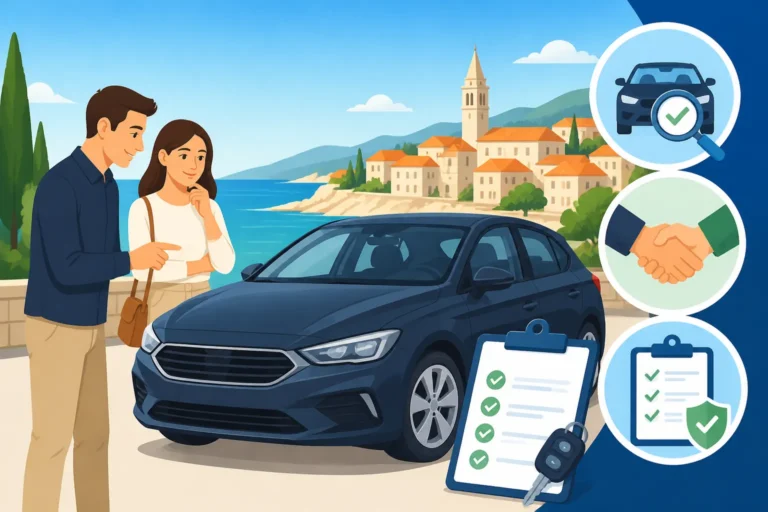
- Used Cars: The used car market in Croatia offers more affordable options, but also more potential pitfalls. You can buy from private sellers or used car dealerships. When buying privately, ensure you bring someone knowledgeable about cars, or even pay for an independent mechanic to inspect the vehicle. Always check the vehicle's history – its servisna knjižica (service book) and ensure all ownership documents (like the prometnna dozvola and knjižica vozila) are in order. The seller should ideally have a valid technical inspection (tehnički pregled) certificate. The transfer of ownership is typically done at a public notary or a vehicle registration office (Stanica za tehnički pregled vozila). You'll also need to pay a 3% real estate transfer tax on used vehicles, calculated on the purchase price. Be wary of deals that seem too good to be true. For detailed insights, check our guide on How to Buy a Used Car in Croatia as a Foreigner.
The Annual Technical Inspection (Tehnički Pregled)
Every vehicle registered in Croatia, new or old, must undergo an annual technical inspection (tehnički pregled) at a licensed CVH station. This is a mandatory safety and emissions check, similar to MOT in the UK or TÜV in Germany. You simply drive your car to a CVH station, present your prometnna dozvola (registration card), and they will conduct a thorough examination. This includes checking brakes, lights, tires, suspension, emissions, and other safety components. If your vehicle passes, you’ll pay a fee and receive a new stamp on your prometnna dozvola and a sticker for your windshield. If it fails, you'll be given a list of defects that need to be repaired, and you’ll have a grace period (usually 15 days) to fix them and bring the car back for a re-inspection. It's a non-negotiable part of car ownership here.
Key Croatian Road Rules and Regulations
Ignorance of the law is no excuse, especially when it comes to driving. Croatian road rules are mostly standard European, but some specific regulations are good to know.
Speed Limits and Traffic Laws
Croatia adheres to standard European speed limits:
- Residential areas: 50 km/h (unless otherwise signed)
- Outside residential areas: 90 km/h (unless otherwise signed)
- Expressways (brza cesta): 110 km/h
- Highways (autocesta): 130 km/h
These limits are strictly enforced, especially with speed cameras and unmarked police cars. Fines can be substantial, and accumulating too many points can lead to licence suspension. Always pay attention to signage, as limits can change frequently, particularly on winding coastal roads. It's also mandatory to drive with headlights on during the day from October 28 to March 31. Beyond that, headlights are always required for motorcycles and mopeds. The use of mobile phones while driving is strictly prohibited unless using a hands-free system. Seatbelts are mandatory for all occupants, front and rear. Children up to 12 years old must be in an appropriate car seat or booster, generally in the rear, unless specific conditions allow otherwise.
Alcohol Limits and Penalties
Croatia has a very strict stance on drinking and driving. The legal blood alcohol limit for most drivers is 0.05% (0.5 grams per liter). However, for professional drivers, drivers under 24 years old, and drivers of certain vehicle categories, the limit is 0.00%. This effectively means that if you're a new or younger driver, even one drink could put you over the legal limit.
Penalties for exceeding the alcohol limit are severe and increase significantly with the level of alcohol in your system. Fines can range from several hundred to several thousand euros, and you could face immediate licence confiscation, driving bans, and even jail time for serious offenses. Given the country's love for good wine and rakija, it's always best to simply not drink and drive at all. Designate a driver, use taxis, or rely on public transport.
Mandatory Equipment and Safety Gear
Your vehicle needs to be equipped with certain items by law. Failing to have these can result in fines during a police check:
- Reflective vest: Every occupant who steps out of a broken-down vehicle on the road must wear a reflective vest. It's wise to have one for each person, readily accessible (not in the boot).
- First-aid kit: A standard European first-aid kit is mandatory.
- Warning triangle: At least one warning triangle is required. If you're towing a trailer, you need two.
- Spare wheel (or repair kit): While a full-sized spare wheel is preferred, a tire repair kit and compressor can sometimes suffice, but check regulations carefully for your vehicle type.
- Winter equipment: From November 15 to April 15, winter tires (with a minimum tread depth of 4 mm) or summer tires with snow chains in the boot are mandatory in certain regions, especially continental Croatia and mountainous areas. Specific signs will indicate where this applies. Generally, it's safer and advisable to have proper winter tires if you'll be driving during this period, even if not strictly enforced everywhere.
Navigating Croatian Roads: Tolls, Parking, and Fuel
Once you're legally ready to drive, understanding the practicalities of day-to-day driving in Croatia becomes essential.
Understanding Highway Tolls and the ENC Device
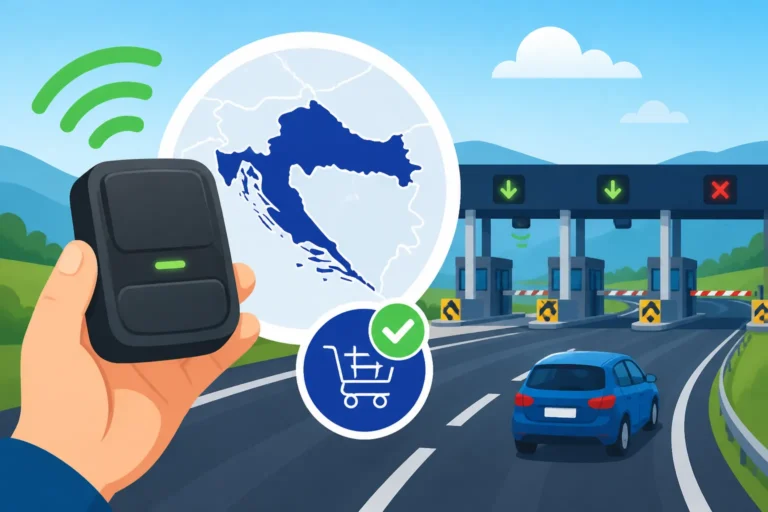
Most Croatian highways (autoceste) are toll roads. The toll system is generally "open" or "closed." In a closed system, you take a ticket when you enter the highway and pay based on distance when you exit. In an open system, you pay a fixed fee at a toll booth for a specific section. You can pay with cash (Euros), credit/debit cards, or, most conveniently, with an ENC device.
The ENC (Elektronička Naplata Cestarine – Electronic Toll Collection) device is a small transponder that you attach to your windshield. As you pass through the dedicated ENC lanes at toll booths, it automatically registers your passage and deducts the toll from your prepaid account, often with a significant discount (usually 20-25%). This saves you time, especially during peak tourist season, and money in the long run. You can purchase an ENC device and load credit onto it at any major toll booth or HAC (Hrvatske autoceste) office. For more information, check out How to Get an ENC Device for Croatian Highway Tolls.
Parking in Croatian Cities
Parking can be a challenge in popular Croatian cities, especially during summer. Most cities operate paid parking zones, often designated by different colors (e.g., red for short-term, green for medium, yellow for long-term). Payment is typically made via parking meters (which accept coins or cards) or, more commonly, via SMS. You send your vehicle's registration plate number to a specific number displayed on the parking sign for the zone you're in, and you'll receive a confirmation SMS. Parking apps are also becoming increasingly popular. Always check the signs carefully for specific zone rules, operating hours, and maximum parking durations. Improperly parked cars are subject to hefty fines and, in some cases, towing (pauk service). Be particularly careful in historic city centers where parking is often limited to residents or completely prohibited.
Fuel Types and Filling Stations
Croatia primarily uses standard European fuel types: Eurosuper 95, Eurosuper 98 (or 100 octane at some stations), and Eurodiesel. LPG (plin) is also widely available. Electric vehicle charging infrastructure is still developing but is growing, especially in cities and along major highways. Filling stations are plentiful on main roads and highways, less so in very rural areas. Many major stations operate 24/7, while smaller ones might have limited hours. You'll find international brands like INA, Crodux, Tifon, Petrol, and Shell. Most stations accept cash and major credit/debit cards. The price of fuel is regulated by the government and can fluctuate, so keep an eye on national news or apps for current pricing.
Dealing with Accidents and Emergencies on Croatian Roads
Even the most careful drivers can encounter unexpected situations. Knowing what to do in case of an accident or emergency can make a stressful situation much more manageable.
Steps to Take After an Accident
If you're involved in a road accident in Croatia, remember to stay calm and follow these steps:
- Ensure Safety: First and foremost, check for injuries. If anyone is injured, immediately call the emergency services. Move your vehicle to a safe location if possible, or put on your reflective vest and place a warning triangle a sufficient distance behind your vehicle to alert oncoming traffic.
- Call Emergency Services:
- 112: General emergency number (police, ambulance, fire)
- 192: Police (if no injuries, but significant damage)
- 194: Ambulance (if injuries)
The police should be called for any accident involving injuries, significant property damage, or if there's a dispute over fault. For minor bumps with no injuries and minimal damage, a police report might not be strictly necessary, but it’s always safer to get one, especially as a foreigner, for insurance purposes.
- Exchange Information: With other parties involved, exchange driver's licence details, vehicle registration numbers, insurance information (company and policy number), and contact details. Take photos of the accident scene, vehicle damage, and any relevant road signs or conditions.
- Do Not Admit Fault: Even if you think you might be at fault, avoid making any admissions at the scene. Let the police and insurance companies determine liability.
- Inform Your Insurance Company: As soon as possible, inform your Croatian car insurance provider about the accident. They will guide you through the claims process.
Emergency Roadside Assistance
For vehicle breakdowns or minor issues, several options are available:
- HAK (Hrvatski autoklub): The Croatian Automobile Club (HAK) provides 24/7 roadside assistance across Croatia. They are the equivalent of AAA or ADAC. If you're a member of a reciprocal club in your home country (like ADAC), you might have coverage through them; otherwise, you can call HAK directly at 1987 (from a Croatian number) or +385 1 1987 (from a foreign number or mobile). They can help with flat tires, battery issues, towing, and minor mechanical repairs.
- Insurance Company Assistance: Many comprehensive car insurance policies in Croatia include roadside assistance as part of their package. Check your policy details for their dedicated emergency number.
- Independent Services: In larger cities, you can find independent tow trucks and repair shops, but for reliability and widespread coverage, HAK is usually the go-to.
Having a charged phone and a portable power bank is always a good idea, as is an emergency data plan from a provider like Airalo if you're using an eSIM, to ensure you can call for help.
Insurance Requirements for Drivers in Croatia
Insurance is not just a good idea; it's a legal requirement. Navigating the world of Croatian car insurance can feel a bit daunting, but understanding the basics is key.
Mandatory Third-Party Liability Insurance
In Croatia, third-party liability insurance (obvezno osiguranje od odgovornosti za štetu nanijetu trećim osobama) is legally mandatory for all vehicles. This insurance covers damages you might inflict on other vehicles, property, or persons in an accident where you are deemed at fault. It does not cover damages to your own vehicle or injuries to yourself.
You cannot register a vehicle or renew its registration without proof of valid third-party liability insurance. Prices vary based on the vehicle type, engine power, your driving history, and the insurance company. Several major insurance companies operate in Croatia, including Croatia Osiguranje, Euroherc, Generali, Uniqa, and Allianz. It's always wise to get quotes from multiple providers to compare prices and coverage. Often, you can purchase this insurance at the same CVH station where you conduct your technical inspection and registration.
Optional Comprehensive and Collision Coverage
While third-party liability is mandatory, many expats opt for additional, voluntary insurance to protect their own vehicle and themselves. These typically include:
- Kasko Osiguranje (Comprehensive Insurance): This is the most extensive optional coverage. It covers damages to your own vehicle, regardless of fault. This can include damage from collisions, theft, vandalism, fire, natural disasters (hail, floods, storms), and even falling objects. The cost of kasko insurance is significantly higher than basic liability, and it often comes with a deductible (franšiza) – an amount you have to pay out-of-pocket before the insurance kicks in.
- Additional Coverages: Many insurers offer specific add-ons, such as:
- Zaštita stakala (Glass protection): Covers damage to your windshield and windows.
- Pomoć na cesti (Roadside assistance): As mentioned earlier, this can be part of your policy.
- Pravna zaštita (Legal protection): Covers legal costs in case of disputes related to driving.
- Osiguranje vozača i putnika (Driver and passenger insurance): Covers injuries to yourself and your passengers, above and beyond the mandatory third-party liability.
Deciding on the level of optional insurance depends on your budget, the value of your car, and your personal risk tolerance. Given the varied driving conditions and potential for minor scrapes in tight parking spots or crowded streets, comprehensive kasko insurance is often a worthwhile investment, especially for newer or more valuable vehicles. Remember, vehicle insurance is just one aspect of protecting your assets; considering other forms of coverage is important, as detailed in Understanding Home Insurance Options in Croatia.
| Licence Type/Origin | Validity Period in Croatia (after residency) | Exchange Required? | Full Driving Test Required? | Key Documents Needed |
|---|---|---|---|---|
| EU/EEA Licence | Indefinite | Recommended | No | Original Licence, OIB, Residency Proof, Medical Cert. |
| Non-EU/EEA (with agreement) | Up to 1 year | Yes | No | Original Licence, OIB, Residency Proof, Med Cert, Translation |
| Non-EU/EEA (no agreement) | Up to 1 year | Yes | Yes (Theory & Practical) | Original Licence, OIB, Residency Proof, Med Cert, Translation |
| International Driving Permit | Valid for 1 year (with foreign licence) | No | No | Original Foreign Licence, IDP |
Driving with a Digital Nomad Permit or Temporary Stay
Croatia has embraced digital nomads, offering a specific residence permit. However, the rules for driving can still be a bit murky depending on your specific situation.
Rules for Short-Term Visitors and Digital Nomads
If you are visiting Croatia as a tourist (typically up to 90 days within any 180-day period for non-EU citizens) or are on a short-term stay, your valid national driving licence from your home country, accompanied by an International Driving Permit (IDP), is generally sufficient. The IDP acts as an official translation of your licence and is recognized under international conventions. You should always carry both your national licence and your IDP.
For those on a Digital Nomad Permit, the situation can be a bit confusing. While your permit grants you temporary residence, the one-year rule for exchanging non-EU/EEA licences still applies from the date your temporary residence is granted. This means that if you're a non-EU digital nomad and plan to stay for the full year of your permit, you'll need to exchange your licence before that one-year mark to continue driving legally. This is a common point of contention and frustration for digital nomads, as the process can be lengthy. For more information on this type of stay, check out How to Get a Croatian Digital Nomad Permit: The Full Guide (2027) and Can I Use Public Healthcare in Croatia on a Digital Nomad Visa? for related topics.
Longer Stays and Residency Implications
The golden rule for anyone establishing longer-term residence in Croatia – whether through work, family reunification, or other temporary residence categories – is to address your driving licence as soon as possible after obtaining your residency permit. As discussed, EU/EEA citizens have more flexibility, but non-EU/EEA citizens face a strict one-year deadline to exchange their licence.
Failure to exchange your licence can lead to significant issues. Not only will you be driving illegally, but your insurance might also be invalidated in the event of an accident. This could leave you personally liable for damages. The MUP is generally quite firm on these regulations, and while the process can be slow and require multiple visits and documents, it's a critical step for smooth integration into Croatian life as a driver. Don't underestimate the time it will take, and begin gathering your documents well in advance. Understanding your overall residency status is paramount, so consider our guide The Complete Guide to Croatian Residence Permits for Expats (2027).
Getting set up to drive in Croatia can certainly feel like a marathon, not a sprint. From understanding the nuances of licence exchange to navigating vehicle registration and deciphering local driving etiquette, there are many hoops to jump through. But with a bit of patience, persistence, and this guide in hand, you’ll soon be confidently cruising along the Adriatic coast or exploring the hidden gems of the Croatian interior. Just remember to breathe, bring all your documents (and then some!), and be prepared for a few extra trips to the MUP. It’s all part of the expat adventure!
Disclaimer
The information provided in this guide is intended for general informational purposes only and does not constitute legal, financial, or professional advice. While we strive to keep the content accurate and up-to-date, regulations in Croatia, particularly those related to driving, residency, and taxes, can change frequently. It is essential to consult with official government sources (such as the Ministry of Interior – MUP, the Croatian Automobile Club – HAK, or a qualified legal professional in Croatia) for the most current and specific advice pertaining to your individual circumstances. We cannot be held responsible for any inaccuracies, omissions, or any actions taken based on the information presented herein.