Understanding the 90/180 Schengen Rule for Croatia
One of the biggest headaches and sources of anxiety for non-EU/EEA citizens exploring Croatia – and indeed the wider European continent – is navigating the infamous Schengen 90/180 rule. It’s a seemingly simple regulation that can quickly become a tangled mess, leading to accidental overstays and severe consequences. This guide aims to untangle that knot for you, providing clear, empathetic, and realistic advice on how to understand and comply with this crucial rule, especially now that Croatia is a full Schengen member.
Croatia and the Schengen Area: A New Era for Travelers
For years, many non-EU visitors could enjoy their 90 days in Croatia then move on to the Schengen Zone for another 90 days, or vice versa, essentially doubling their stay in Europe. Ah, those were the days, right? Well, that particular loophole firmly closed on January 1, 2023, when Croatia officially joined the Schengen Area. This means that your time spent in Croatia now counts towards your overall Schengen allowance, fundamentally changing how many of us plan our European adventures.
Croatia's Full Entry into Schengen
Croatia’s entry into the Schengen Area was a huge milestone, celebrated by many for the ease of travel it brought between member states. No more passport controls when driving from Slovenia to Croatia, or taking a ferry from Italy! For residents, it meant seamless travel. However, for our non-EU friends, it also meant a significant shift in how their travel days are calculated. Suddenly, that lovely month you spent exploring the Dalmatian coast, then another month hiking in Austria, and a third visiting family in Germany, all fall under one umbrella: the 90-day limit within any 180-day period. It’s a game-changer, and it has certainly caught some people off guard, leading to difficult situations.
Think of the Schengen Area not as a collection of individual countries, but as one single territory when it comes to visa and entry rules for third-country nationals. Once you're in, you're in the whole zone. This unity means simplified border crossings internally but also demands a stricter adherence to overall stay limits. For instance, if you’re planning a big move, perhaps with the help of international moving services like Sirelo, it’s crucial to understand that even your initial scouting trips or short visits before your long-term visa is approved will count towards this limit. Don't underestimate how quickly those days can add up!
Who the 90/180 Rule Applies To
This rule is primarily for non-EU/EEA/Swiss citizens who do not require a visa for short stays in the Schengen Area. This includes citizens of countries like the United States, Canada, Australia, the United Kingdom (post-Brexit), and many others. If you're from one of these countries, you can typically enter the Schengen Area for tourism, business, or family visits for up to 90 days without needing a visa. The catch? It's not 90 days per country, nor 90 days per trip, but 90 days total within any 180-day rolling period across the entire Schengen Zone.
If you already have a national long-stay visa (Type D visa) for Croatia or another Schengen country, or a temporary residence permit in Croatia, then the 90/180 rule doesn't apply to your stay in the issuing country. However, it does apply to your travel outside of that country but still within the Schengen Area. For example, if you have a Croatian residence permit and decide to pop over to Italy for a weekend, those days in Italy will still count towards a separate 90/180 allowance if you were to visit other Schengen countries without returning to Croatia. It's convoluted, I know, but the key is to differentiate between your authorized long-term stay in one country and your short-term tourist visits to others within the zone.
Breaking Down the 90/180 Rule: The Fundamentals
The 90/180 rule often sounds more complicated than it is, but its application can indeed be tricky because of the "rolling" nature of the 180-day period. Let's really break it down, piece by painful piece.
Defining "90 Days"
The "90 days" part refers to the maximum cumulative number of days you are allowed to spend in the Schengen Area. This is the total number of days, regardless of how many times you enter or exit. Every day you are physically present in any Schengen country counts. Even if you arrive at 11 PM and leave at 1 AM the next day, that's still considered two days. It doesn't matter if you spend them all in Croatia, or hop between France, Germany, and then back to Croatia. They all add up towards that 90-day maximum.
Imagine you flew into Zagreb on January 1st and stayed for 30 days. You then left for a non-Schengen country (say, Albania or Bosnia and Herzegovina – great places to visit by the way!) and re-entered the Schengen Area (perhaps Slovenia) on March 1st for another 30 days. You now have used 60 days. If you then return to Croatia for a final 30 days, you've hit your 90-day limit. At this point, you absolutely must leave the Schengen Area for a non-Schengen country and cannot return until a significant cool-off period has passed.
Defining "180 Days"
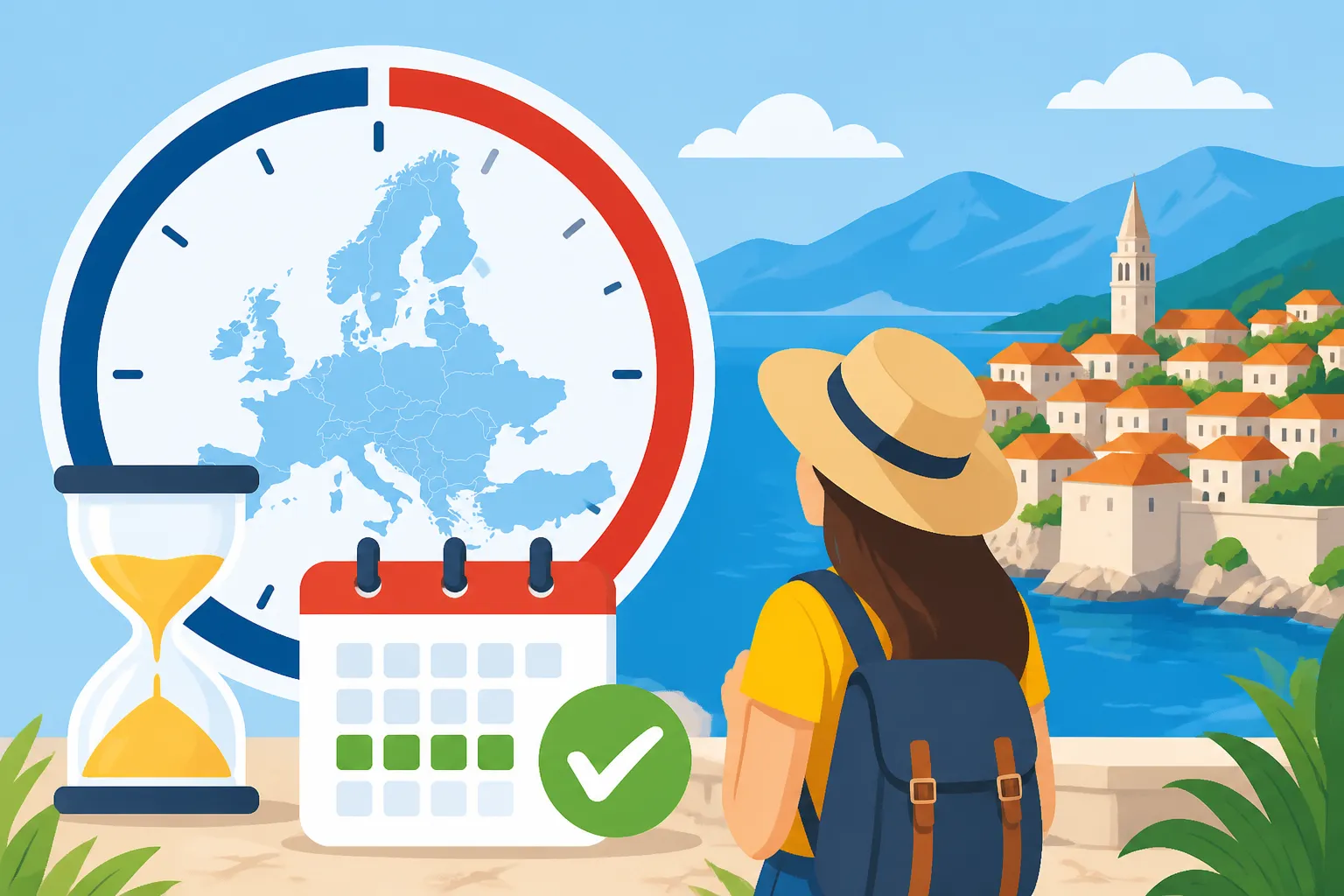
This is where it gets particularly nuanced. The "180 days" doesn't mean you get a fresh 90 days every six months from your first entry. It's a "rolling" period. What does "rolling" mean? It means that on any given day, you must not have spent more than 90 days in the Schengen Area within the preceding 180-day period. This is crucial to grasp. It's not a fixed calendar period like January 1 to June 30. It's constantly moving.
Let's say today is October 27th. To figure out if you're compliant, you would look back exactly 180 days from October 27th (which would be around May 1st). Then, you'd add up all the days you've spent in the Schengen Area between May 1st and October 27th. If that sum is 90 days or less, you're good. If it's more, you've overstayed or are about to. This rolling calculation is the part that trips up most people and why it's so important to track your days meticulously. It demands forward-thinking and careful planning, especially if you plan multiple entries and exits.
The Rolling Window Explained
Let's try a concrete example of the rolling window to make it clearer:
- January 1: You enter Croatia (Schengen). Stay for 30 days.
- January 31: You exit Schengen. Total days used: 30. Remaining: 60.
- March 1: You re-enter Slovenia (Schengen). Stay for 30 days.
- March 31: You exit Schengen. Total days used: 60. Remaining: 30.
- May 1: You re-enter Germany (Schengen).
Now, here's the trick: on May 1st, when you re-enter, the immigration officer (or your mental calculator) looks back 180 days from May 1st. So, they're looking at the period from early November of the previous year to May 1st. In that period, you've spent 30 days in January and 30 days in March. That's 60 days. So, you still have 30 days left in your current 180-day window.
The days you spent in January will eventually "fall off" the 180-day window as time progresses. For example, if on July 1st you were to check your allowance, the 180-day window would be from January 2nd to July 1st. Your January 1st entry would no longer be counted in that window, thus "freeing up" those days. This rolling aspect means that the 180-day period isn't a fixed block; it's a sliding scale that constantly shifts based on the current date. It's truly a "look back" system.
Calculating Your Days: How to Stay Compliant
Given the complexities of the rolling 180-day window, merely estimating your days is a recipe for disaster. You need a system, folks! Getting this wrong can lead to serious trouble down the line, so take this part seriously.
Manual Tracking Methods
If you're old-school or just prefer to have a tangible record, a simple spreadsheet or even a dedicated notebook can be your best friend. Create columns for:
- Entry Date (Schengen)
- Exit Date (Schengen)
- Country of Entry/Exit
- Number of Days Spent
- Cumulative Days in Schengen
Each time you enter or exit the Schengen Area, record it. Then, to check your allowance, take your current date and count back 180 days. Sum up all the days you've spent within that specific 180-day timeframe. It's tedious, yes, but it works. This method also gives you a clear log of your movements, which can be useful if there are ever any discrepancies at border control.
Many expats find this a bit overwhelming, especially if they make frequent short trips in and out of the Schengen zone. It’s easy to make a mistake when doing it manually, and those mistakes can be costly. For example, if you're exploring the Balkans, it's very easy to pop into Bosnia and Herzegovina or Montenegro from Croatia, then back into Croatia, and each of those entries and exits needs to be logged meticulously.
Online Calculators and Apps
Thankfully, technology is here to save us from mental gymnastics! The European Commission provides an official short-stay visa calculator, which is generally considered the most reliable tool. You input your past and planned entry/exit dates, and it tells you how many days you have remaining. It's a lifesaver.
There are also various third-party apps available for smartphones that aim to do the same thing. Just be sure to pick a reputable one and double-check its calculations against the official guidelines or the European Commission's calculator if you have any doubts. These tools simplify the rolling 180-day calculation, giving you peace of mind. Always keep your passport stamps as your definitive record, as border guards will rely on those. These apps and calculators are fantastic for planning, but the stamps are the ultimate proof of your actual movements.
Here's a simplified example of how such a calculator might display your days:
| Entry Date | Exit Date | Days in Schengen | Remaining Days (Current 180-day window) |
|---|---|---|---|
| 2024-01-05 | 2024-02-04 | 31 | 59 |
| 2024-03-10 | 2024-04-09 | 31 | 28 |
| 2024-05-15 | (Planned) | 28 days left until 2024-11-10 |
Note: This table is a simplified view. An actual calculator would dynamically adjust "Remaining Days" based on the current date and the rolling 180-day window.
Common Misconceptions and Pitfalls for Expats
It's astonishing how many subtle misunderstandings there are about the Schengen rule, even among seasoned travelers. These misconceptions can lead to unintentional overstays, which are still treated seriously.
Counting Entry and Exit Days
A common mistake is thinking that your day of entry and day of exit don't count, or that only "full days" count. This is absolutely not true. The rule explicitly states that the day of entry and the day of exit both count towards your 90-day total. So, if you arrive on Monday and leave on Tuesday, that's two days used, not one. This might seem trivial, but it can quickly shave off precious days if you have a lot of short trips planned. Be meticulous with your calendar.
Furthermore, it's not about 24-hour periods. It's simply about being present in the Schengen Area at any point during a calendar day. If you cross the border at 11:59 PM, that day counts. If you leave at 12:01 AM, that day also counts. This level of detail is why a digital calculator is often preferred over manual counting, as it minimizes human error in these small but significant calculations.
Difference Between Schengen and EU
This is a big one, especially now with Croatia's new status. Many people conflate the "European Union" with the "Schengen Area," but they are not the same thing. The European Union is an economic and political union of 27 member states. The Schengen Area is a zone of 27 European countries that have abolished passport and all other types of border control at their mutual borders.
Crucially, not all EU countries are in Schengen (e.g., Ireland, Cyprus, Bulgaria, Romania, though the latter two are in the process of partial accession as of early 2024). And some non-EU countries are in Schengen (e.g., Iceland, Liechtenstein, Norway, Switzerland). So, spending time in a non-Schengen EU country like Ireland does not count towards your 90-day Schengen limit. Conversely, spending time in a non-EU Schengen country like Switzerland does count. This distinction is vital for accurate travel planning. Previously, Croatia was an EU country but not Schengen, which allowed for that separate 90-day stay. No more!
"Visa Runs" and Their Futility
In the old days, before strict enforcement and sophisticated tracking systems, some travelers attempted "visa runs" – a quick hop out of the Schengen Area to a neighboring non-Schengen country (like Bosnia and Herzegovina, Serbia, or Montenegro from Croatia), only to re-enter a day or two later, hoping to "reset" their 90-day clock. Let me be clear: this does not work for the 90/180 rule. The rolling 180-day period ensures that those days spent outside the Schengen Area simply allow the "old" days to fall off the back end of the 180-day window. It doesn't give you a fresh 90 days as soon as you re-enter.
Immigration authorities are well aware of this tactic and have sophisticated databases that track all your entries and exits. Trying to manipulate the system by doing "visa runs" is not only futile but can also raise red flags, leading to increased scrutiny and potential issues upon re-entry or future visa applications. The only way to get a "fresh" 90-day period is to genuinely spend sufficient time outside the Schengen Area for enough of your previous days to roll off the 180-day calculation, or to secure a long-stay visa for a specific country.
Consequences of Overstaying: What to Expect
Let me tell you, overstaying your welcome in Croatia, or any Schengen country for that matter, is absolutely not something you want to experience. The consequences can range from a slap on the wrist to very severe penalties that affect your future travel plans globally. It’s just not worth the risk.
Fines and Deportation
The immediate consequences of an overstay usually involve fines. These can vary significantly depending on the country, the length of your overstay, and the discretion of the border officer. In Croatia, the fines for overstaying can be substantial. For example, you might be looking at fines ranging from €130 to €660, or even higher, depending on the severity and duration of the overstay. And that's just the financial penalty.
Beyond the fines, deportation is a very real possibility. If caught overstaying, authorities have the right to detain you and arrange for your immediate removal from the Schengen Area. This means you’ll be put on the next available flight back to your home country (or a country that will accept you), often at your own expense. This isn't just an inconvenience; it can be incredibly distressing and costly. I've heard stories from fellow expats, and trust me, it’s not an experience anyone wants to have.
Future Travel Bans
Perhaps the most long-lasting and impactful consequence of overstaying is a potential ban from re-entering the Schengen Area. If you overstay, even by a few days, you could be flagged in the Schengen Information System (SIS), a shared database used by all member states. This flag can result in a ban of several years (commonly 1 to 5 years, but potentially longer for more severe overstays).
A Schengen ban means you will be denied entry to all Schengen countries during the ban period. This isn't just about tourism; it can impact future work opportunities, family visits, or even transit through major European hubs. It can also complicate visa applications for other countries, as an immigration violation in one region can sometimes be viewed negatively by other nations. A travel ban can seriously derail your life plans, so it's critical to be vigilant and avoid overstaying at all costs. It's truly better to be safe than sorry when it comes to these rules.
Beyond the 90/180 Rule: Long-Stay Options in Croatia
If the 90-day limit feels too restrictive for your Croatian dreams, don't despair! Croatia, like other Schengen countries, offers various long-stay options that allow you to reside here for extended periods, bypassing the 90/180 rule entirely. These are typically called Temporary Residence Permits (Privremeni Boravak) or long-stay (Type D) visas.
Temporary Residence Permits
For those who wish to spend more than 90 days in Croatia within a 180-day period, a temporary residence permit is usually the answer. These permits are granted for specific purposes, such as:
- Work: If you've found a job with a Croatian employer, you'll apply for a single work and residence permit. You can read more about this in our guide on The Expat Guide to Temporary Residence (Privremeni Boravak) in Croatia.
- Study: If you're enrolling in a Croatian educational institution.
- Family Reunification: For spouses or immediate family members of Croatian citizens or existing residents.
- Self-Employment/Business: If you plan to open a business or operate as a self-employed individual. This often involves registering a paušalni obrt.
- Other purposes: There are also categories for scientific research, humanitarian reasons, or even ownership of real estate under certain conditions.
The process for obtaining a temporary residence permit involves submitting a comprehensive application to the Ministry of Interior (MUP) in Croatia, either directly or through a Croatian embassy/consulate in your home country. This will require a lot of documentation, including proof of financial means, accommodation, criminal record checks, and crucially, health insurance. Make sure your health insurance, such as a plan from Cigna Global, meets all the requirements for your residence permit application. You can find more details in The Complete Guide to Croatian Residence Permits for Expats (2027).
Digital Nomad Visa
Croatia was one of the first countries in Europe to introduce a dedicated Digital Nomad Permit, and it has been a huge success! This permit allows non-EU/EEA citizens who work remotely for foreign companies or clients to reside in Croatia for up to one year, with the possibility of renewal after a 6-month break. This is an excellent option for those who want to experience Croatian life without being tied to a local employer.
To qualify, you generally need to prove you're a legitimate digital nomad (e.g., provide employment contracts, business registration, client invoices), demonstrate sufficient income (which is regularly updated, so always check the latest requirements!), and secure comprehensive health insurance. This permit specifically allows you to stay in Croatia for the duration of its validity, and your time spent here does not count towards the Schengen 90/180 rule. However, remember, if you travel to other Schengen countries, your time there would fall under the 90/180 rule for those other countries. Dive deep into How to Get a Croatian Digital Nomad Permit: The Full Guide (2027) for all the nitty-gritty details.
Other Long-Term Options
Beyond work, study, and digital nomad permits, Croatia offers a few other avenues for long-term stays:
- Long-Stay (Type D) Visa: This is a national visa issued by a specific Schengen country (in this case, Croatia) that allows you to stay for longer than 90 days. It's often a prerequisite for applying for a residence permit once you arrive in Croatia. For example, if you're applying for a student residence permit, you might first need a Type D student visa. You can learn more about this in How to Apply for a Long-Stay (Type D) Visa for Croatia.
- Pensioner Residence: While not a direct "retiree visa" like some other countries, non-EU pensioners can often apply for temporary residence in Croatia based on sufficient financial means. This requires proving a stable, regular income from your pension or other sources, adequate health insurance, and secured accommodation. Understanding Residence Requirements for Pensioners in Croatia has more details.
- EU Long-Term Resident Status: After five continuous years of legal residence in Croatia, you might be eligible for EU long-term resident status, which grants more extensive rights and easier movement within other EU countries.
- Permanent Residence: The ultimate goal for many, allowing indefinite stay in Croatia. This typically requires five years of continuous temporary residence. Check out Permanent Residence in Croatia: The Complete Pathway (2027) for the full picture.
No matter which path you choose, remember that moving to a new country like Croatia involves a fair bit of paperwork and planning. Companies like Sirelo can be incredibly helpful for managing the logistics of international moves, ensuring your belongings arrive safely while you navigate the immigration maze. It’s also wise to research health insurance options early on; policies from providers like Cigna Global are often designed with expats in mind and can fulfill the requirements for most long-term visa or residence applications. Getting your OIB, a personal identification number, will be a fundamental step in all these processes, so you'll also want to understand How to Get Your OIB and Why It Matters for Healthcare Access. And don't forget to understand what health insurance you actually need for your specific permit; What Health Insurance Do I Need for a Croatian Residence Permit? is a good place to start. Finally, once you have your permit, you'll receive your How to Get a Biometric Residence Card (Boravišna Iskaznica) in Croatia, which is your official proof of residence.
Disclaimer
Please remember that immigration laws and regulations in Croatia and the wider Schengen Area can change frequently. While we strive to provide the most accurate and up-to-date information, this guide is for informational purposes only and does not constitute legal advice. Always consult with official government sources, the Croatian Ministry of Interior (MUP), or a qualified immigration lawyer for personalized advice regarding your specific situation.