How Do I Add My Spouse to My Croatian Health Insurance?
Moving to Croatia with a partner often feels like a romantic adventure until you encounter the legendary bureaucracy of the Croatian Health Insurance Fund, known as HZZO. Navigating the paperwork required to ensure your spouse is legally covered and has access to a doctor is one of the most stressful hurdles for new expat families. This guide explains exactly how to bridge that gap and successfully add your spouse to your health insurance plan.
Understanding the Legal Basis for Spousal Coverage in Croatia
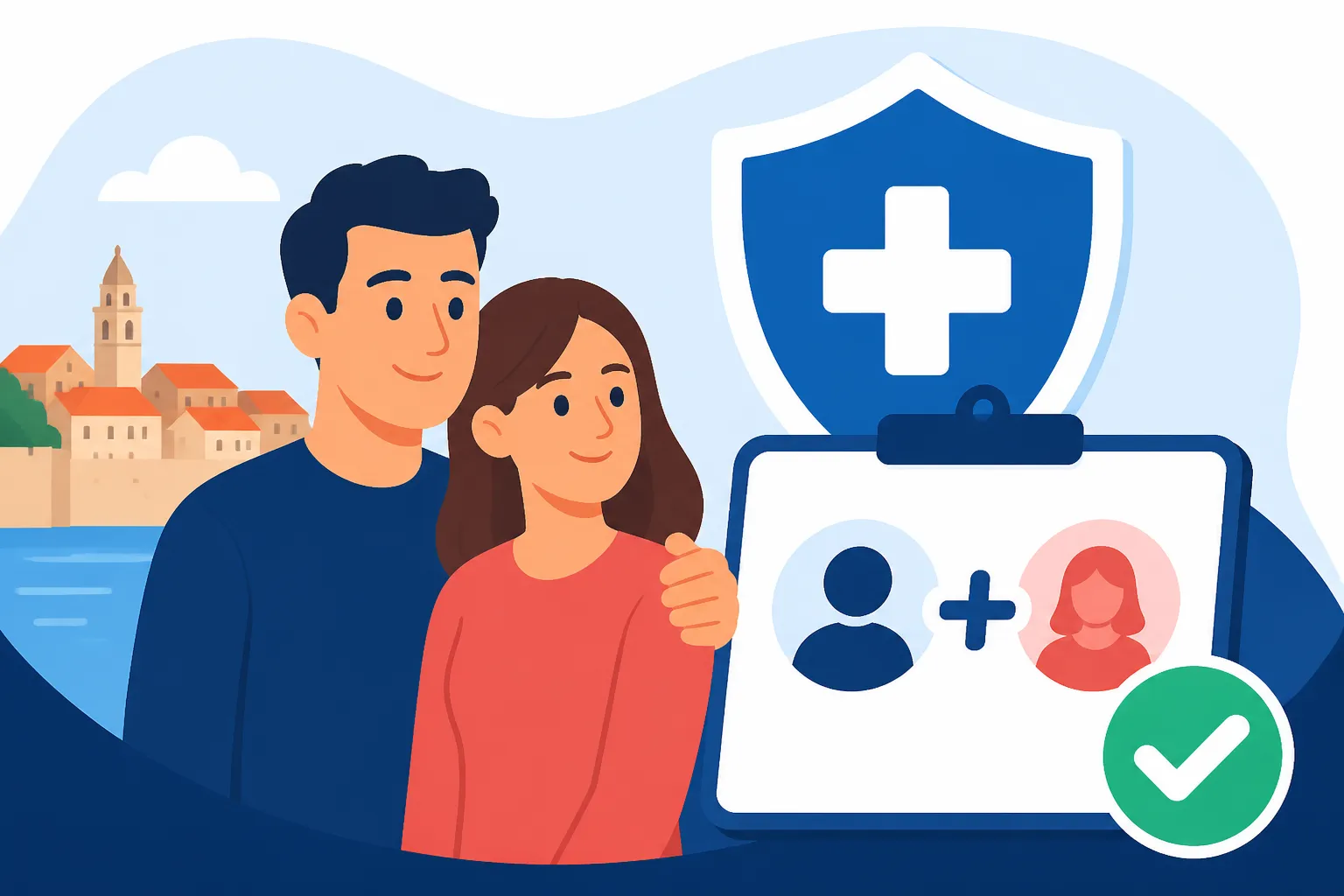
In Croatia, the healthcare system is built on a foundation of universal mandatory insurance managed by HZZO (Hrvatski zavod za zdravstveno osiguranje). If you are legally employed in Croatia, or if you have a recognized residence status that requires you to pay into the system, you are the "primary insured person." Your spouse can often be covered under your policy as a dependent, a status known as osigurani član obitelji.
This isn't a simple "check a box" process. The Croatian state meticulously verifies the legitimacy of the relationship and the residency status of both parties. To get started, you must understand How the Croatian Health Insurance Fund (HZZO) Works: A Full Overview to appreciate that this is a centralized, highly regulated public system. It is not like a private plan where you just call an agent; it involves physical visits to regional offices and a specific sequence of document submissions.
The status of your spouse depends heavily on their own residency. If they have been granted temporary residence based on family reunification, they are eligible to be insured through you. However, the clock starts ticking the moment they receive their residence permit. Croatia generally requires every resident to be insured, so avoiding this task can lead to retroactive debt where HZZO charges you for "uninsured months" dating back to the day the residence permit was issued.
Who Qualifies as a Spouse for HZZO Purposes?
The definition of a spouse in Croatia is relatively broad but strictly documented. It includes legally married husband and wife, but Croatia also recognizes formal and informal life partnerships. If you are in a same-sex partnership, you should look into Understanding Life Partnership (Životno Partnerstvo) for Immigration to see how your legal status translates to healthcare rights.
For the traditional marriage route, you will need a marriage certificate that is not older than six months in many cases, or at least a fresh extract from the registry. If the marriage took place outside of Croatia, this document must be translated into Croatian by a certified court interpreter and, depending on your home country, may need an Apostille stamp. Without the proper "legalization" of your marriage certificate, the HZZO clerk will likely reject the application immediately.
The Importance of the OIB and Residency
Before you even walk into an HZZO office, your spouse must exist in the Croatian system. This starts with the OIB (Osobni identifikacijski broj). You cannot add a spouse to insurance if they do not have this personal identification number. If you are still in the early stages of relocation, reading up on How to Get Your OIB and Why It Matters for Healthcare Access is an essential first step.
Furthermore, your spouse must have a registered address. When you go to the police station (MUP) to register their stay, they will receive a certificate or a biometric card. This card is the golden ticket. HZZO will rarely process an insurance application for a spouse until the MUP has confirmed their residence status. If you are waiting on a permit, it is often wise to have a bridge policy like SafetyWing to ensure you aren't left without any protection while the wheels of bureaucracy turn. SafetyWing offers a flexible way to stay covered during these transitional months when you are legally in the country but not yet "in the system."
The Step-by-Step Process for HZZO Registration
Once you have your OIB and your residence permit, it is time to visit the local HZZO branch. In Zagreb, this is often the office at Jukićeva or Margaretska, but every major town like Split, Rijeka, or Osijek has its own regional administrative center.
The process usually requires the primary insured person (the one who is working or already has insurance) to be present, or at least to have signed the necessary forms. If you are employed by a Croatian company, your HR department is responsible for your insurance, but they often do not handle the "addition of family members." That responsibility frequently falls on the individual expat to handle at the HZZO counter.
Step 1: Gathering the Required Documentation
Nothing stops a Croatian administrative process faster than a missing stamp. You will need to bring a thick folder of documents to the counter. For a non-EU spouse, the requirements are more stringent than for EU citizens, but the core list remains the same. You should consult How to Register Family Members for Health Insurance in Croatia for a deep dive into the specific forms, but here is a realistic list of what you will need:
- Form Tiskanica T-2: This is the official application form for changing or adding insurance status. You can usually find these in the office, but it’s better to download it in advance.
- The Marriage Certificate: Translated by a Croatian court interpreter and legalized (Apostille) if required.
- Proof of Identity: Your spouse’s passport and their Croatian biometric residence card.
- The OIB Certificate: The paper you received from the Tax Administration.
- Proof of the Primary Person’s Insurance: Your own HZZO card or a certificate showing you are currently employed and insured.
- Proof of Living Together: Usually, the MUP registration of address (Uvjerenje o prebivalištu/boravištu) for both of you showing the same address.
Step 2: The Physical Visit and the "Waiting Game"
When you arrive at the HZZO office, you will likely take a number and wait. When your number is called, present your folder of documents clearly. The clerk will verify that your employer has been paying your contributions. If there is even a one-day gap in your own insurance history, they might refuse to add your spouse until that gap is resolved.
If the clerk accepts the documents, they will issue a paper certificate (Potvrda). This paper acts as temporary proof of insurance. Do not lose this! It can take several weeks or even months for the plastic HZZO card to be mailed to your home address. Until that card arrives, your spouse must carry this paper to every doctor's appointment or pharmacy. For those who find this gap in physical cards nerve-wracking, having SafetyWing as a secondary backup can provide peace of mind, especially if you need to travel outside Croatia before the HZZO card arrives. SafetyWing is particularly useful because it covers you globally, whereas HZZO has specific limitations once you cross the border.
Step 3: Choosing a Primary Care Doctor
Adding your spouse to the insurance fund is only half the battle. Once they are "in the system," they are legally entitled to medical care, but they don't automatically have a doctor. You must manually find a GP who is accepting new patients. This is often the most frustrating part of the lifestyle in Croatia. You can find more detail in The Expat Guide to Finding a Family Doctor (Obiteljski Liječnik) in Croatia.
Your spouse will need to visit a Dom Zdravlja (Health Center) and ask the nurses at various offices if they have room for a new patient. Once a doctor agrees, your spouse signs a form, and that doctor becomes their gatekeeper for all referrals and prescriptions.
| Document Type | EU Spouse Requirements | Non-EU Spouse Requirements |
|---|---|---|
| Marriage Certificate | Standard EU Multilingual form | Translated by Court Interpreter + Apostille |
| Identity Proof | National ID or Passport | Passport + Biometric Residence Card |
| Residency Proof | Registration at MUP | Approved Temporary Residence Permit |
| OIB | Mandatory | Mandatory |
| HZZO Form | Tiskanica T-2 | Tiskanica T-2 |
Navigating Costs and Supplemental Insurance
A common misconception among expats is that being "on the insurance" means everything is free. In Croatia, the basic HZZO insurance covers a lot, but it does not cover everything. There is a system of co-payments called participacija. If your spouse goes to the ER or sees a specialist, they may be asked to pay a small fee out of pocket—ranging from a few euros to significant amounts for hospital stays.
The Role of Dopunsko (Supplementary Insurance)
To avoid these co-payments, almost everyone in Croatia buys Dopunsko Zdravstveno Osiguranje. This is an additional policy that usually costs around 10 EUR per month and covers all co-payments within the public system. When you add your spouse to HZZO, you should immediately look into Understanding Dopunsko Zdravstveno Osiguranje (Supplementary Insurance) in Croatia.
Without Dopunsko, a simple diagnostic test or a prescription can result in unexpected bills at the pharmacy. Most expats choose to get this supplementary insurance through HZZO directly or through private banks and insurance companies. It is a small price to pay for the "all-access" feel of the healthcare system.
Public vs. Private Options
Even with HZZO and Dopunsko, you will quickly realize that public waiting lists for specialists can be months long. This is why many expats choose to supplement their HZZO coverage with private health insurance. While HZZO is mandatory, private clinics (polyclinics) offer much faster service and often more English-speaking staff.
You should weigh the pros and cons by reading Public vs. Private Healthcare in Croatia: Which Should Expats Choose?. Many expat families find that a combination works best: HZZO for major emergencies and chronic care, and a private policy or a travel-ready plan like SafetyWing for quick specialist visits and international coverage. SafetyWing is especially popular among the digital nomad and expat community in Croatia because it handles the "international" aspect that local HZZO policies often struggle with, especially regarding medical evacuation or coverage back in your home country.
Common Obstacles and How to Overcome Them
Adding a spouse to your insurance rarely goes perfectly the first time. There are several specific "traps" that foreigners fall into. One of the most common is the "Unemployed Spouse Trap." If your spouse was working in your home country and recently quit to move to Croatia, HZZO might ask for a document from your home country's health fund (like an S1 or E104 form in the EU) proving they are no longer insured there. They want to ensure there is no "double insurance" happening within the EU.
Handling the Gap in Coverage
If your spouse's residence permit is taking a long time to process, they are technically in a legal limbo. During this time, they cannot yet be added to your HZZO. This is the most dangerous time for an expat family. If an accident happens, you will be billed as a "private payer," which can be incredibly expensive in a Croatian hospital.
This is exactly where Health Insurance in Croatia: Mandatory, Supplementary and Private Options Explained becomes vital reading. Many expats use SafetyWing during this interim period. Because SafetyWing can be bought while you are already traveling and can be cancelled once your HZZO kicks in, it acts as the perfect safety net for the 2-3 months it typically takes to get your Croatian paperwork in order.
Dealing with Language Barriers
Most HZZO offices do not have dedicated English-speaking counters. While many younger clerks speak excellent English, the "old guard" of the bureaucracy may only speak Croatian. If you are not yet fluent, it is highly recommended to bring a Croatian-speaking friend or a professional translator with you.
Misunderstanding a single instruction can lead to your application being filed in the "incomplete" pile, where it might sit for weeks. If you find yourself struggling to find a doctor who speaks English once the insurance is active, you can check How to Find an English-Speaking Doctor in Croatia for tips on navigating the local medical community.
Final Thoughts on Spousal Integration
Adding your spouse to your Croatian health insurance is more than just a bureaucratic checkbox; it is a vital part of your family’s security in a new country. While the process of visiting HZZO, gathering Apostilled documents, and waiting for plastic cards can be exhausting, the system is robust once you are finally "in."
Remember that the Croatian system values the "paper trail." Keep every receipt, every temporary certificate, and every stamped document. Once the process is complete, your spouse will have the same access to the high-quality, though sometimes slow, Croatian medical system as any citizen. By combining the mandatory HZZO coverage with supplemental Dopunsko and an international backup like SafetyWing, you ensure that your family is protected no matter what happens, whether you are in a clinic in Zagreb or traveling back home for the holidays.
Disclaimer
The information provided in this guide is for informational purposes only and does not constitute legal or medical advice. Healthcare regulations and immigration laws in Croatia are subject to change. While we strive to provide the most up-to-date information, you should always verify requirements with the official HZZO (Hrvatski zavod za zdravstveno osiguranje) or the Ministry of the Interior (MUP) before making administrative decisions. The mention of private insurance providers like SafetyWing is intended as an example of available options and does not replace the mandatory legal requirement for HZZO insurance for residents in Croatia.