Do Digital Nomads Need Health Insurance to Enter Croatia?
Navigating the bureaucracy of the Mediterranean can feel like a full-time job, and for those eyeing the Croatian Digital Nomad permit, the health insurance requirement is often the first major roadblock. This guide solves the confusion around exactly what coverage you need to enter the country, satisfy the Ministry of Interior (MUP), and ensure you are actually protected while living the dream on the Adriatic coast.
The Legal Necessity Why Health Insurance is Non Negotiable for Entry and Residence
If you are planning to move to Croatia as a remote worker, you need to understand that the "Digital Nomad Visa" is technically a grant of temporary stay. Under the Croatian Foreigners Act, providing proof of health insurance is a mandatory requirement for your application to be even considered. Many travelers assume their credit card travel insurance or a basic policy will suffice, but the reality at the local police station (MUP) can be much more rigid.
When you first enter Croatia as a tourist, especially if you are from a non-EU country like the United States, Canada, or the UK, you are likely entering under the 90/180-day Schengen rule. While you might not be asked for insurance at the border crossing at Pleso Airport or the Bregana border, you absolutely cannot transition to a residence permit without it. The officials are looking for specific language in your policy that covers the entire duration of your intended stay.
The stakes are high because a missing or inadequate insurance document is one of the most common reasons for a permit delay. You don't want to be in a situation where you have found a perfect stone house in Split but cannot secure your residency because your insurance policy doesn't meet the "full healthcare" criteria. Understanding How to Access Healthcare While on a Digital Nomad Permit in Croatia is the first step in ensuring your paperwork passes the first desk at MUP.
The Difference Between Entry Insurance and Residency Insurance
It is a common mistake to conflate the insurance you need to cross the border with the insurance you need for your residence permit. For a simple tourist entry, standard travel insurance is generally fine. However, for the Digital Nomad permit, the policy must explicitly cover "medical expenses" and "repatriation for medical reasons." This is where a specialized provider like SafetyWing becomes incredibly useful, as their policies are designed with the specific nomadic lifestyle and administrative requirements in mind.
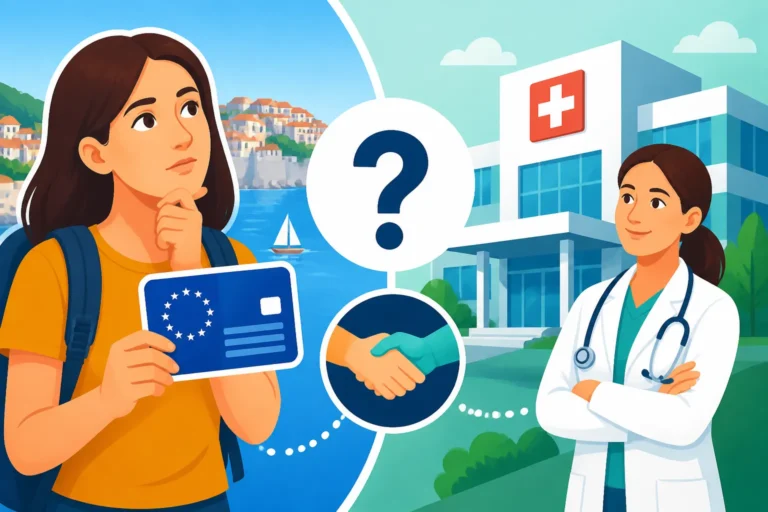
If you are an EU citizen, your path is slightly different. You can initially rely on your European Health Insurance Card (EHIC). However, if you plan to stay long-term and register your residence, you will eventually need to look into How to Use Your EHIC (EKZO) Card in Croatia as an EU Citizen and how it translates to the local system once you are no longer a "visitor" but a "resident."
Minimum Coverage Requirements for the MUP Application
The Ministry of Interior doesn't just want to see a card; they often want to see the "Policy Summary" or "Table of Benefits" translated into Croatian. The coverage must be valid for the entire period of the requested stay—usually one year. If your insurance expires in six months, they will only grant you a permit for six months.
The policy must cover at least 30,000 EUR in medical expenses, which aligns with standard Schengen requirements, but it also needs to be "comprehensive." This means it should cover emergencies, hospitalizations, and specialist visits. This is why many nomads choose SafetyWing, as it provides the necessary documentation that Croatian officials are accustomed to seeing. Using a recognized brand can sometimes smooth over the local administrative hurdles because the clerks are familiar with the format of the insurance certificates.
Exploring Your Insurance Options Public Private and International
Once you realize that insurance is mandatory, the question becomes: which type should you choose? Croatia has a robust public healthcare system, but as a digital nomad, you are in a unique category. You are not a traditional employee of a Croatian company, which means you aren't automatically funneled into the state system through payroll contributions.
Most nomads opt for a "Private International" or "Travel Medical" policy for their initial application. This is because getting into the state system, known as HZZO, can be a "chicken and the egg" scenario where you need a residence permit to get the insurance, but you need the insurance to get the residence permit. Knowing How the Croatian Health Insurance Fund (HZZO) Works: A Full Overview can help you decide if you want to eventually transition to public care once you are settled.
Travel Medical Insurance for Nomads
For the vast majority of applicants, travel medical insurance is the path of least resistance. Providers like SafetyWing offer a "Nomad Insurance" product that acts as a bridge. It meets the MUP requirements for the residence permit application and provides global coverage, which is essential if you plan to take weekend trips to Montenegro, Bosnia, or Slovenia while based in Croatia.
The advantage here is the subscription model. You can start the policy before you arrive, use the PDF certificate for your online or in-person application at MUP, and keep it active for the duration of your stay. Since SafetyWing is built for remote workers, the claims process is typically more streamlined than trying to navigate the bureaucracy of a local Croatian insurer without speaking the language.
Local Private Health Insurance in Croatia
Another option is to purchase a policy from a local Croatian provider such as Croatia Osiguranje or Allianz. These are often referred to as "Supplementary" or "Additional" insurance. While these are great for locals, they can be tricky for nomads to set up before they have an OIB (Personal Identification Number).
If you do go this route, you will need to know How to Get an OIB and Why It Matters for Healthcare Access. Without this number, you effectively do not exist in the Croatian administrative system, making it nearly impossible to sign a contract for local private insurance.
The State Health Insurance Fund (HZZO)
Technically, some nomads can opt into the HZZO system, but it is often the most expensive and administratively taxing option for someone only staying for a year. If you join HZZO, you are required to pay a monthly contribution (around 90-100 EUR) and, crucially, you may be required to pay "back-payments" for the time you were in Croatia before you registered.
Before committing to the state system, you should check How Much Is the Monthly HZZO Contribution for Self-Employed Workers to see if the math makes sense for your specific situation. For most, the combination of an international policy like SafetyWing for the permit and paying out-of-pocket for small clinic visits is the more cost-effective strategy.
| Insurance Type | Best For | MUP Acceptance | Monthly Cost (Approx) |
|---|---|---|---|
| Travel Medical (e.g. SafetyWing) | Permit Application & Travel | Very High | €45 – €90 |
| Local Private (Croatia Osiguranje) | High-end local clinics | High | €50 – €150 |
| Public State (HZZO) | Long-term residents | Mandatory for some | €95 + back-payments |
| EHIC (EU Citizens only) | EU Residents visiting | High (initially) | Free (from home country) |
The Practical Steps Proving Coverage at the MUP Office
You have your policy, you have your laptop, and you are ready to hit the MUP office in Petrinjska (if you are in Zagreb) or near the stadium in Split. But simply having the insurance isn't enough; you have to prove it in a way the Croatian clerk will accept. This is where the "administrative hurdle" becomes very real.
The clerk at the desk is often looking for specific keywords: osiguranje (insurance), bolničko liječenje (hospital treatment), and repatrijacija (repatriation). If your policy is only in English, there is a chance—depending on the city and the specific official—that they will ask for a certified translation by a "Stalni sudski tumač" (Permanent Court Interpreter).
Translation and Notarization Requirements
In larger hubs like Zagreb or Split, officials are more accustomed to English documents from global providers like SafetyWing. However, if you are applying in a smaller town or on an island like Hvar or Vis, be prepared for the request for a translation. A certified translation can cost anywhere from 20 to 40 EUR per page.
To avoid this, try to get your insurance provider to issue a one-page "Visa Letter" that summarizes the coverage in simple, clear terms. This often bypasses the need for a full policy translation. If you are still in the planning stages, you should research What Documents Do I Need for a Croatian Residence Permit to ensure your entire folder is ready for scrutiny.
What to Do If Your Insurance is Rejected
Don't panic if the official tells you your insurance isn't valid. This usually means the document doesn't clearly state that it covers the entire duration of your stay or that it lacks repatriation coverage. In this case, you can often buy a "stop-gap" local policy for a month while you fix the paperwork, or simply contact your provider to get a more detailed letter.
SafetyWing is particularly helpful here because you can download the necessary proof of coverage immediately from their portal. If MUP requires a specific date range, you can usually adjust your coverage period to match. Remember, the goal of the official is to ensure that if you get hit by a scooter in a narrow stone alley, the Croatian state isn't stuck with the bill.
Navigating the Biometric Residence Card Process
Once your insurance is accepted and your permit is approved, you will be issued a biometric residence card. This card is your "golden ticket" for living in Croatia. However, the insurance requirement doesn't end the day you get the card. You are legally required to maintain that coverage for as long as your permit is valid.
If you let your insurance lapse and the MUP finds out (which can happen during a renewal or a random check), your permit could be revoked. For a detailed roadmap of this process, see Navigating the Croatian Healthcare System: An Expat's Roadmap (2027).
Life After the Permit Using Your Insurance in Croatia
Congratulations! You have your permit and your insurance. Now, what happens when you actually get a sore throat or need a dental check-up? The Croatian healthcare system is split between the "Dom Zdravlja" (Public Health Centers) and "Poliklinike" (Private Clinics).
As a digital nomad with private international insurance like SafetyWing, you will most likely be using the private clinics. These facilities are top-tier, often looking more like boutique hotels than doctors' offices, and many of the physicians speak fluent English.
Finding English-Speaking Doctors
In major cities, finding a doctor who speaks English is relatively easy. However, you should still look into How to Find an English-Speaking Doctor in Croatia before you actually need one. Most private clinics (Poliklinike) will require you to pay upfront and then file a claim with your insurance provider for reimbursement.
This is a key point: unlike the public system where you might just show a card, with private insurance, you should always ask for a "Račun" (Invoice) and a "Povijest bolesti" (Medical history/report). Your insurance provider will need these documents to process your claim. SafetyWing has a straightforward online portal where you can upload photos of these documents to get your money back.
Pharmacies and Prescriptions
If you need medication, you will head to a Ljekarna (Pharmacy). In Croatia, pharmacists are highly trained and can often give advice for minor ailments, saving you a trip to the doctor. If you have a prescription from a private doctor, it is a "White Prescription" (Bijeli recept), and you will pay the full market price for the medicine.
For those with chronic conditions, it is worth reading about Prescription Medications and Pharmacies in Croatia: The Complete Guide to understand how to bring your medications into the country and how to get them refilled locally.
Emergency Situations
In a true emergency, you should dial 112. Croatian emergency rooms (Hitna Pomoć) will treat anyone regardless of their insurance status in a life-threatening situation. However, once you are stabilized, they will ask for your insurance details. Knowing Emergency Medical Care in Croatia: What Every Expat Needs to Know can be life-saving in those high-stress moments.
Having a policy like SafetyWing ensures that if an emergency leads to a long hospital stay or requires you to be flown back to your home country, the massive costs associated with those events are covered. This peace of mind is worth far more than the monthly premium, especially when navigating a foreign medical system.
Disclaimer
The information provided in this guide is for informational purposes only and does not constitute legal or medical advice. Immigration laws and health insurance requirements in Croatia are subject to change, and you should always verify the latest regulations with the official Ministry of Interior (MUP) website or a qualified legal professional before making travel or residency arrangements.