How Do I Register as an EU Citizen Living in Croatia?
So, you've arrived in Croatia, perhaps captivated by its stunning coastlines, vibrant cities like Zagreb, or the promise of a calmer way of life. As an EU citizen, you might be thinking it’s a simple hop, skip, and a jump to settle in, but the Croatian administrative process can feel like a labyrinth if you don't know the ropes. This guide is crafted by an expat who’s been there, done that, and probably filled out more MUP forms than they care to remember, to walk you through the precise steps of officially registering your residence, making your transition as smooth as possible.
Why Bother with Formal Registration? It's More Than Just a Rule
As an EU citizen, you have the right to live and work in Croatia, but this doesn't mean you can just show up and forget about paperwork. While you can generally stay for up to 90 days without registering, any longer and you need to make your stay official. This isn't just a bureaucratic formality; it unlocks a whole host of rights and services that are essential for long-term living. Think of it as your official welcome into Croatian society, allowing you to seamlessly integrate into daily life.
The Legal Obligation and Your Rights
The legal obligation for EU citizens to register their residence in Croatia stems from EU law itself, which outlines the rights of free movement and residence. For stays exceeding three months, you are required to register your temporary residence, known as privremeni boravak, with the Ministry of Interior (MUP). Ignoring this isn't just inconvenient; it can lead to fines and complications down the road. I've heard stories of expats who put it off, only to find themselves in a bind when trying to open a bank account or access healthcare.
Once you’re officially registered, you gain access to the public healthcare system (HZZO), social security benefits, and the ability to register your children for local schools. This official stamp of approval on your residency status is also crucial for things like exchanging your foreign driving licence in Croatia. Without it, you’re essentially operating in a legal gray area, which is never a comfortable position in a foreign country. Trust me, getting it done early saves a lot of headaches later.
Accessing Public Services and Benefits
Registering your residence is the golden ticket to truly living in Croatia, not just visiting. For instance, without a registered address, even getting an OIB (Personal Identification Number) becomes complicated, and that little number is the key to everything here. It's tied to your tax obligations, your bank accounts, and pretty much every official interaction you’ll have. If you’re planning to work, start a business, or even just sign up for utilities, you’ll need to prove your legal residence.
Consider healthcare: while your European Health Insurance Card (EHIC) covers emergencies for the initial period, if you're living here long-term, you'll need to register with the Croatian Health Insurance Fund (HZZO). This is a critical step for comprehensive medical care, and it relies entirely on your registered address. This guide on The Complete Guide to Healthcare in Croatia for Expats (2027) can give you a deeper dive into the healthcare system, but securing your residency at the MUP is the very first step to accessing it. Without a registered residence, getting an e-Recept or an e-Uputnica for specialist care will be nearly impossible.
Navigating the MUP: Your Step-by-Step Registration Process
Alright, deep breaths! The MUP can be intimidating, but with the right preparation, it's manageable. The key is to be organized, patient, and to understand exactly what’s expected of you. Remember, they deal with foreigners all day, every day, so while language can be a barrier, persistence is your friend.
Gathering Your Arsenal of Documents
Before you even think about stepping foot in a MUP office, you need to gather all your necessary documents. This is where most people stumble. Always, always bring originals and photocopies of everything. And if you have any doubts, bring extra documents you think might be relevant – better to have too much than too little.
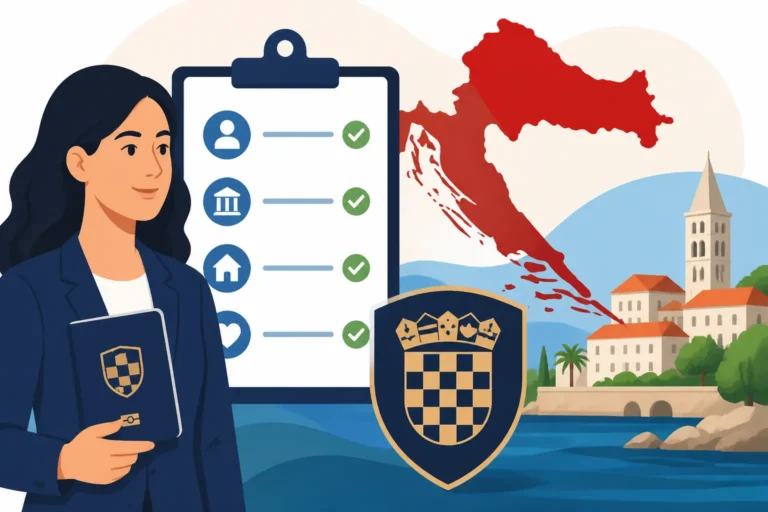
Here's a breakdown of what you'll typically need to present:
Document Type Specific Requirements # How Do I Register as an EU Citizen Living in Croatia?
Getting your affairs in order when moving to Croatia as an EU citizen might seem like a straightforward task, given the principle of free movement across the bloc. However, don't be fooled into thinking it's entirely devoid of bureaucracy! While it's certainly simpler than for non-EU citizens, Croatia's administrative processes have their own unique quirks and demands. This comprehensive guide will walk you through everything you need to know about officially registering your residence, ensuring you bypass common pitfalls and establish your new life smoothly and legally.
The Mandate to Register: Why It's Crucial for EU Citizens
You've got your EU passport, you've crossed the border, and you're ready to soak up the Croatian sun. Fantastic! But once that initial 90-day tourist period is up, if you intend to stay longer, the law requires you to formally register your presence. This isn't just about ticking a box; it's about cementing your rights and responsibilities as a resident and truly integrating into your new home. Skipping this step can lead to a whole host of complications down the line, from minor annoyances to significant legal headaches.
Legal Requirements and the MUP
For any EU citizen planning to reside in Croatia for more than three months, it is legally mandatory to register your temporary residence, or privremeni boravak, with the Ministry of Interior (Ministarstvo Unutarnjih Poslova, or MUP). This requirement is enshrined in both Croatian law and the directives of the European Union, which govern the free movement and residence of EU citizens and their family members. Think of it as putting down official roots. You might be able to get by for a little while without it, but eventually, you'll hit a wall when trying to access essential services. I've known people who thought they could fly under the radar, only to face fines or delays when they finally had to register for something critical. It's really not worth the stress.
The MUP office relevant to your place of residence is where you'll be submitting your application. In larger cities like Zagreb or Split, there are dedicated departments for foreigners, but in smaller towns, it might be part of the general MUP operations. It’s always a good idea to check the specific MUP website for your area or even visit in person (if you have local language support) to understand their operating hours and specific departmental locations.
Unlocking Your Rights: Healthcare, Employment, and More
Registering your residence is the gateway to fully enjoying the benefits of living in Croatia. Without this official registration, you'll find yourself severely limited. For example, while your European Health Insurance Card (EHIC) provides cover for medically necessary treatments during a temporary stay, it's not a substitute for proper national health insurance if you're residing here long-term. To access the Croatian public healthcare system through HZZO, your residency must be formally acknowledged. This means getting registered, finding a family doctor, and eventually getting your health insurance card. You can learn more about The Complete Guide to Healthcare in Croatia for Expats (2027) in our detailed guide, but remember, MUP registration is the very first domino to fall.
Beyond healthcare, your privremeni boravak is essential for:
- Employment: While EU citizens don't need a work permit, employers will require proof of your legal residence and an OIB for payroll and social security contributions.
- Banking: Opening a full-service bank account at institutions like Zagrebačka Banka or PBZ, and setting up utilities, all hinge on having an OIB and registered address. You can read more in The Expat Guide to Opening a Bank Account in Croatia.
- Education: Enrolling children in local public schools or kindergartens will require proof of parental residence.
- Driving: If you plan to stay long-term, you'll need to exchange your foreign driving licence for a Croatian one, a process that requires valid residence status. Our guide on How to Exchange Your Foreign Driving Licence in Croatia explains this thoroughly.
- Property: Whether you're renting long-term or even considering buying property, your registered address will be a fundamental piece of information for contracts and legal documents.
This foundational step also sets you on the path towards permanent residence (stalni boravak) if you choose to make Croatia your long-term home, which typically becomes an option after five continuous years of registered temporary residence.
The MUP Marathon: Your Step-by-Step Registration Journey
Navigating the MUP can feel like a marathon, not a sprint. The key is preparation, patience, and a willingness to ask questions (even if it means a little charades!). Don't expect things to move at lightning speed, but also don't assume the worst. Many MUP officers are helpful, especially if you come prepared.
Assembling Your Documents: The Foundation of Success
The most critical step in the entire process is gathering the correct documents. Any missing piece can send you home to start over, prolonging your wait. Always bring the originals and at least two sets of photocopies of everything. While not all MUPs always ask for photocopies, some certainly do, and having them saves you a trip to a nearby copy shop (if you can find one!).
Here’s what you’ll generally need for your initial registration as an EU citizen:
- Valid ID: Your passport or national ID card from your EU member state. This is your primary identification.
- Proof of Accommodation: This is often the trickiest part. You need to prove you have a place to live.
- If you own property: A copy of your vlasnički list (ownership certificate) from the land registry.
- If you're renting: Your rental contract (ugovor o najmu) which must be notarized and registered with the tax administration (Porezna Uprava). The landlord might need to be present at the MUP, or provide a signed statement (often called izjava o smještaju) confirming you live there, along with a copy of their ID and proof of their property ownership.
- If staying with friends/family: A notarized statement from the property owner confirming you are living with them, along with a copy of their ID and their proof of property ownership.
- Proof of Sufficient Means of Subsistence: This shows you won't be a burden on the state. The MUP currently looks for evidence that you have enough funds to support yourself and any family members.
- If employed: An employment contract (ugovor o radu) from a Croatian employer.
- If self-employed: Proof of your registered business (e.g., obrt) or a declaration of self-employment.
- If a student: Proof of enrollment at an educational institution in Croatia.
- If a pensioner: Proof of pension income.
- Others (e.g., financially independent): Bank statements showing regular income or sufficient savings. The specific amount can vary, but generally, having at least enough to cover the Croatian minimum wage over a few months is a good benchmark.
- Proof of Health Insurance: Again, this is vital.
- If employed: Your employer will register you for HZZO, and you'll present your employment contract.
- If self-employed or not employed: You might initially use your EHIC (for the first few months) or show proof of private health insurance coverage. Eventually, you will be required to register with HZZO based on your residency. Companies like Cigna Global offer comprehensive private health insurance options that can bridge the gap or provide supplementary coverage.
- Administrative Fee (Upravna Pristojba): There's a small fee, typically paid in Croatian biljezi (stamps) purchased at a post office or directly at the MUP if they have a cash desk. The amount is usually very modest, often around €5-10.
- Application Form: You'll fill out an application form (often Form 1a) at the MUP office or download it beforehand if available online.
Gathering these documents can sometimes be a mini-adventure in itself. For example, getting your rental contract notarized and registered might require your landlord's cooperation, which isn't always straightforward. Platforms like Sirelo can be helpful for understanding the broader relocation logistics, which might include advice on housing options that simplify this proof of accommodation step.
The MUP Appointment: Expect the Unexpected
Once you have your document bundle, it’s time for the MUP. In larger cities, you might need to make an appointment online through the e-Građani system (if you already have access, which is unlikely at this stage) or by phone, or simply take a number and wait. In smaller towns, it might be more informal. Always go early, even if you have an appointment.
Here's what to expect:
- Waiting: Prepare for a wait. Bring a book, your phone, or a friend.
- Language Barrier: While some MUP officers speak English, don't count on it. Having a Croatian-speaking friend, or at least Google Translate ready, is incredibly helpful. Write down key phrases or questions if you need to.
- Scrutiny: The officer will go through your documents with a fine-tooth comb. They might ask for additional papers, even if you think you have everything. Remain polite and cooperative.
- Flexibility: Be prepared for slight variations in the process or required documents depending on the specific MUP office or even the officer you get. This is just part of the charm!
The MUP officer will review your application and documents. If everything is in order, they will issue you a confirmation of registered temporary residence. This document is golden – keep it safe! It will usually be a small paper slip or a printed document, often valid for five years. After five years of continuous temporary residence, you generally become eligible to apply for Permanent Residence in Croatia: The Complete Pathway (2027).
Understanding Your Confirmation of Residence
This initial paper confirmation is your proof that you have legally registered your presence. It will state your name, OIB (if you already have one, otherwise you’ll get one soon!), and your registered address. This document, along with your passport/ID, will be your primary proof of residence for various administrative tasks until you get your biometric residence card, boravišna iskaznica.
Remember that while you've registered your privremeni boravak, you might also need to formally register your address (prebivalište) at the MUP. These two processes are often intertwined, and the MUP will guide you on which forms to fill out. The guide on Registering Your Residence (Prebivalište) at the MUP explains this in more detail. In essence, your privremeni boravak confirms your right to reside, while prebivalište specifically registers your physical address.
Life After Registration: Unlocking Your Croatian Experience
Congratulations! You’ve cleared the biggest hurdle. But the journey doesn’t end there. Your MUP registration is the first step that allows you to fully engage with life in Croatia. There are a few more critical pieces of the puzzle you’ll need to sort out, all of which become much easier with that MUP stamp in hand.
Your OIB and the World It Opens
If you didn't receive your OIB (Osobni Identifikacijski Broj) during your MUP visit, or if you acquired it separately beforehand, this unique personal identification number is absolutely fundamental. It's Croatia's equivalent of a national ID number or tax ID, and you'll need it for everything from getting a phone contract to paying taxes. Seriously, you can't do much without it. You can learn exactly How to Get an OIB (Personal Identification Number) in Croatia through our dedicated article, but in short, it’s usually issued by the tax administration (Porezna Uprava), and often, the MUP can even assist with the application during your residence registration.
Once you have your OIB, you’ll start seeing how interconnected everything is. Your employer will use it for your salary and contributions, the bank for your account, and the healthcare system for your registration. It's the numerical thread that weaves through all your official interactions in Croatia.
Healthcare and Social Security Enrollment
With your residence officially registered, you can now move forward with securing your healthcare coverage through HZZO. If you are employed by a Croatian company, your employer is responsible for registering you. If you are self-employed or otherwise not employed, you will need to register yourself at your local HZZO office. This involves presenting your MUP residence confirmation, your OIB, and proof of your status (e.g., proof of self-employment, student status, or sufficient funds). There might be a short waiting period before full coverage kicks in, or if you're not gainfully employed, you may need to make direct contributions. Our guide on Registering with HZZO in Croatia: The Complete Expat Guide (2027) offers a deep dive into this essential process.
Beyond basic health insurance, you might also consider supplementary health insurance (dopunsko zdravstveno osiguranje) to cover the participacija (co-payments) that are often required for public healthcare services. This is not mandatory, but it can save you money in the long run.
Banking, Driving, and Other Essentials
With your MUP registration and OIB, setting up your life becomes much smoother:
- Bank Account: Head to a bank like PBZ, Erste Bank, or Zagrebačka Banka. You'll typically need your passport/ID, OIB, and MUP residence confirmation to open an account. While some digital banks like Revolut or Wise are popular, having a local Croatian bank account is indispensable for things like utility payments, receiving salaries, and dealing with local businesses.
- Driving Licence: If you have an EU driving licence, you generally have a grace period (often up to one year from your registration of residence) to exchange it for a Croatian one. Don't let this deadline pass, as driving with an expired "foreign" licence after the deadline can lead to fines. The process for exchanging your licence is also handled at the MUP, requiring your residence confirmation and OIB, along with other documents.
- Utilities and Internet: You'll need your OIB and proof of address to set up electricity (HEP), water, gas, and internet services. Companies like Hrvatski Telekom, A1, and Telemach are the main providers.
- Local Council (Gradska Uprava/Općina): In some municipalities, there are additional local registrations or communal fees (komunalna naknada) you might need to sort out. It's always good to inquire at your local city or municipal office (Gradska Uprava or Općina) once you're settled.
Essentially, your registered residence acts as the keystone for building your life in Croatia. Take the time to tick off these boxes, and you’ll find yourself much more settled and stress-free.
Common Roadblocks and How to Smooth Them Over
Even with all the preparation, hiccups can happen. It's Croatia, after all! But knowing what to anticipate can help you navigate these bumps with a smile. The journey of The Complete Guide to Moving to Croatia: Your First 90 Days (2027) often includes these administrative challenges.
Language Barriers and MUP Patience
One of the most common frustrations is the language barrier. While younger generations and those in tourist areas often speak English, don't assume this will be the case at every MUP office. Many officers will try their best, but complex administrative terms can easily get lost in translation.
Tips for overcoming this:
- Bring a Croatian Speaker: If you have a friend, colleague, or even a professional translator who can accompany you, this will save you immense stress and prevent misunderstandings.
- Prepare Key Phrases: Write down exactly what you need to do in Croatian (e.g., "Želim prijaviti boravak kao građanin EU," which means "I want to register residence as an EU citizen").
- Google Translate is Your Friend: Have it ready on your phone, but use it for simple sentences.
- Patience is a Virtue: Seriously, cultivating extreme patience is probably the best advice any expat can give you for dealing with Croatian bureaucracy. Go in with a relaxed mindset, and be prepared for things to take longer than you expect. A smile and a polite demeanor go a long way.
Dealing with Missing or Incorrect Documents
The MUP process is quite particular about documents. One missing signature, an unregistered lease, or an old bank statement can halt your application.
Tips for avoiding document pitfalls:
- Double-Check Everything: Before your MUP visit, go through your entire checklist one last time. Does every document have a signature? Is the date correct? Are all necessary pages included?
- Photocopies: As mentioned, bring multiple sets of photocopies.
- Originals: Always carry the originals for verification.
- Seek Clarification: If the MUP asks for something you don't have or don't understand, politely ask for clarification. Sometimes, there might be an alternative document they can accept, or a simple explanation will suffice. Don't be afraid to ask where to get the missing document.
- Landlord Cooperation: For proof of accommodation, ensure your landlord is fully aware of the requirements for EU citizens. Their cooperation is crucial, especially regarding notarized lease agreements and, if necessary, their presence at the MUP or a signed statement with their ID. This is one area where many expats face delays if their landlord isn't used to the process.
The process of registering as an EU citizen living in Croatia, while requiring some diligence, is ultimately a manageable one. By understanding the requirements, preparing your documents meticulously, and approaching the MUP with a good dose of patience, you'll soon have your temporary residence sorted. This key step will open doors to a more integrated, secure, and truly Croatian expat experience.
Disclaimer
The information provided in this guide is intended for general informational purposes only and does not constitute legal, financial, or immigration advice. While we strive to keep the information accurate and up-to-date, laws and procedures in Croatia can change. Always consult with official government sources (such as the Ministry of Interior – MUP, or local administrative bodies), or seek professional legal advice tailored to your specific situation before making any decisions. We are not liable for any actions taken or not taken based on the information provided herein.