How Do I Switch from Private to Public Healthcare in Croatia?
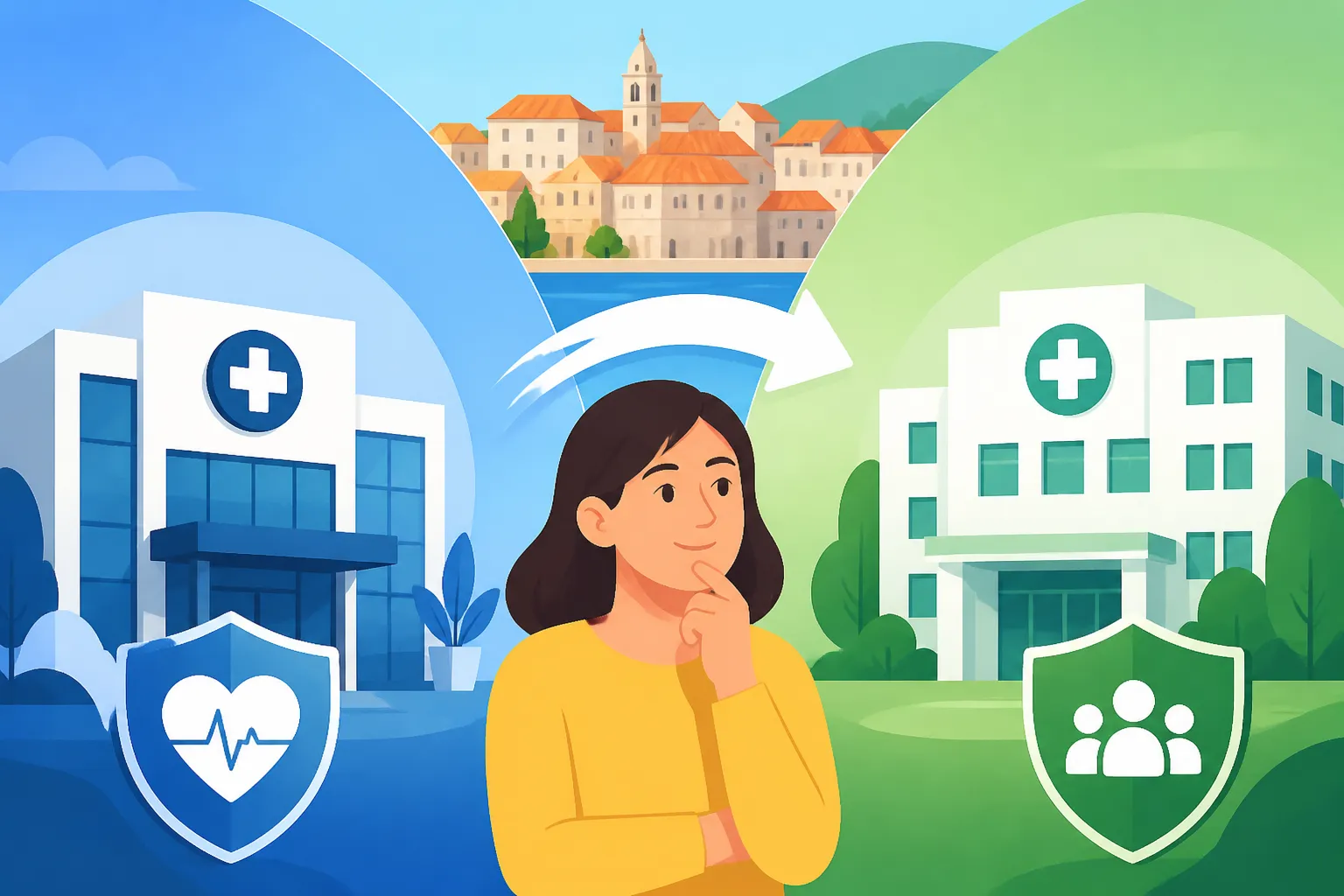
Many expats arrive in Croatia relying on international private insurance, only to find that securing a residence permit often requires transitioning into the mandatory state healthcare system. Navigating this shift from a streamlined private plan to the paperwork-intensive world of the Croatian Health Insurance Fund (HZZO) can be overwhelming. This guide explains the exact administrative steps, costs, and cultural nuances required to switch from private to public healthcare without losing coverage.
Understanding the Requirement to Move from Private to Public Care
In the early stages of your life in Croatia, especially if you are here on a digital nomad permit or as a tourist, you likely rely on a private international provider like SafetyWing to satisfy your initial visa requirements. These plans are fantastic for providing global flexibility and catastrophic coverage while you explore the Adriatic coast. However, the moment your status shifts—whether you become a resident through employment, marriage to a Croatian citizen, or by opening a business—the Croatian government views you as a permanent member of their social fabric. At this point, the state mandates that you contribute to the public health fund, known as the HZZO.
The transition isn't just about changing who you pay; it is a fundamental shift in how you access medical services. Private insurance often allows you to walk into a polyclinic and get seen within the hour. The public system, while robust and comprehensive, operates through a network of primary care doctors and health centers. Understanding The Complete Guide to Healthcare in Croatia for Expats (2027) is essential during this phase, as it helps you visualize where you fit in the national hierarchy. For many, the public system feels "slower" because of the administrative hurdles, but it provides the foundational coverage required for long-term residency and more complex medical procedures that private clinics may not handle.
Many newcomers feel frustrated when they realize they cannot simply keep their private international plan and ignore the HZZO. In Croatia, health insurance is not just a personal choice; it is a legal obligation linked to your residence permit. While you might continue to keep a plan from SafetyWing for your travels outside of Croatia or for the convenience of private clinics, you must still register for the public system to remain compliant with MUP (the Ministry of the Interior). This dual-layered approach is common among veteran expats who want the security of the state system and the speed of the private sector.
The Conflict Between Private Speed and Public Compliance
When you are using a plan like SafetyWing, you are essentially paying for "freedom." You choose your doctor, you pay, and you get reimbursed. The Croatian public system, governed by the HZZO, is a "pre-paid" socialized system. Your contributions are deducted from your salary or paid monthly as a self-employed person. How the Croatian Health Insurance Fund (HZZO) Works: A Full Overview provides a deep dive into how these funds are distributed. The conflict arises during the transition period when you might be "between" statuses—no longer a nomad but not yet fully processed in the HZZO database.
During this transition, it is vital to keep your private coverage active. You do not want to cancel your international policy until you have the physical "health card" (the blue or white HZZO card) in your hand. The bureaucracy at the HZZO offices can sometimes take weeks to process a new application, and if you have an accident during that window, you will be thankful for your private fallback. This overlap is the most common advice shared among the expat community in Zagreb and Split.
Why You Can’t Always Stay 100% Private
For those coming from countries with entirely private systems, the concept of mandatory public insurance can feel restrictive. However, in Croatia, the public system is the gatekeeper to most specialist care, hospitalizations, and prescription medications. If you require emergency surgery, you will likely be taken to a KBC (Clinical Hospital Centre), which is a public institution. Having HZZO coverage ensures that these high-cost events are covered. Public vs Private Healthcare in Croatia: Which Should Expats Choose? explains that while private polyclinics are great for a quick ultrasound or a dermatologist check-up, the heavy lifting of healthcare is done by the state.
The Step-by-Step Process of Switching to HZZO
The administrative path to the public system starts at your local MUP office. You cannot walk into an HZZO office and ask for insurance without first proving your right to be in the country. Once MUP has approved your temporary residence, they will issue you a certificate or a biometric card. This document is your "golden ticket." Armed with this, you must then visit the HZZO office relevant to your registered address. For those in the capital, the main office on Jukićeva is often the starting point, though smaller branches exist in every neighborhood.
Before you go, ensure you have your OIB (Personal Identification Number). This number is the backbone of all administrative life in Croatia. Without it, you do not exist in the state’s digital eyes. If you haven't secured one yet, you should read How to Get Your OIB and Why It Matters for Healthcare Access to understand why this is your first priority. At the HZZO office, you will fill out the "Prijava" form. The clerk (the "teta" behind the counter) will look for proof of your previous insurance. This is a crucial point for non-EU citizens: Croatia often requires proof that you were insured elsewhere to avoid charging you for the previous 12 months of back-payments.
| Step | Action Item | Documentation Needed |
|---|---|---|
| 1 | Secure Residence | MUP Approval / Biometric Card |
| 2 | Obtain OIB | Tax Administration (Porezna Uprava) Certificate |
| 3 | HZZO Visit | Form T1/T2, Passport, MUP Certificate |
| 4 | Proof of Prior Coverage | Letter from Private Insurer (SafetyWing or similar) |
| 5 | Payment Setup | Bank details for monthly contributions (if self-employed) |
Dealing with the 12-Month Back-Payment Rule
This is the part where most expats feel the sting. If you are a non-EU citizen moving to Croatia and you haven't been part of another EU state's healthcare system, the HZZO may ask you to pay "retroactive" contributions for the past year. This is a lump sum intended to "buy you into" the system. It can amount to over 1,000 EUR depending on the current year’s rates. However, if you can show that you were covered by a private plan like SafetyWing during that period, you might be able to negotiate a waiver or a reduction, though this is highly dependent on the clerk's interpretation of the law.
To minimize this cost, always bring a translated certificate of your private insurance. The more "official" it looks, the better. Registering with HZZO in Croatia: The Complete Expat Guide (2027) goes into detail about the specific forms and the "teta" culture you will encounter. Being polite, having all your papers organized in a folder, and perhaps bringing a Croatian-speaking friend can make this transition significantly smoother.
Transitioning from Employee to State-Insured
If you are switching because you found a job with a Croatian company, the process is much easier. Your employer is legally responsible for registering you with the HZZO. You will simply need to provide them with your OIB and a copy of your residence permit. In this scenario, the transition is seamless. One day you are on your private plan, and the next, your contributions are being deducted from your gross salary. However, even in this case, you should check your status via the e-Građani portal to ensure the registration was actually completed.
Bridging the Coverage Gap: Supplementary and Private Options
Once you are officially in the HZZO system, you might think you are "finished." Unfortunately, the basic HZZO coverage does not cover everything. You will still be expected to pay "participacija" (co-payments) for doctor visits, hospital stays, and prescriptions. To avoid these out-of-pocket costs, almost every expat and local signs up for Dopunsko Zdravstveno Osiguranje (Supplementary Insurance). This is a secondary policy that covers the 20% of costs that the state does not pay for.
Many expats choose to keep a base level of international coverage with SafetyWing even after joining HZZO. Why? Because the public system has waiting lists. If you need a non-emergency MRI, the wait in the public system might be six months. With a private backup, you can go to a polyclinic and get it done tomorrow. Understanding Dopunsko Zdravstveno Osiguranje (Supplementary Insurance) in Croatia is a must-read to understand how this small monthly fee (usually around 10 EUR) can save you from massive hospital bills if you are ever admitted for a long stay.
Why You Should Never Cancel Private Coverage Too Early
The administrative wheels in Croatia turn at their own pace. There is often a gap between when you apply for HZZO and when you are actually "active" in the system. If you cancel your private plan the day you submit your paperwork, you are taking a massive risk. I have seen expats stuck in a limbo where MUP says they are covered by HZZO, but HZZO says their card hasn't been printed yet, and the local GP refuses to see them. Keeping a flexible monthly plan like SafetyWing during this 30-to-60-day transition period is the smartest move you can make.
Finding Your "Primary" Care Team
Switching to the public system means you need to choose a Liječnik opće prakse (General Practitioner). In the private world, you just call a clinic. In the public world, you must physically go to a Dom Zdravlja (Health Centre) and ask a doctor if they have room on their list. This can be a bit like a scavenger hunt. You are looking for a doctor who is "receiving patients" (prima pacijente). How to Register for HZZO Health Insurance as a Foreigner in Croatia covers the logistics of this search.
Once you find a doctor and they sign your registration form, you are truly integrated. You will also need to find a public dentist and, for women, a public gynaecologist. These providers form your primary care circle. Everything else—specialist referrals, blood tests, and hospital care—flows through your GP. Understanding The Expat Guide to Finding a Family Doctor (Obiteljski Liječnik) in Croatia will help you find English-speaking options, which are more common in the larger cities like Zagreb and Rijeka.
Life After the Switch: Navigating the New Normal
Now that you are in the public system, you will notice some major changes in how you receive care. The most significant is the e-Recept and e-Uputnica system. Croatia has a surprisingly advanced digital backbone for healthcare. When your GP prescribes a medication, it is sent digitally to your OIB. You can walk into any pharmacy in the country, show your health card, and they will see your prescription. Understanding the e-Recept (E-Prescription) System in Croatia explains how this works in practice.
However, you will also encounter the Dom Zdravlja. These are community hubs where your GP, dentist, and sometimes specialist labs are located. They can feel a bit "retro" compared to the sleek private polyclinics you might be used to. Understanding the Role of the Dom Zdravlja (Health Centre) in Croatia will help you manage your expectations. The care is professional, but the aesthetics are often a throwback to a different era. This is part of the realistic expat experience in Croatia—the healthcare is excellent, but the "packaging" is modest.
Maintaining a Hybrid Approach
The most successful expats in Croatia don't rely 100% on the public system. They use the HZZO for their "mandatory" status, their cheap prescriptions, and their "just-in-case" hospital coverage. But for their annual check-ups, specialized scans, or when they just want to speak to a doctor for 30 minutes without a crowded waiting room, they go private.
Whether you use an international plan like SafetyWing for its global reach or pay out-of-pocket at a local poliklinika, having a hybrid strategy is the best way to maintain your mental and physical health. The public system ensures you aren't bankrupt by a major illness, while the private sector ensures you aren't waiting six months to find out why your knee hurts.
Final Administrative Checklist
Before you consider your switch "complete," make sure you have ticked these boxes:
- Received your blue/white HZZO card.
- Signed up for Dopunsko (Supplementary) insurance.
- Registered with a GP at a Dom Zdravlja.
- Confirmed your status is "active" on the e-Građani portal.
- Translated and filed your old private insurance records for your new doctor.
The transition from private to public healthcare in Croatia is a rite of passage. It marks the moment you stop being a visitor and start being a resident. It requires patience, a fair amount of walking between government offices, and an acceptance that things move at a different speed here. But once you are in, you are part of a system that, despite its quirks, ensures that every resident has a right to care.
Disclaimer
The information provided in this guide is for informational purposes only and does not constitute legal or medical advice. Healthcare regulations and immigration laws in Croatia are subject to change. Always consult with the official HZZO (Hrvatski zavod za zdravstveno osiguranje) or MUP (Ministarstvo unutarnjih poslova) websites, or seek professional legal counsel to ensure you are compliant with the most current requirements.