What Is the Difference Between a Dom Zdravlja and a KBC in Croatia?
You wake up in Zagreb with a nagging pain in your side, or perhaps you have just moved to Split and your child has developed a sudden, high fever. You open Google Maps and see two clinical-sounding options: a local Dom Zdravlja just down the street and a massive KBC complex on the outskirts of town. Which one do you choose? Navigating the Croatian healthcare system can feel like deciphering an ancient code, but understanding the fundamental difference between a Dom Zdravlja and a KBC is the first step toward getting the right care without losing your sanity in a waiting room.
The Foundation of Croatian Care: What is a Dom Zdravlja?
The term Dom Zdravlja literally translates to House of Health. Think of this as the primary gateway to the entire medical system in Croatia. It is not a single hospital, but rather a community health center that houses various independent practices under one roof. For most expats, this will be the most frequent point of contact with Croatian medicine.
The Hub of Primary Healthcare
At the heart of the Dom Zdravlja is your primary care physician, or what locals call the Liječnik opće prakse. This doctor is the gatekeeper of your health. When you first arrive and settle into your neighborhood, one of your primary administrative tasks should be The Expat Guide to Finding a Family Doctor (Obiteljski Liječnik) in Croatia. Unlike in some countries where you can simply walk into any clinic, in Croatia, you must be formally registered with a specific doctor at a specific Dom Zdravlja to receive non-emergency care.
The atmosphere in a Dom Zdravlja is often very local. You will see elderly neighbors chatting in the hallways and parents with toddlers waiting for vaccinations. It is an essential part of the social fabric of a Croatian neighborhood. While the buildings can sometimes look a bit dated—remnants of socialist-era architecture with heavy wooden doors and linoleum floors—the care is generally professional and highly standardized. Because these centers are decentralized, you will find several of them scattered across a city like Zagreb, often organized by district (e.g., Dom Zdravlja Centar, Dom Zdravlja Zapad).
Services Beyond the Family Doctor
A Dom Zdravlja is much more than just a GP’s office. It is designed to be a one-stop shop for basic medical needs. Within the same building, you will typically find a community dentist, a gynecologist, and a pediatrician. This is also where you will go for routine diagnostic work. If your doctor needs to check your cholesterol or blood sugar, they will send you to the laboratory located right there in the building.
Furthermore, many health centers provide Understanding the Role of the Dom Zdravlja (Health Centre) in Croatia services such as basic physical therapy, community nursing (patronažna služba) for new mothers, and even basic radiological services like X-rays or ultrasounds. The goal of the Dom Zdravlja is to treat roughly 80% of all medical issues at the local level, preventing the large hospitals from being overwhelmed with routine cases like the common flu or prescription renewals. For digital nomads or those just arriving who haven't finished their paperwork, having a plan like SafetyWing can provide a safety net while you navigate the registration process for these local services.
The Pinnacle of Specialization: What is a KBC?
When a medical issue becomes too complex for a community health center, the system scales up to the KBC. KBC stands for Klinički Bolnički Centar, which translates to Clinical Hospital Centre. These are the heavy hitters of the Croatian medical world. They are tertiary care facilities, meaning they provide the highest level of specialized medical care, often combined with university research and medical education.
Tertiary and Specialist Care Centers
A KBC is not just a hospital; it is a massive institution. In Croatia, KBCs are located in the four major regional hubs: Zagreb, Split, Rijeka, and Osijek. If you are living in a smaller town like Zadar or Varaždin, you might visit an "Opća Bolnica" (General Hospital), but for the most advanced surgeries, rare disease treatments, or high-tech diagnostics like MRIs and PET scans, you will likely be referred to a KBC.
The Understanding Hospital Care at a KBC (Clinical Hospital Centre) in Croatia experience is very different from the Dom Zdravlja. These facilities are often sprawling campuses with multiple buildings divided by medical departments (e.g., Cardiology, Neurology, Oncology). Because they are teaching hospitals, don't be surprised if your specialist is accompanied by a group of medical students. These institutions are where the country's top experts reside, and they handle everything from organ transplants to complex neurosurgery.
The Referral Culture and Specialist Access
You cannot simply walk into a KBC for a consultation because you have a headache. The system is strictly tiered. To see a specialist at a KBC, you must first visit your GP at the Dom Zdravlja, who will then issue an electronic referral. Understanding How e-Uputnica (E-Referrals) Work for Specialist Appointments in Croatia is crucial. Once the referral is in the system, you—or often the nurse at your GP's office—will book an appointment at the KBC.
The only exception to this referral rule is the Emergency Room (Hitna Pomoć). Every KBC has an emergency intake, but be warned: if you show up at a KBC emergency room with a minor issue that could have been handled at a Dom Zdravlja, you may face incredibly long wait times or even be redirected. The KBC is designed for life-threatening situations and advanced medical crises. For those who are still waiting for their official residency cards, using a provider like SafetyWing can be helpful if you end up in an emergency situation and need to cover costs before the HZZO system fully recognizes your status.
Key Differences: A Side-by-Side Comparison
To help you decide where to go, it is helpful to look at these institutions side-by-side. The differences are not just about the size of the building, but the entire philosophy of care they provide.
| Feature | Dom Zdravlja (Health Centre) | KBC (Clinical Hospital Centre) |
|---|---|---|
| Primary Goal | General wellness, prevention, and basic illness | Specialized treatment and complex surgery |
| Staffing | GPs, Nurses, Dentists, Lab Techs | Specialists, Surgeons, Medical Professors |
| Access | Walk-in for registered patients or call GP | Referral (Uputnica) strictly required |
| Location | Neighborhood-based, many per city | Regional-based, only in major cities |
| Diagnostics | Basic blood work, simple X-rays | MRIs, CT scans, Biopsies, Genetic testing |
| Emergency Use | Only for minor injuries during day hours | 24/7 Trauma and life-threatening emergencies |
The Administrative Bridge: Referrals and Insurance
Whether you are visiting a Dom Zdravlja or a KBC, the underlying machinery is the same: the Croatian Health Insurance Fund, or HZZO. This is the mandatory state insurance that most residents pay into. Understanding How the Croatian Health Insurance Fund (HZZO) Works: A Full Overview is the key to avoiding massive out-of-pocket bills.
The Role of the "Uputnica"
The referral, or uputnica, is the legal document that moves you from the primary level (Dom Zdravlja) to the secondary or tertiary level (KBC). In the past, these were physical slips of paper, but today they are almost entirely electronic. When your GP "gives" you a referral, it is uploaded to a central system. When you arrive at the KBC, you simply present your health insurance card (the little red card or the temporary paper version), and the receptionist pulls up the referral.
Without this link, the KBC will treat you as a private patient, and the costs can escalate quickly. Even with insurance, you should be aware of Understanding Participacija (Co-Payments) in the Croatian Health System. Most specialist visits and hospital stays require a small co-payment unless you have a supplementary insurance policy called Dopunsko.
Navigating the System as a Newcomer
For many expats, the period between arriving in Croatia and receiving their HZZO card is a "grey zone." During this time, you are technically required to have health insurance to even apply for your residence permit. This is where international options like SafetyWing are particularly popular. They provide the necessary documentation for the police (MUP) and cover you for accidents or sudden illnesses while you are waiting for the bureaucratic wheels of the local system to turn. Once you are fully integrated into HZZO, you will primarily use the Dom Zdravlja for your day-to-day needs, keeping the KBC as a resource for more serious medical events.
Practical Scenarios for Expats
Theory is one thing, but real life in Croatia is often more chaotic. Let's look at a few hypothetical scenarios to see how this works in practice.
Scenario 1: The Winter Flu
You have a high fever, a cough, and total exhaustion.
Where to go: Your GP at the Dom Zdravlja.
Why: This is primary care. Your doctor can listen to your lungs, prescribe antibiotics if necessary through the e-prescription system, and issue a sick note for your employer. Going to a KBC for the flu is a breach of protocol and will result in a very long wait and a frustrated medical staff.
Scenario 2: Chronic Knee Pain
You have an old sports injury that is flaring up, and you think you might need surgery.
Where to go: First, the Dom Zdravlja, then a KBC.
Why: You visit your GP at the Dom Zdravlja to get a referral for an Orthopedist. With that referral, you then book an appointment at the KBC’s orthopedic department for a specialist consultation and potentially an MRI.
Scenario 3: A Sudden Allergic Reaction
Your throat is tightening after eating something at a restaurant.
Where to go: The nearest KBC Emergency Room (Hitna).
Why: This is a life-threatening emergency. In this case, you skip the referral and the Dom Zdravlja entirely. You go straight to the KBC trauma/emergency center. If you are in a remote area without a KBC, you would go to the nearest Emergency Medical Care in Croatia: What Every Expat Needs to Know station.
Navigating Language Barriers and Wait Times
One of the biggest fears for foreigners is the language barrier. In our experience, there is a distinct difference between the two types of facilities when it comes to English proficiency.
Language at the Dom Zdravlja
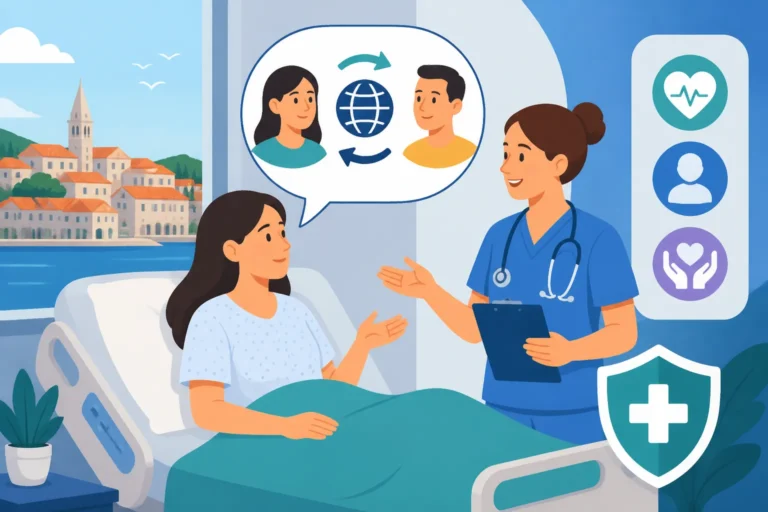
At the local Dom Zdravlja, the staff—especially the administrative nurses at the front desk—may not always speak fluent English. Their focus is on the local community, which is predominantly Croatian-speaking. However, many younger doctors speak excellent English. It is often a "luck of the draw" situation. If you are nervous, check out our guide on How to Find an English-Speaking Doctor in Croatia to find a GP who can communicate clearly with you.
Language at the KBC
At a KBC, the chances of finding English speakers are significantly higher. Because these are academic institutions, doctors are required to keep up with international medical literature and often participate in global conferences. Most specialists will speak English quite well. However, the intake process (the "šalter") can still be a challenge. We always recommend having the "Google Translate" app ready or bringing a Croatian-speaking friend for the initial paperwork.
Dealing with the "Lista Čekanja"
The most significant pain point in the Croatian public system is the lista čekanja or waiting list. While a Dom Zdravlja appointment with your GP is usually quick (often same-day or next-day), a specialist appointment at a KBC can take months. If you are referred for a non-urgent ultrasound or a specialist consultation, you might be told the first available slot is in six months.
This is why many expats choose a hybrid approach. They keep their HZZO insurance and their local GP at the Dom Zdravlja for routine matters but use private polyclinics for specialist consultations to bypass the KBC waiting lists. International insurance like SafetyWing can sometimes be utilized for these types of private interventions depending on the policy, providing a way to get faster answers when the public system is bogged down. This is all part of Navigating the Croatian Healthcare System: An Expat's Roadmap (2027), which every new resident should study.
Final Advice for a Smooth Medical Experience
To make your life easier, always keep your OIB (Personal Identification Number) and your health insurance card (zdravstvena iskaznica) with you. The Croatian system is very bureaucratic, and having the right numbers can be the difference between a 10-minute visit and a two-hour headache.
If you are just starting your journey here, remember that the system is designed to be comprehensive. It may be slower than what you are used to, and the buildings might not have the "shiny" feel of a private US or UK clinic, but the medical expertise in the KBCs is top-tier. Start by building a good relationship with your nurse and doctor at the Dom Zdravlja; they are your best allies in navigating the path to the KBC if you ever truly need it. For a bird's eye view of how it all fits together, don't miss The Complete Guide to Healthcare in Croatia for Expats (2027).
Disclaimer
The information provided in this guide is for educational and informational purposes only and does not constitute professional medical or legal advice. Healthcare regulations and procedures in Croatia are subject to change. Always consult with a qualified medical professional or the official HZZO office regarding your specific health situation or insurance status. Additionally, while international insurance options like SafetyWing are mentioned as potential solutions for expats, users should independently verify coverage details and policy terms to ensure they meet their specific needs and Croatian residency requirements.